Table of Contents
- The Problem: Slow Service and Inefficient Equipment
- Why Serving Hot Drinks On Demand Matters for Staff Retention
- Bean to Cup Coffee Machine Benefits for High Volume Environments
- Comparison: Manual Service vs Automated On Demand Solutions
- Improving Employee Breakroom Experience Through Better Equipment
- Commercial Coffee Machine Installation and Ongoing Support
- Temperature Control, Safety Protocols and Health Considerations
- Making the Switch: Implementation and Staff Adoption
- Frequently Asked Questions
Last Updated: September 19, 2026
The Problem: Slow Service and Inefficient Equipment
Most offices face the same frustration: employees queue for coffee during breaks, machines jam at peak times, and outdated equipment delivers lukewarm drinks or fails entirely when demand peaks. The cost extends beyond wasted time to staff morale, productivity, and resentment.
When your break area can’t keep pace with demand, staff drift to external cafés, extend breaks beyond scheduled time, and build habits of leaving the office, which fragments team cohesion and reduces focus time.
Why Serving Hot Drinks On Demand Matters for Staff Retention
Serving hot drinks on demand is a retention tool. Workplace amenities directly influence employee tenure and engagement.
A workplace that serves exceptional fresh hot drinks on demand signals investment in employee experience. Replacing a skilled employee costs three to five months of salary, far more than a quality coffee machine.
On demand service removes friction: no queues, no waiting, no cold drinks. Employees spend less time away from desks and more time productive.
Modern break areas with quality beverages available instantly reinforce your brand as forward thinking and employee focused.
Bean to Cup Coffee Machine Benefits for High Volume Environments
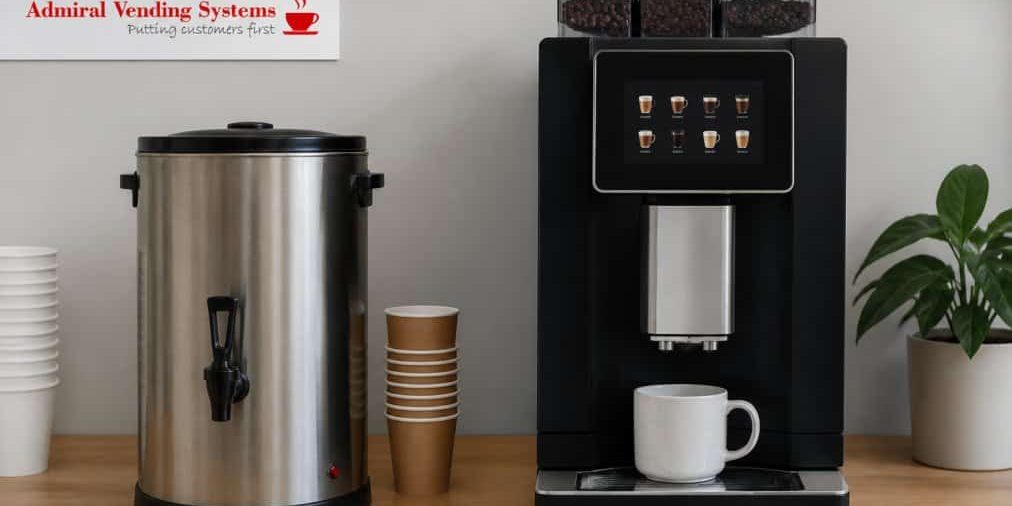
Bean to cup machines grind fresh beans and brew each drink automatically, delivering café quality beverages without a trained barista. For high volume environments, the advantage lies in understanding why traditional equipment fails under demand and how bean to cup design prevents it.

Traditional espresso machines require operator skill at every step.
Commercial Bean to Cup Coffee Machines eliminate the operator variable. Every espresso tastes the same, building staff trust and reducing drift to external cafés.
A quality bean to cup machine serves 40-60 drinks per hour, preventing bottlenecks during peak periods.
Uptime determines whether equipment feels efficient. Bean to cup machines fail when maintenance is neglected, but these failures are preventable.
Milk line blockage is a common cause of downtime. Modern machines with automatic milk purge cycles can help prevent this problem.
Grinder burr wear degrades performance gradually. Machines with automatic replacement alerts can help maintain quality.
Hard water causes mineral scale buildup, reducing flow and triggering shutdowns. Machines with automatic descaling cycles can help maintain performance.
Temperature stability under load matters. Machines with large thermal mass or dual boiler systems can maintain stable temperature.
Maintenance design determines efficiency. Machines with automatic self cleaning cycles and descaling alerts require minimal intervention.
Floor standing bean to cup models deliver capacity for hundreds of daily drinks. Real world performance depends on maintenance features that prevent common failure modes.
Bean to cup machines deliver consistent quality at scale because automation removes human variables. But they maintain that consistency only if designed with automatic maintenance features, milk purge, descaling alerts, burr replacement indicators, that prevent the gradual degradation that makes equipment feel “inefficient.”
Comparison: Manual Service vs Automated On Demand Solutions
| Aspect | Manual Service | Bean to Cup Machine | Automated Kiosk |
|---|---|---|---|
| Speed per drink | 3-5 minutes | 45-90 seconds | 30-60 seconds |
| Staff required | 1-2 baristas | None (self service) | None (self service) |
| Consistency | Variable | High | Very High |
| Capacity (drinks/hour) | 15-25 | 40-60 | 50-80 |
| Maintenance | Daily cleaning, regular repairs | Weekly cleaning cycles | Self cleaning, minimal downtime |
| Best for | Small offices, premium experience | Medium to large offices | Large corporate, high footfall |
Lost productivity from queuing staff can exceed equipment investment.
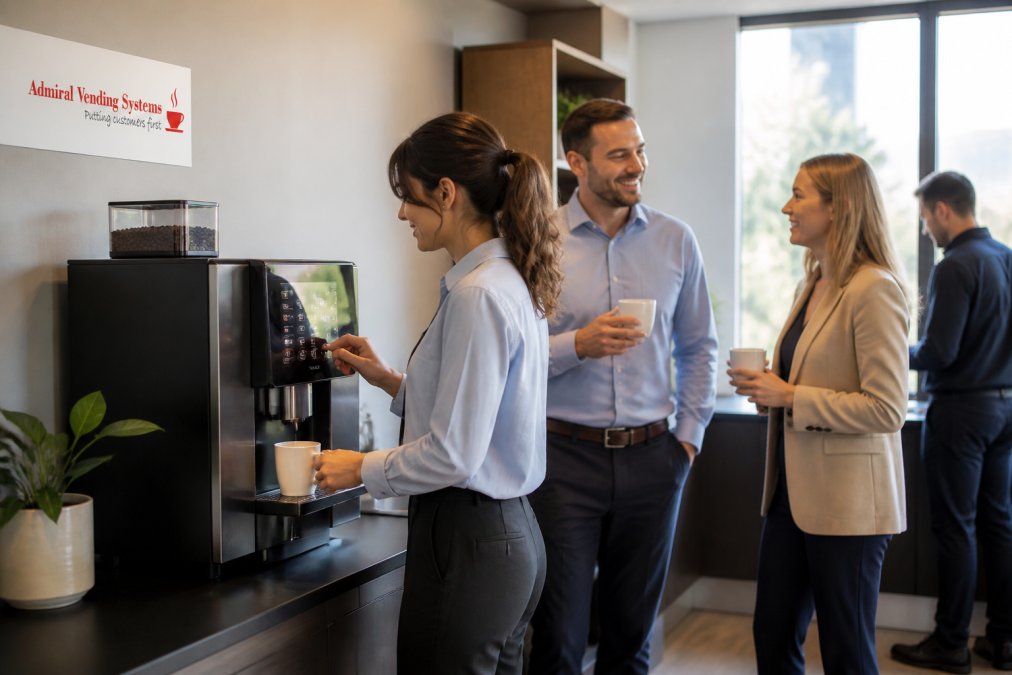
Automated on demand solutions can help eliminate queuing and maintain consistency at scale. For offices over 50 people, the productivity gains can justify the equipment cost.
Improving Employee Breakroom Experience Through Better Equipment
The breakroom is where workplace culture happens, where informal conversations spark collaboration and employees decide whether they feel valued.
Slow, unreliable equipment signals that management sees break time as downtime rather than investment in employee wellbeing.
Improving the experience requires machines that brew quickly, deliver hot drinks consistently, and rarely break down, allowing employees to grab beverages in under two minutes.
Equipment that maintains precise temperature throughout the service day prevents lukewarm beverages by mid afternoon.
A machine offering espresso, americano, cappuccino, latte, hot chocolate and tea gives employees genuine choice, reducing those who skip the break area.
Modern machines take less counter space, allowing better layout and a breakroom that feels like a destination.
Commercial Coffee Machine Installation and Ongoing Support
Installation and ongoing support determine whether you get consistent performance or recurring frustration.
Professional installation ensures the machine is positioned correctly for water supply, drainage, and electrical requirements. Poor installation creates operational issues that persist for years. The machine might work, but not optimally.
Staff training is equally critical. Even the most intuitive machine requires users to understand basic operation. Proper training reduces damage from misuse, improves drink quality, and ensures staff feel confident using the equipment.
Ongoing support separates reliable suppliers from transactional ones. When a machine breaks down, you need rapid response. Extended downtime means staff revert to external cafés, defeating the purpose of the investment.
Preventative maintenance reduces breakdowns. Regular servicing catches small issues before they become major failures. This includes cleaning internal components, checking seals, and testing temperature sensors.
Supply chain reliability matters too. A machine is only useful if you can source compatible beans, milk, cups, and consumables consistently. Suppliers who manage this end to end reduce the operational burden on your team.
Poor installation or inadequate support can leave you with expensive equipment that underperforms or breaks frequently. Choose suppliers who include professional installation and maintenance as standard, not optional extras.
Temperature Control, Safety Protocols and Health Considerations
Hot beverage safety has become increasingly important in workplace settings, but the relationship between temperature control and service efficiency is often overlooked. The tension is real: machines that serve drinks too quickly may deliver unsafe temperatures, while machines that cool drinks to safe levels before serving can create delays.
Modern commercial machines can resolve this through precision temperature management. Rather than brewing at a single fixed temperature, they can separate brew temperature from serving temperature. Water is heated to 90-95°C for optimal extraction, then the dispensed drink cools to a safe serving range of 65-70°C within seconds. This allows staff and customers to consume beverages immediately without burn risk, whilst maintaining the heat level needed for fresh taste and proper milk frothing.
This distinction matters operationally. Older machines may brew at serving temperature, which can mean either unsafe heat or extended cooling time. Modern machines with dual stage temperature control can help eliminate this trade off. You can get speed and safety simultaneously.
Temperature sensor failure is a common cause of machine downtime in high volume environments. When sensors malfunction, machines can either overheat (creating safety hazards and triggering automatic shutdowns) or underheat (producing lukewarm drinks and customer complaints). Machines with redundant temperature sensors and automatic calibration can reduce this failure mode. This is why equipment selection directly impacts whether your break area stays reliable or becomes a source of frustration.
Hygiene standards extend beyond temperature. Machines with self cleaning cycles that run automatically after each use can reduce bacterial growth in milk lines and brewing components. This is particularly important in high volume settings where multiple users access the machine throughout the day. Look for machines with sealed milk systems and automatic purge cycles rather than open steam wands, which require manual cleaning and can create inconsistency.
Regular descaling prevents mineral buildup that affects water quality, temperature stability, and machine performance. Hard water areas may require more frequent descaling. Machines with automatic descaling alerts and integrated descaling cycles can reduce the operational burden on your team and help prevent gradual performance degradation.
Staff training on temperature safety is essential. Employees should understand that modern machines are designed to serve safely. Clear signage stating “Safe to drink immediately” can reduce hesitation. Simple training can also prevent common errors like blocking temperature sensors or forcing machines to dispense before they’ve reached safe serving temperature.
Regulatory compliance matters in commercial settings. The Health and Safety at Work etc. Act 1974 places responsibility on employers to provide safe working conditions, which includes safe access to hot beverages.
Precision temperature control that separates brew temperature from serving temperature is a mechanism that allows modern machines to deliver on demand speed without safety compromise. This is why equipment choice directly determines whether your break area feels fast and reliable or slow and frustrating.
Making the Switch: Implementation and Staff Adoption
Transitioning from manual service or outdated equipment to modern on demand solutions requires planning. Done poorly, it creates resistance. Done well, it generates enthusiasm.
Frequently Asked Questions
How does serving hot drinks on demand improve staff retention?
Employees value convenient access to quality refreshments. When staff can obtain fresh hot drinks without queuing or leaving the office, it reduces frustration, improves morale, and signals that the employer invests in their comfort. This amenity becomes a retention factor, particularly in competitive talent markets where workplace culture differentiates employers. Quality beverages available on demand also reduce the time staff spend away from their desks seeking coffee elsewhere.
What are the key benefits of bean to cup coffee machines for businesses?
Bean to cup machines deliver café quality drinks instantly, eliminating service bottlenecks that slow operations. They grind fresh beans on demand, ensuring consistent taste and reducing waste. For businesses, the benefits include improved operational efficiency, lower staff costs compared to manual barista service, and enhanced guest or employee experience. These machines work across office environments, showrooms, hospitality venues and factory floors, scaling from 40 to 150+ staff.
How long does commercial coffee machine installation typically take?
Professional installation timelines depend on machine type, location complexity, and plumbing requirements. Tabletop machines can be installed and staff trained within days, whilst floor standing units in high volume environments may require additional setup. Reputable providers offer nationwide support with delivery, expert installation, operator training and ongoing maintenance included.
What temperature should hot drinks be served at for safety?
Modern hospitality standards recommend serving hot beverages at temperatures that balance quality with safety. Drinks should be hot enough to preserve flavour and prevent rapid cooling, yet cool enough to prevent burn injuries. Quality commercial machines include temperature controls that meet food safety standards and occupational health guidance. Proper equipment reduces risk of scalding incidents whilst maintaining the premium beverage experience that staff and guests expect.