Table of Contents
- What a Coffee Barista Machine Delivers in a Workplace
- Bean to Cup vs Traditional Espresso Machine: Which Suits Your Site
- Commercial Bean to Cup Coffee Machines: Features That Decide the Buy
- Workplace Coffee Machine Capacity: Matching Demand to Output
- Office Coffee Machine Maintenance: What Keeps Machines Reliable
- Water Quality, Repairability and Workflow: What Most Buyers Miss
- Choosing and Rolling Out Your Coffee Barista Machine
- Frequently Asked Questions
Last Updated: September 16, 2026
What a Coffee Barista Machine Delivers in a Workplace
A coffee barista machine is a commercial bean to cup system that grinds fresh beans, tamps, extracts and textures milk automatically, giving staff café style drinks at the press of a button. At Admiral Vending, we supply these machines to workplaces that want fresh coffee without training everyone as a barista. The appeal is simple: fresh ground coffee on demand, consistent results, and no queue building while someone wrestles with a manual group head.
Bean to Cup vs Traditional Espresso Machine: Which Suits Your Site
The choice comes down to who operates the machine and how much consistency you need. A traditional espresso machine hands control to the user; a bean to cup machine takes that control back and standardises the result. For most workplaces, that trade is worth making.
Where Traditional Machines Still Win
Traditional machines suit sites with trained staff who enjoy the craft. A skilled operator can dial in grind size, pressure control and extraction time to pull a genuinely exceptional shot. The trade off is that quality depends on the person at the group head, and a busy site rarely has that person on shift all day.
Where Bean to Cup Takes Over
Bean to cup machines win wherever volume and consistency matter more than manual craft. They grind on demand, manage pre-infusion and PID temperature control automatically, and deliver the same cappuccino at 9am and 3pm. For offices, showrooms and hospitality sites, that reliability is the whole point.
| Factor | Traditional Espresso Machine | Bean to Cup Machine |
|---|---|---|
| Operator skill needed | High | Minimal |
| Shot consistency | Varies by user | Consistent |
| Milk texturing | Manual steam wand | Automatic |
| Best for | Trained baristas | Offices, showrooms, high footfall |
Commercial Bean to Cup Coffee Machines: Features That Decide the Buy
Commercial bean to cup coffee machines live or die on three things: grind consistency, pressure control and temperature stability. Get those right and the machine will serve café quality drinks for years.

Grind Settings, Pressure Control and Temperature Stability
Grind size decides how fast water moves through the coffee puck. Too coarse and the shot runs thin; too fine and it chokes. A machine with adjustable grind settings lets you correct for bean age and humidity. Pressure control keeps brewing pressure steady, while PID temperature control holds the boiler within a tight band so every shot extracts the same way.
Check whether the grinder is integrated or separate. Integrated grinders keep the workflow tight and reduce the number of parts that can drift out of calibration.
Workplace Coffee Machine Capacity: Matching Demand to Output
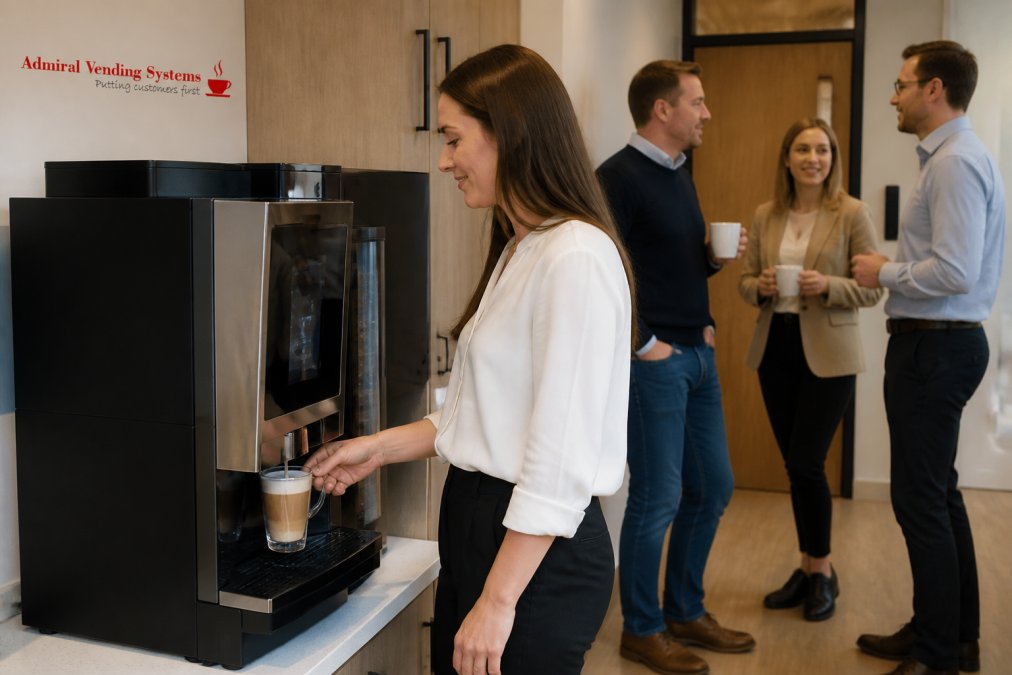
Workplace coffee machine capacity should match your busiest hour, not your average day. A machine that copes at 10am but queues at 9am will frustrate staff regardless of how good the coffee tastes. The mistake most buyers make is dividing headcount by working hours and assuming that figure is the requirement. In practice, demand is lumpy: the first hour after opening and the mid-morning break can each account for a quarter of daily drinks.
Why Peak Hour Beats Headcount
A site with 80 staff might serve 40 drinks between 8am and 9am, then 15 drinks across the rest of the morning. Sizing to the daily average would under-specify the machine and create a visible queue at the worst possible moment. Sizing to peak demand means the machine recovers between drinks quickly enough to keep the queue moving.
Two specifications drive that recovery:
- Drinks per hour, the manufacturer’s rated throughput for espresso and milk drinks. Milk-based drinks take longer because the steam wand or automatic frother must heat and texture between shots.
- Recovery time, how long the boiler takes to return to brewing temperature after a shot or a milk cycle. A machine with a small boiler may hit its hourly rating in bursts but slow down under sustained demand.
A Practical Sizing Guide
Use peak demand per hour rather than headcount alone. As a rough guide:
- Fewer than 50 staff, peak under 20 drinks per hour: compact tabletop machine
- 50 to 150 staff, peak 20 to 60 drinks per hour: higher capacity tabletop machine with a larger boiler
- 150 plus or high footfall, peak over 60 drinks per hour: floor standing machine with dual boilers or a heat exchanger
- Hospitality and showrooms with unpredictable peaks: floor standing with high output and a bypass for decaf or tea
The Factors That Quietly Cut Output
Rated throughput assumes ideal conditions. In a real kitchen or breakout area, several things reduce it:
- Water inlet temperature, a machine plumbed to cold mains takes longer to heat than one fed from a warmed supply.
- Grinder speed, a dull or slow burr set adds seconds to every drink, which compounds across a queue.
- Milk type, plant milks often texture differently from dairy and may need a separate setting or a longer cycle.
- Cup warming, pulling a shot into a cold cup drops the drink temperature and can prompt a remake.
- Placement, a machine tucked in a corner forces staff to queue in a narrow space, which feels slower even when the machine keeps pace.
Ask the supplier for the drinks per hour rating at your expected drink mix, not the headline figure. A machine rated at 100 espressos per hour may manage far fewer lattes.
Matching Capacity to Your Site Without Overbuying
Overbuying wastes budget and floor space; underbuying creates daily friction. The sensible approach is to measure a week of peak demand, add a margin for growth, and choose the smallest machine that clears that peak with room to spare. A machine running at 70 to 80 per cent of its rated output during peak will last longer and recover faster than one pushed to its limit every morning.
Office Coffee Machine Maintenance: What Keeps Machines Reliable
Office coffee machine maintenance is mostly about routine, not repair. Descaling, cleaning the milk system and rinsing the brew group on schedule prevents the failures that take a machine offline.
Skipping descaling is the fastest way to kill a boiler. Limescale builds silently, restricts flow rate and eventually blocks the system entirely, turning a routine clean into a costly repair.
Water Quality, Repairability and Workflow: What Most Buyers Miss
Water quality, repairability and workflow rarely appear on a spec sheet, yet they decide how a machine performs over its life. Most buyers focus on drink menu and price, then discover these factors later. This is the part of the buying decision that separates a machine that serves well for a decade from one that limps through its warranty and then fails.
Water Chemistry: The Silent Decider
Water is roughly 98 per cent of every espresso shot, so its mineral content shapes both flavour and machine health. Two measures matter most:
- Hardness, dissolved calcium and magnesium. Hard water scales the boiler, restricts flow and insulates the heating element, forcing it to work harder. Scale is the single most common cause of premature machine failure.
- Alkalinity and pH, high alkalinity buffers the acids in coffee, flattening brightness and muting origin character. Very low pH can corrode metal components over time.
Filtration Options and What They Actually Do
Filtration is not one product but a family of approaches, each suited to different water:
- Sediment filters remove particles but leave dissolved minerals untouched. They protect valves and solenoids, not the boiler.
- Carbon filters reduce chlorine and odour, improving taste, but do not soften water.
- Ion exchange softeners swap calcium and magnesium for sodium, cutting scale formation. These are the workhorse for hard water sites.
- Reverse osmosis removes almost everything, then typically requires remineralisation to restore flavour balance.
Repairability: The Spec Sheet Never Shows It
A machine with accessible parts and available spares lasts longer than a sealed unit, even if the sealed unit has better headline features. When comparing machines, ask:
- Are the grinder burrs replaceable, and how often do they need changing?
- Is the brew group removable for cleaning without tools?
- Are boilers, pumps and valves stocked as spares, and what is the typical lead time?
- Does the manufacturer publish a service manual or offer technician training?
Workflow: Where Layout Beats Features
Workflow is about how quickly a person moves from wanting a coffee to holding one. Three layout decisions matter more than most buyers expect:
- Placement, the machine should sit where staff naturally pass, not in a distant kitchen. A machine five minutes away gets used less than one two minutes away.
- Cup storage, cups within arm’s reach of the spout remove a step from every drink.
- Milk handling, a fridge adjacent to the machine keeps milk at the right temperature and reduces trips.
The best machine is the one that fits your water, your peak demand and your service support, not the one with the longest feature list. Test your water, check spares availability, and plan the layout before you commit.
A Short Pre-Purchase Checklist
Before signing off on any machine, confirm:
- Water hardness tested and filtration specified accordingly
- Descaling interval confirmed for your water and written into the maintenance schedule
- Spares availability and lead times checked for grinder burrs, brew group seals and pumps
- Service manual or technician support available
- Layout planned for placement, cup storage and milk access
- End-of-life plan considered: repair, refurbish or recycle
Choosing and Rolling Out Your Coffee Barista Machine
Rolling out a coffee barista machine is a project, not a purchase. Selection, installation, training and support all shape whether staff actually use it.
Work through a short checklist before you commit:
- Measure peak demand per hour, not daily average
- Confirm water supply and filtration needs
- Check the service and spares support on offer
- Plan placement for workflow, not just space
- Arrange operator training at handover
- Set a maintenance schedule from day one
Frequently Asked Questions
Are bean to cup machines better than traditional espresso machines for offices?
For most workplaces, yes. A bean to cup machine grinds fresh beans on demand and produces espresso, americano, cappuccino and latte at the touch of a button, so nobody needs barista training. Traditional espresso machines give more control over grind size, pressure and milk texturing, but they rely on a skilled operator and slow down at peak times. If your priority is consistent cafe style drinks with minimal staff effort, bean to cup is the practical choice. If you employ trained baristas and want full manual control, traditional still has a place.
How do I work out the right workplace coffee machine capacity?
Start with headcount and drinking habits rather than the machine’s headline spec. A rough planning figure is one to two drinks per person per day, with most demand landing in mid morning and early afternoon. A smaller office typically needs a compact tabletop machine, while a larger office or a high footfall showroom usually needs a higher capacity or floor standing model with larger bean and water containers. Share your numbers with a supplier and ask them to match output to your busiest hour, not your average day.
What does office coffee machine maintenance actually involve?
Daily rinsing of the spout and drip tray, weekly cleaning of the brew unit and milk system, and descaling at intervals set by your water hardness. Bean to cup machines run automatic rinse and cleaning cycles. A service plan matters more than any single task: scheduled engineer visits catch worn parts before they cause downtime. Ask what is included after the first year and how quickly an engineer can attend.
Is a coffee barista machine worth the investment for a small business?
It usually is when staff regularly leave the site to buy coffee. Those trips cost working time, and a machine that produces cafe style drinks in under a minute keeps people on site. Smaller operations do not need to overbuy: compact tabletop models suit smaller teams and scale up as you grow. Focus on reliability, support response times and running costs rather than the lowest headline figure, and ask for a quote based on your actual daily drink volumes.