Table of Contents
- Coffee for Restaurants: What Actually Drives Repeat Visits
- How to Choose Coffee Suppliers for Restaurants
- Best Coffee Beans for Restaurants: Matching Roast to Menu
- Commercial Coffee Machines for Restaurants: Fit by Service Model
- Cost to Serve: What Restaurant Coffee Really Costs
- Coffee Machine Maintenance for Restaurants and Service Consistency
- Beyond Espresso: Menu Options That Widen Your Appeal
- Conclusion
- Frequently Asked Questions
Last Updated: October 14, 2026
Coffee for Restaurants: What Actually Drives Repeat Visits
Coffee for restaurants is no longer a courtesy cup at the end of a meal. This guide from Admiral Vending draws on eight years of supplying commercial bean to cup machines.
A diner who finishes a good meal with a poor coffee remembers the poor coffee. One who finishes with a coffee that rivals the café down the road tells people about it.
Restaurant coffee succeeds or fails on three decisions: the supplier, the machine matched to your service model, and the consistency of the pour. Get those right and the menu practically sells itself.
How to Choose Coffee Suppliers for Restaurants
The right coffee suppliers for restaurants treat service, training and delivery as part of the product, not extras. A roastery that sells excellent beans but cannot deliver before a bank holiday weekend is a liability.
Most guides treat supplier selection as a price comparison, but a restaurant is not a café. Your service model, menu and staff skills should drive the brief you give suppliers.
Start With Your Service Model, Not the Bean
Before you request samples, write down four things:
- Format: Fine dining, casual dining, a pub with food, a hotel restaurant or quick service? Each has a different tolerance for wait time and expectation of quality.
- Volume: Estimate covers per day, the proportion that order coffee, and the split between espresso and filter. A site serving 80 covers a day needs a different supply rhythm from one serving 400.
- Menu: Do you need a full espresso range, batch brew, decaf, plant-based milk compatibility, or all of the above? Your menu determines grinder settings, hoppers and training burden.
- Staff skills: Will a trained barista be on shift every service, or will servers make coffee between other tasks? This decides whether you need a bean to cup system or a traditional machine.
Questions to Ask Before You Sign
- What is the minimum order for wholesale coffee, and how quickly do you dispatch?
- Do you provide barista training, and is it repeated when staff change?
- What happens if a delivery is late or a batch tastes off?
- Can you supply a coffee menu with drink specs, or do we build our own?
Ask for a trial batch before committing. A cheaper bean that produces inconsistent shots costs more in wasted milk and unhappy customers than a slightly dearer one that pulls reliably.
Red Flags in a Restaurant Supply Arrangement
- No trial or sample policy. If a supplier will not let you test a batch in your own machine, you are buying blind.
- Training treated as an extra. Staff turnover is constant, so training that is not repeated when staff change disappears.
- Delivery windows that do not match your service. A roastery that ships twice a week can leave you without beans on a Saturday.
- One roast fits all. A supplier who cannot adjust roast profile or grind for your machine is not solving your problem.
Signing a supply contract without checking dispatch times is a common mistake. A roastery that ships twice a week can leave you without beans on a Saturday, and no amount of goodwill fixes a sold-out espresso service.
How to Compare Suppliers Fairly
Build a simple scorecard. Rate each supplier on bean quality (from your trial), delivery reliability, training provision, service support, and flexibility on roast and grind. Weight delivery and training more heavily than price if your service is high volume. A supplier who scores well on all five is worth a longer contract; one who only wins on price is a risk.
Best Coffee Beans for Restaurants: Matching Roast to Menu
The best coffee beans for restaurants match how your kitchen and bar operate. An espresso roast built for a traditional machine behaves differently in a bean to cup system, and a delicate single origin can disappear under a heavy dessert.

For most restaurants, a medium to medium-dark espresso roast is the safe default. It cuts through milk, holds up in an americano and forgives small variations in grind and dose, which matters more than subtlety if you serve a lot of flat whites and cappuccinos.
Arabica, Robusta and Single Origin
Arabica is the base of most specialty coffee, prized for sweetness and acidity. Robusta brings body, crema and caffeine, and a small proportion in a blend adds backbone. A blend of the two is often the most practical choice for a busy restaurant, because it stays consistent across a long service.
| Bean choice | Best for | Trade-off |
|---|---|---|
| Arabica blend | Milk drinks, general menu | Less crema than Robusta |
| Arabica and Robusta blend | High-volume espresso service | Slightly less delicate |
| Single origin | Filter, guest rotations | Harder to keep consistent |
| Decaf | Evening service, dietary needs | Needs its own grinder setting |
Freshness is not negotiable. Beans should arrive freshly roasted and be used within a sensible window, which is why roast profile and dispatch speed matter as much as origin.
Commercial Coffee Machines for Restaurants: Fit by Service Model
Choosing commercial coffee machines for restaurants comes down to one question: who is making the drink, and how fast?
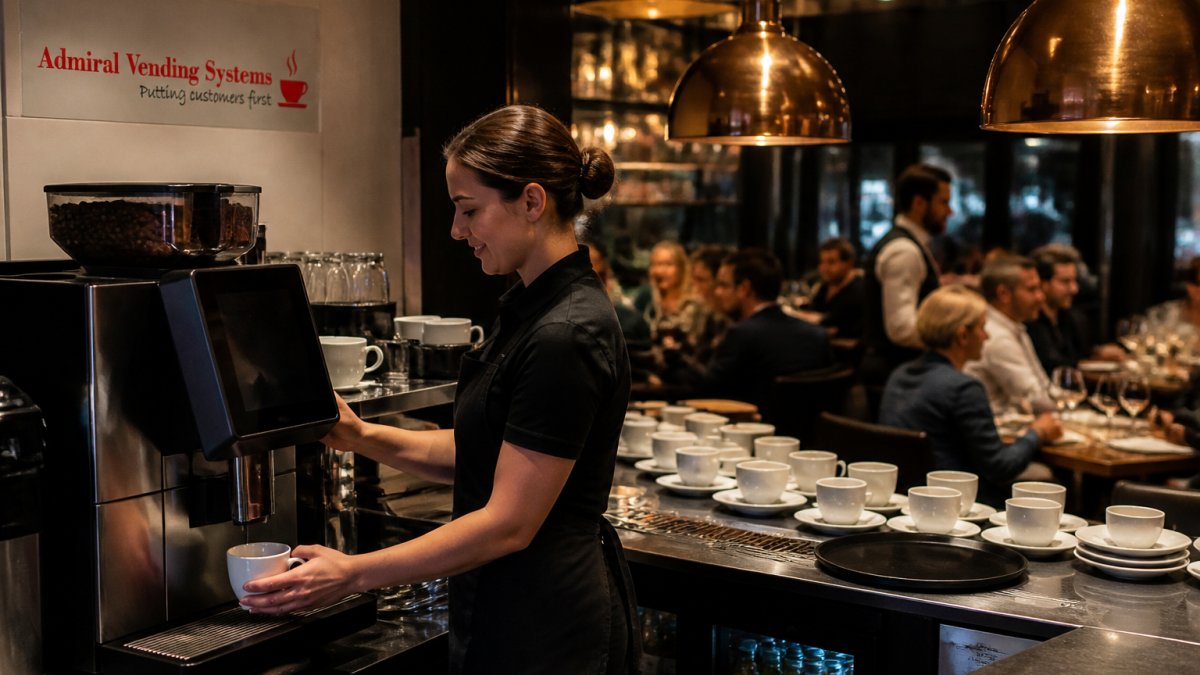
For high footfall sites, a floor standing bean to cup machine handles hundreds of drinks a day without the queue that builds behind a single group espresso machine.
Bean to Cup, Traditional Espresso or Vending
- Bean to cup: one-touch espresso, americano, cappuccino, latte and hot chocolate; minimal training; consistent output.
- Traditional espresso: maximum control for trained baristas; higher skill dependency.
- Vending: unattended service for staff areas, waiting rooms and sites without bar cover.
Admiral Vending supplies commercial bean to cup coffee machines across tabletop and floor standing formats, matched to your daily drink volume rather than headline specs.
Match the machine to your busiest hour, not your average day. A machine sized for the lunch rush prevents the queue that forms when every table orders coffee at once.
Cost to Serve: What Restaurant Coffee Really Costs
The true cost of restaurant coffee is not the price of the beans. It is the bean, milk, cup, labour, machine and maintenance divided by the number of drinks you sell.
Most guides stop at the wholesale bean price, which is the smallest part of the picture. A restaurant that knows its cost to serve can price confidently, spot waste and decide whether a premium bean is worth it.
The Cost Drivers You Need to Track
Work out your cost per drink by adding these components:
- Bean cost per drink: Divide your wholesale coffee cost per kilogram by the drinks you get from it. A typical espresso uses 18 to 20 grams, so a kilogram yields roughly 50 to 55 shots before waste.
- Milk cost per drink: A flat white or latte uses 150ml to 220ml of milk. Multiply your milk cost per litre by that volume. Plant-based milks often cost more, so track them separately.
- Consumables: Cups, lids, stirrers, sugar sachets and napkins add up across a service.
- Labour: Estimate the seconds each drink takes, including grinding, tamping, steaming and cleaning, then multiply by your hourly staff cost.
A Simple Portion Cost Example
Build the calculation with your own numbers rather than assuming coffee is cheap because the beans are.
How Menu Pricing Follows From Cost to Serve
Once you know your cost to serve, you can decide where to position coffee on the menu. A restaurant that treats coffee as an afterthought often prices it low and loses margin on every cup. One that prices it as a quality item, with a clear description and a trained person making it, can charge more and still see repeat orders.
Consider these pricing decisions:
- Espresso vs milk drinks: Milk drinks cost more to serve because of the milk and labour. Price them accordingly rather than charging the same as an espresso.
- Decaf and plant-based milk: These often cost more per serve. Price them as a premium option or absorb the cost as part of your appeal to dietary needs.
- Batch brew vs espresso: Batch brew has a lower labour cost per drink but a higher waste risk if you brew more than you sell.
- Included with a meal: If coffee is included in a set menu, you are absorbing the cost to serve. Make sure the menu price reflects it.
The most profitable coffee menus are not the cheapest to run. They are the ones where the cost to serve is known, the price reflects the quality, and the machine never sits idle during service.
Reducing Cost Without Reducing Quality
- Train staff to avoid waste. Overfilling milk jugs and pulling shots that sit too long are the two most common sources of waste.
- Match the machine to your volume. An oversized machine wastes energy and maintenance; an undersized one creates queues and rushed drinks.
- Review your bean yield. If your grinder is set too coarse or too fine, you use more coffee per drink than you need.
- Track waste for a week. Most restaurants find one or two easy fixes that pay for themselves within a month.
Pricing for machines and supply depends on your volume, site and service model, so we quote per business rather than publishing a list. Our AI powered instant quote system produces a tailored figure in minutes.
Coffee Machine Maintenance for Restaurants and Service Consistency
Coffee machine maintenance for restaurants protects the quality you paid for. A machine that is not descaled, cleaned and checked drifts out of spec, and the first sign is usually a customer saying the coffee tastes different. Build a daily routine: purge the group, clean the steam wand, empty and rinse the grounds. A machine backed by ongoing service and technical support keeps your coffee quality steady across staff changes and busy periods.
Skipping descaling shortens machine life and changes extraction. It is the single fastest way to turn a good bean into a disappointing cup.
Beyond Espresso: Menu Options That Widen Your Appeal
A strong coffee menu does more than espresso.
Dietary-friendly options matter too. Oat, soy and lactose-free milks let you serve customers who would otherwise order nothing, and a decaf option keeps evening covers in the coffee round.
The goal is a coffee menu that covers the everyday order and gives coffee connoisseurs a reason to try something new, all from equipment your team can operate without a barista qualification.
Conclusion
Building a coffee offer that earns its place on the menu takes more than picking a bean. It takes a supplier who delivers, a machine sized to your service model, and a maintenance routine that keeps every cup consistent.
At Admiral Vending, we supply commercial bean to cup coffee machines to restaurants, hotels and hospitality sites, backed by expert machine selection, professional installation, operator training and nationwide support.
Frequently Asked Questions
What coffee is best for restaurants?
A medium to medium-dark roast blend built for espresso usually works best. It gives the sweetness and body that carry through milk drinks, which make up most restaurant orders. A blend of Arabica for flavour and a small share of Robusta for crema and strength is a common choice, and it holds up across espressos, cappuccinos and lattes without changing character between services.
How do restaurants choose a coffee supplier?
Start with the menu and daily volume, then compare suppliers on bean range, delivery frequency, machine support and response times. Ask how quickly they respond to a breakdown and whether they service equipment as well as supply beans. A supplier that covers both, such as a commercial bean to cup provider, removes the gap where nobody takes responsibility when service slips.
Should restaurants serve whole bean or pre-ground coffee?
Whole bean is the better choice for restaurants. Grinding on demand keeps the aromatics intact, and a bean to cup machine does this automatically for every drink. Pre-ground coffee loses flavour within days of opening, so it suits low-volume sites where a machine is not practical. If you serve fewer than about 30 coffees a day, weigh the trade-off between freshness and equipment cost.
How often should a commercial coffee machine be cleaned?
Daily rinsing of the group and milk lines is standard, with a deeper clean weekly and a full service at the interval the manufacturer sets. Milk residues are the main cause of off flavours and blockages, so lines used for lattes and cappuccinos need attention every service. A maintenance plan with scheduled visits keeps this consistent when staff turnover is high.