Table of Contents
- What Nationwide Service Really Means for Commercial Coffee Machine Suppliers
- Commercial Coffee Machine Maintenance: What Belongs in a Service Contract
- Commercial Coffee Machine Servicing: Response Times, Parts and Labour
- Bean to Cup Coffee Machines for Offices: Matching Capacity to Headcount
- Coffee Machine Installation for Businesses: Onboarding Without Downtime
- Leasing, Hire and Buying: How Supplier Models Affect Total Cost
- Choosing a Commercial Coffee Machine Supplier: A Practical Checklist
- Conclusion
- Frequently Asked Questions
Last Updated: October 12, 2026
What Nationwide Service Really Means for Commercial Coffee Machine Suppliers
Choosing between commercial coffee machine suppliers in the UK often comes down to one question: who will actually turn up when the machine stops working? This guide breaks down what nationwide service really means, how maintenance contracts differ, and how to compare suppliers on evidence rather than sales talk.
Nationwide service is a supplier’s ability to attend and repair your machine anywhere in the country under one contract, rather than passing you to a distant third party. It matters because a machine that sits idle costs you staff time and morale.
Coverage Areas: Local Technician vs Regional vs Nationwide
Coverage falls into three broad models, and they behave very differently in practice.
- Local technician: fast when the engineer is nearby, but coverage collapses the moment you open a second site.
- Regional: strong within a defined area, with no guarantee of the same standard outside it.
- Nationwide: one point of contact, one contract, and consistent terms across every location.
For multi-site businesses, the practical difference is admin. One contract beats five. What most guides miss is that “nationwide” is a claim, not a standard, so ask any supplier to name the areas they genuinely cover before you sign.
How to Verify a Nationwide Coverage Claim
Most suppliers say they cover the whole country. Fewer can prove it. The gap between the two is where downtime lives.
A practical way to test any coverage claim is to ask for a postcode level breakdown. Not a map with shaded regions, but a list of the postcode areas where the supplier has engineers based or regularly scheduled. If a supplier cannot produce that, their nationwide promise is likely a patchwork of subcontractors and next day couriers.
Ask three specific questions:
- Which postcode areas have a resident engineer? This tells you where response times are genuinely fast.
- Which areas rely on a partner or subcontracted engineer? This is where standards can slip and accountability blurs.
- What is the target attendance time for my specific postcode? Not a national average, but the commitment for your site.
A common pattern is that national providers have strong coverage in major cities and rely on partners elsewhere. That is not necessarily a problem, but you should know which model applies to you before you sign. If your sites are spread across the country, ask how the supplier manages consistency when different engineers attend different locations.
One useful test is to request a sample service report from a site in a similar postcode area. It should show the engineer’s name, arrival and departure times, work carried out, and parts used. If the supplier cannot share a redacted example, treat that as a warning sign.
Ask for the maintenance schedule in writing before you sign. A supplier who cannot produce one is selling you breakdown cover, not preventative maintenance.
Commercial Coffee Machine Maintenance: What Belongs in a Service Contract
A commercial coffee machine maintenance contract should set out visit frequency, what each visit includes, parts and labour terms, and response commitments. If a contract is vague on any of those four points, treat it as a warning sign.
Preventative maintenance is scheduled work that keeps a machine running before it fails, rather than repairing it after a breakdown.
Preventative Maintenance Schedules and What They Cover
A sensible schedule typically includes descaling, deep cleaning, boiler and safety inspection, and a check of grinder and group head condition. The right frequency depends on daily drink volume and water hardness, so a supplier quoting a fixed interval without asking about usage is guessing.
Commercial Coffee Machine Servicing: Response Times, Parts and Labour
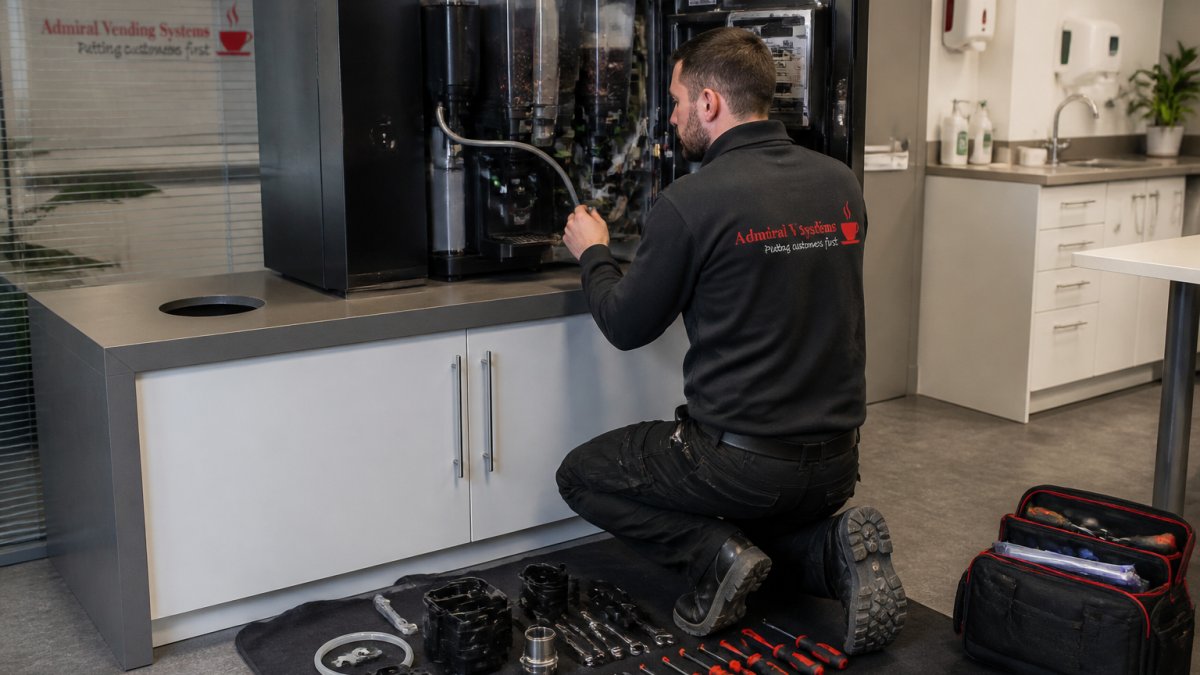
Commercial coffee machine servicing lives or dies on two numbers: how quickly an engineer attends, and whether parts and labour sit inside the contract or on a separate invoice. Get both in writing.
Breakdown Support and Equipment Uptime Commitments
Published service level commitments are rare in this market, which is exactly why they are worth demanding. Ask for the target response window, what happens outside working hours, and whether a loan machine is available during a long repair.
When you receive those answers, compare them against these benchmarks. A same day or next day attendance target is typical for urban areas on a comprehensive contract. For more remote postcodes, a 48 hour target is common. If a supplier promises four hour attendance nationwide, ask how they staff that and where the nearest engineer is based.
Out of hours cover usually means evenings and weekends, but check whether it is included or charged as a premium. For sites that trade early or late, this can be the difference between a minor disruption and a lost day of sales.
Loan machines are not standard. Ask whether one is available, what size it is, and how quickly it can be delivered. For a busy site, a loan machine can be more valuable than a fast repair.
| Contract Element | What to Ask | Why It Matters |
|---|---|---|
| Response time | Target attendance window for your postcode | Predicts downtime |
| Parts and labour | Included or chargeable | Controls repair costs |
| Preventative visits | Frequency and scope | Reduces breakdowns |
| Out of hours | Covered or premium | Protects busy sites |
| Loan machine | Available or not | Keeps service running |
A contract that covers parts but not labour, or labour but not call-out, can leave you with a bill after every visit. Confirm what is included before the first engineer arrives.
What Good Looks Like in Practice
A strong service contract will state the response time in hours, not days. It will confirm that parts and labour are included for the duration of the agreement. It will set out how many preventative visits you receive per year and what each visit covers. It will explain the out of hours process and any additional cost. And it will say whether a loan machine is available and under what conditions.
If any of those points are missing or vague, ask for them in writing. A supplier who is confident in their service will not hesitate to put commitments on paper. A supplier who deflects is telling you something important.
One final check: ask what happens if the response time is missed. Some contracts include a service credit or a free month. Most do not. Even if there is no penalty, knowing the escalation process is useful when you need to chase a repair.
Bean to Cup Coffee Machines for Offices: Matching Capacity to Headcount
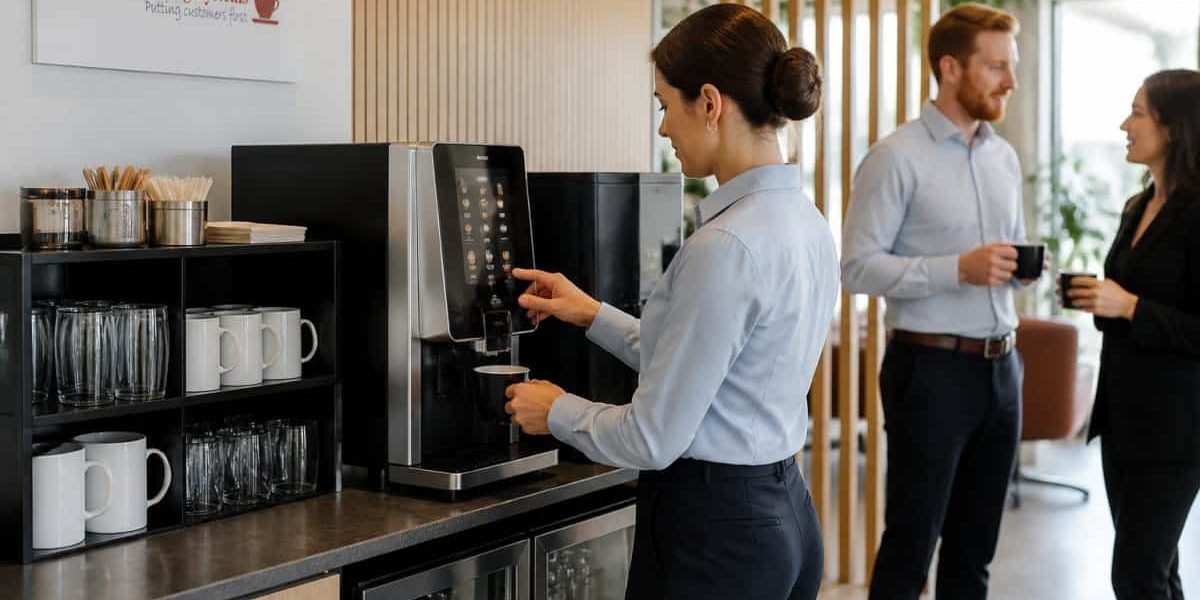
Bean to cup coffee machines for offices should be sized to peak demand, not average demand. A machine that copes at 10am but queues at 11am is the wrong machine.

As a working rule, match the model to headcount and daily drink volume: compact tabletop machines suit smaller offices and meeting rooms, higher capacity tabletop models suit busy offices and showrooms, and floor standing units handle high footfall sites needing hundreds of drinks a day. Admiral Vending supplies this full range, which means the recommendation follows your usage rather than whatever happens to be in stock.
Coffee Machine Installation for Businesses: Onboarding Without Downtime
Coffee machine installation for businesses should be planned around your working day, not the supplier’s. Professional installation covers siting, water and power connection, commissioning, and operator training. Seamless integration of your equipment is only the first step toward a consistent office brew, as the long-term quality of your service depends heavily on partnering with a reliable wholesale coffee supplier.
The onboarding question worth asking is simple: how long from order to first cup? A supplier who handles delivery, installation and training as one process removes the gap where a machine sits boxed in a corridor. Our own approach at Admiral Vending is to complete selection, delivery, installation and training as a single sequence, so staff are making drinks the same week.
Leasing, Hire and Buying: How Supplier Models Affect Total Cost
Leasing, hire and outright purchase change your total cost of ownership far more than the sticker price does. Purchase means capital outlay and you own the maintenance burden. Leasing and hire spread cost monthly and usually bundle servicing and supplies.
The comparison that matters is three-year total cost, not upfront price. Add servicing, parts, descaling, coffee supplies and expected downtime. A cheaper machine with a weak service contract is rarely the cheaper option.
Compare suppliers on total cost of ownership across the contract term, including servicing and supplies, rather than on the machine price alone.
Choosing a Commercial Coffee Machine Supplier: A Practical Checklist
Use this checklist to compare commercial coffee machine suppliers on evidence rather than presentation.
- Written confirmation of the areas covered
- Published response time commitments
- Clear list of what parts and labour include
- Preventative maintenance schedule in writing
- Named engineer or local technician for your site
- Support for all makes and models, or a clear statement of limits
- Operator training included at installation
- Evidence of service quality, such as reviews or references
- Exit terms and what happens at contract end
guidance on buying fair and transparent service contracts
Conclusion
The hard part of choosing a supplier is not finding machines, it is finding one that answers the phone in year three. Admiral Vending supplies commercial bean to cup coffee machines with professional installation, operator training and nationwide support, backed by eight years of industry experience and an AI powered instant quote system. Get your instant quote from Admiral Vending and match the right machine to your headcount, your sites and your service expectations.
Frequently Asked Questions
Which commercial coffee machine suppliers provide nationwide maintenance?
Nationwide maintenance means a supplier has service engineers positioned across the country, not just in one region. When comparing commercial coffee machine suppliers, ask how many engineers they employ directly, whether repairs are handled in-house or subcontracted, and what response time they commit to in writing. A supplier that publishes its coverage map and service-level commitments is easier to hold to account than one that only promises ‘fast support’.
What should a commercial coffee machine service plan include?
A thorough commercial coffee machine maintenance plan typically covers scheduled preventative visits, descaling, deep cleaning, boiler and safety inspections, replacement parts, and labour. Check whether call-outs for breakdowns are included or charged separately, and whether the plan lists what counts as fair wear and tear. Ask for the terms in writing before signing, so you can compare plans on the same basis rather than on headline promises.
How often should a commercial coffee machine be serviced?
Service frequency depends on daily drink volume and water hardness in your area. A busy office machine making hundreds of drinks a day will need more frequent attention than a small meeting room unit. Most suppliers set their schedule around usage tiers, so give accurate daily cup numbers when you request a quote. Hard water areas usually need more regular descaling to protect the boiler and keep drink quality consistent.
Can a supplier install and maintain bean to cup coffee machines?
Yes, a full-service supplier handles machine selection, delivery, coffee machine installation for businesses, operator training, and ongoing maintenance under one contract. This matters because if installation and servicing sit with different companies, breakdowns can stall while responsibility is disputed. Ask whether the same engineers who install your bean to cup coffee machines for offices also attend service calls, and confirm what operator training is included at handover.