Table of Contents
- Why Offices Are Moving Away From Traditional Coffee Pods
- Bean to Cup Coffee Machine for Office: How It Compares to Pods
- Ground Coffee for Office Coffee Machines: Filter and Batch Brewing
- Reusable Coffee Pods for Office: Refillable Capsules and Stainless-Steel Pods
- Compostable and Recyclable Pods: What Actually Changes
- Instant Coffee and Pod Machines: Where Each Still Fits
- Office Coffee Machine Maintenance and Service Requirements
- Total Cost of Ownership and Break-Even by Workplace Scenario
- Frequently Asked Questions
Last Updated: October 15, 2026
Why Offices Are Moving Away From Traditional Coffee Pods
Office managers are rethinking office coffee pods, and the reasons go well beyond cost. Alternatives to traditional office coffee pods now range from bean to cup machines and batch brewing to refillable capsules and instant coffee, each suited to different workplace sizes and drinking habits.
The shift is practical. Pods create a steady stream of waste that most general waste streams will not accept, and the per-drink cost quietly adds up across a large team. Meanwhile, staff expectations have risen: people want a proper flat white at their desk, not a lukewarm instant.
This guide from Admiral Vending breaks down each alternative and which setup fits which workplace. We supply commercial bean to cup coffee machines across the UK and have seen first hand where pod systems fall short.
Bean to Cup Coffee Machine for Office: How It Compares to Pods
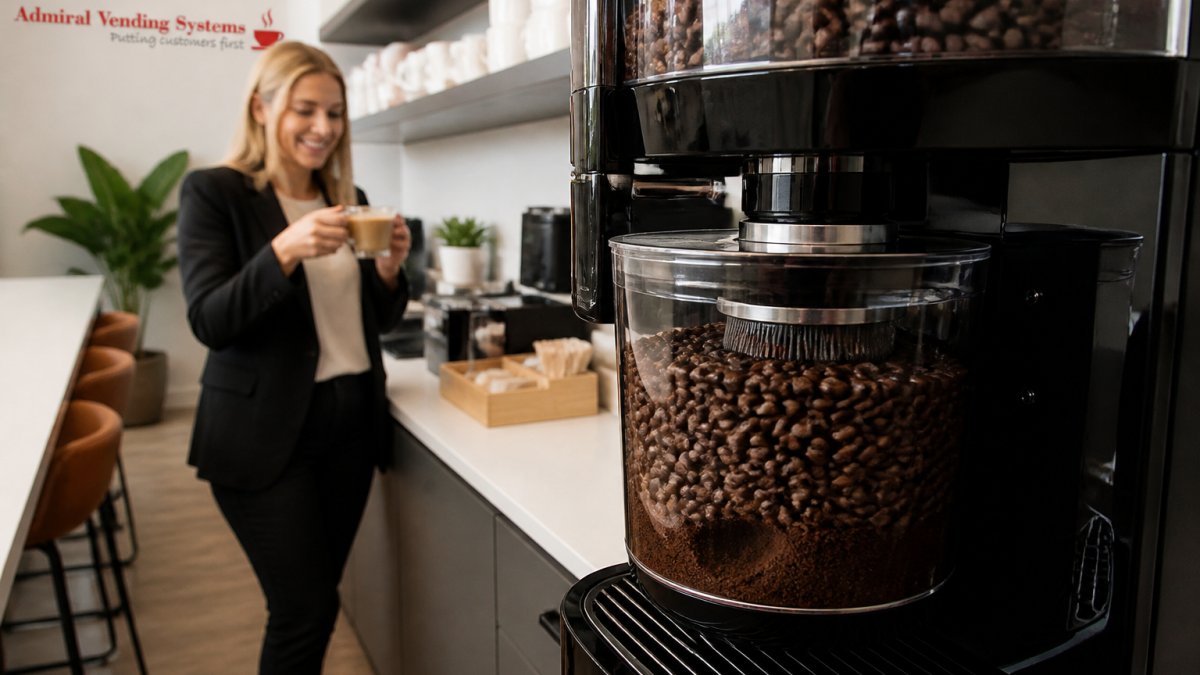
A bean to cup coffee machine for office use grinds fresh beans on demand and dispenses espresso, americano, cappuccino, latte and hot chocolate at the touch of a button. Compared with pods, it removes the packaging waste and the manual handling almost entirely.
What Changes in Daily Office Use
The biggest change is workflow. Nobody has to remember to order pods, store boxes, or clear a bin full of used capsules. Staff select a drink, and the machine handles grinding, tamping and milk texturing.
Drink quality also improves. Freshly ground beans taste noticeably better than coffee that has sat in a sealed capsule for months, and the machine can produce a wider range of drinks than most pod systems.
Matching Machine Capacity to Team Size
Capacity is where pod systems and bean to cup machines diverge most. A small team of around 40 people needs a compact tabletop machine for meeting rooms and kitchens. Busy offices, showrooms and car dealerships need higher capacity tabletop units. Large sites and factory floors need floor standing machines built for hundreds of drinks a day.
Getting this wrong is the most common mistake we see. An undersized machine queues at 9am and breaks down under load.
Count your peak hour, not your daily total. If 60 staff all want a drink between 8:30 and 9:30, you need a machine rated for that hour, not for the daily average.
Ground Coffee for Office Coffee Machines: Filter and Batch Brewing
Ground coffee for office coffee machines remains a cost-effective way to serve a crowd. Filter and batch brewers produce large volumes with minimal fuss, and the running cost per cup is often lower because you are not paying for packaging.

The trade off is drink variety. A batch brewer gives you black coffee and little else. No lattes, no cappuccinos, no hot chocolate. For teams that mostly want a straightforward mug of filter coffee, that is fine. For teams that expect café style drinks, it will not satisfy anyone.
Batch brewing also needs someone to take ownership. Someone has to brew a fresh pot, clean the jug, and manage the ground coffee supply. In practice, that responsibility usually falls to whoever notices the pot is empty, which means quality varies through the day.
Reusable Coffee Pods for Office: Refillable Capsules and Stainless-Steel Pods
Reusable coffee pods for office kitchens are refillable capsules and stainless steel pods that you fill with your own ground coffee and rinse after use. They can reduce waste, provided your existing pod machine accepts them.
Here is where it falls apart. Refillable capsules only work in compatible machines, filling them is fiddly, and each pod needs cleaning between uses. In a busy office, that labour adds up fast and compliance drops within weeks.
Stainless steel pods last longer than plastic refillables but still need emptying, rinsing and drying. If your team will not do that reliably, you will end up with a drawer of dirty pods and a machine nobody trusts.
The operational reality is rarely discussed. A reusable pod needs to be emptied, rinsed under a tap, and left to dry before it can be refilled. That is a two to three minute task per pod, per use. In an office where ten people each have two drinks a day, that is forty minutes of unpaid cleaning time daily. Someone has to own that process, and in most workplaces it falls to the person who cares most about coffee, not the person with facilities responsibility.
There is also a hygiene question. Capsules that are not fully dry before refilling can clog the machine and affect taste. Stainless steel pods retain heat, so they need a moment to cool before handling. Neither issue is insurmountable, but both add friction that a traditional pod does not have.
A common pattern in offices that try reusable pods is a burst of enthusiasm followed by a gradual return to disposables. The reusable pods end up in a cupboard, and the office manager orders another box of capsules. If your team is small, highly motivated, and already has a cleaning rota, reusable pods can work. For most shared workplaces, they are a stopgap rather than a solution.
Do not assume a reusable pod is automatically more sustainable. It only reduces waste if it is actually used repeatedly. A pod that is bought, tried twice, and abandoned has a worse environmental profile than a standard capsule.
Compostable and Recyclable Pods: What Actually Changes
Compostable and recyclable pods reduce the waste problem, but only if your disposal route can actually handle them. Compostable capsules need industrial composting, not a general waste bin, and recyclable pods often need the foil and grounds separated.
In practice, most offices do not have the collection infrastructure to make either option genuinely circular. The pod still leaves the building in a bin.
The honest position: switching pod materials is a marginal improvement. Removing the pod altogether, by grinding fresh beans on demand, is a structural one.
Do not assume a compostable pod breaks down in general waste. Without an industrial composting collection, it behaves much like any other capsule.
Instant Coffee and Pod Machines: Where Each Still Fits
Instant coffee still fits in one place: very low volume sites where a handful of drinks a day do not justify any machine. It is often inexpensive, needs minimal maintenance and is generally reliable.
Pod machines fit where variety matters more than cost and volumes are modest. They are simple to use and require little training.
Neither scales well. Once a team grows past a certain size, the per-drink cost of pods and the quality ceiling of instant both become obvious problems.
Office Coffee Machine Maintenance and Service Requirements
Office coffee machine maintenance is the hidden cost that separates a good setup from a bad one. Bean to cup machines need descaling, cleaning cycles, milk line hygiene and periodic servicing. Pod machines need less, but they still fail.
The difference is who handles it. With a managed supply, installation, training and ongoing service support are included, so a breakdown is a phone call rather than a facilities problem. With a self bought machine, you own every fault.
Ask any supplier what happens on a Friday afternoon when the machine stops. The answer tells you more than the spec sheet.
Total Cost of Ownership and Break-Even by Workplace Scenario
Total cost of ownership is where the pod habit can be less favourable. Pods often carry a low upfront cost but can have a higher ongoing one, because you pay for packaging, coffee and waste handling with every single drink.
Most comparisons stop at the sticker price of the machine and the cost of a capsule. That misses the bigger picture. A proper total cost of ownership calculation for workplace coffee includes the machine itself, installation, coffee, filters, cleaning supplies, descaling, servicing, repairs, waste disposal, and the staff time spent restocking and cleaning. Some of those costs are obvious.
| Setup | Upfront Cost | Ongoing Cost | Best For | Waste |
|---|---|---|---|---|
| Pod machine | Low | High per drink | Small teams, low volume | High |
| Instant coffee | Very low | Very low | Under 10 drinks a day | Low |
| Batch brewer | Low | Low per drink | Filter coffee drinkers only | Low |
| Refillable pods | Low | Medium, plus labour | Existing pod machines | Medium |
| Bean to cup | Higher | Low per drink | Busy offices, showrooms | Minimal |
Break-even depends on volume. At low daily volumes, a pod machine is often hard to beat on simplicity. As volumes rise, the per-drink saving of grinding fresh beans can become more apparent, and the gap can widen over time.
But volume is not the only variable. Peak demand matters just as much. An office with forty staff who all want a drink between 8:30 and 9:30 needs a machine rated for that hour, not for the daily average. An undersized machine queues, overheats, and breaks down under load.
Workplace size and consumption patterns change the recommendation. For a team of under twenty with modest coffee habits, a pod machine or a simple batch brewer is often sufficient. For twenty to fifty staff with a mix of drink preferences, a compact bean to cup machine usually offers the best balance of variety, running cost, and reliability.
Hybrid working adds another layer. If only half the team is in on any given day, peak demand is lower but less predictable. A machine that is too large wastes energy and coffee. A machine that is too small fails on the days everyone turns up.
Service and maintenance costs are the hidden line item. Bean to cup machines need descaling, cleaning cycles, milk line hygiene and periodic servicing. Pod machines need less, but they still fail. A managed supply with installation, training and ongoing service support turns a breakdown into a phone call rather than a facilities problem.
A simple way to compare is to calculate cost per drink over three years. Add the machine cost, installation, coffee, filters, cleaning, servicing, and any expected repairs. Divide by the number of drinks you expect to serve. That figure, not the purchase price, tells you which option is actually cheaper for your workplace.
Match the machine to your peak hour and your drink expectations, not to the cheapest sticker price. The machine with the lowest purchase price is not always the most cost-effective to run in the long term.
Frequently Asked Questions
What are the best alternatives to disposable coffee pods in an office?
The main options are bean to cup machines, filter or batch brewing with ground coffee, reusable coffee pods for office use, compostable and recyclable pods, and instant coffee. Bean to cup suits larger teams that want fresh drinks on demand with minimal handling, while ground coffee and reusable pods suit smaller teams willing to accept more manual steps. The right choice depends on your daily drink volumes, available space and how much staff time you can give to refilling and cleaning.
Is a bean to cup machine better than coffee pods for an office?
A bean to cup coffee machine for office use grinds fresh coffee beans on demand, so every drink is made from freshly ground coffee rather than a sealed capsule. That usually means better coffee quality and more drink variety, including espresso, americano, cappuccino, latte and hot chocolate. Pods remain simpler to stock and clean up. For teams drinking dozens of coffees a day, bean to cup can help reduce the volume of single-use pod waste.
Can an office coffee machine use ground coffee instead of pods?
Yes. Filter brewers and batch brewers use ground coffee for office coffee machines and can produce jugs or urns for meetings and shared kitchens. The trade-offs are that ground coffee goes stale once the bag is opened, so you need regular deliveries or airtight storage, and someone has to dispose of the grounds and rinse the filter. Batch brewing suits predictable demand, such as morning rushes, rather than one-off drinks through the day.
Are reusable coffee pods suitable for workplace use?
Reusable coffee pods for office kitchens work best in small teams of roughly five to twenty people. Stainless-steel pods and refillable capsules cut pod waste and let you choose your own ground coffee, but each pod must be emptied, rinsed and refilled, and they only fit compatible pod machines. Once daily demand climbs past a few dozen drinks, the refilling workload and the risk of a machine clogging from incorrectly filled capsules usually outweigh the savings.