Table of Contents
- Understanding Bean to Cup Machine Capacity Requirements
- Calculating Commercial Coffee Machine Daily Output
- Defining Usage Levels: Light, Medium and High Volume
- Peak Demand vs Average Daily Output
- Plumbed vs Tank fed Coffee Machines
- Key Factors Influencing Your Machine Selection
- Maintenance, Waste and Service Requirements at Scale
- Conclusion
- Frequently Asked Questions
Last Updated: September 21, 2026
Understanding Bean to Cup Machine Capacity Requirements
Choosing the right bean to cup machine capacity requirements for your workplace is often overlooked. Most facilities managers focus on features rather than whether the machine can handle actual staff demand.
An undersized machine creates frustration and queues; oversizing wastes money. Finding the balance requires calculating daily output needs, recognising usage levels, and accounting for hidden performance factors.
This guide breaks down the exact methodology to determine your bean to cup machine capacity requirements, moving beyond simple cup counts to cover the factors that determine whether a machine succeeds in your environment.
Calculating Commercial Coffee Machine Daily Output
The starting point for bean to cup machine capacity requirements is calculating how many drinks your staff consumes daily.
Begin with total headcount. For a 150 person office, assume 60 70% of staff use the machine daily (90 105 active users).
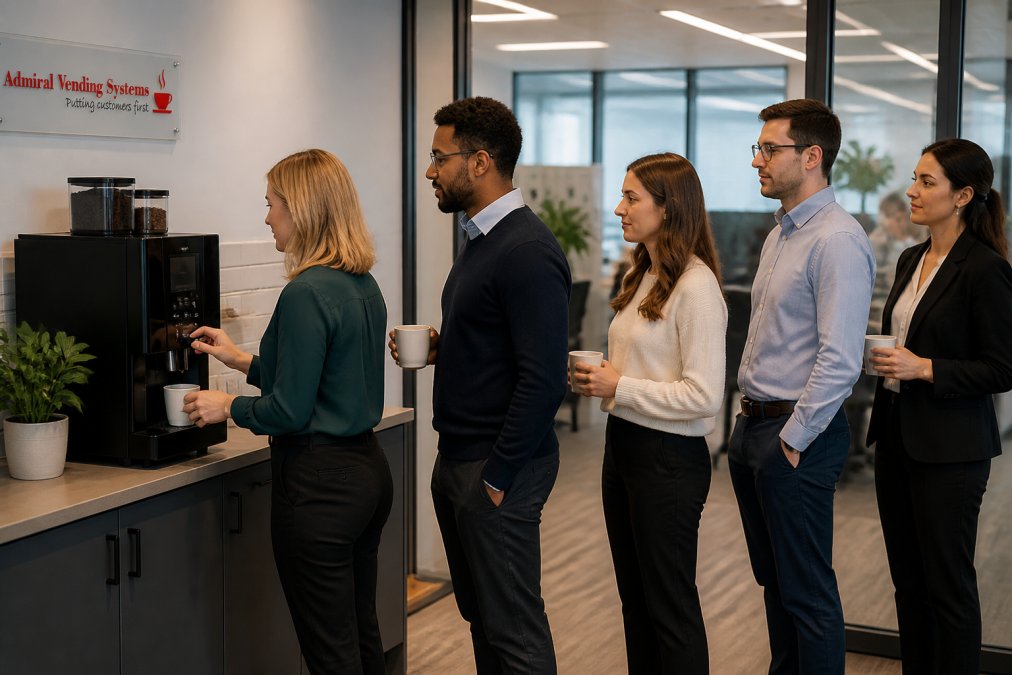
Multiply active users by average consumption: 100 users × 1.5 drinks = 150 drinks per day. Peak demand concentrates in the morning (8am 10am) and mid afternoon (2pm 3pm), which is critical for selecting a machine that handles consecutive drinks without bottlenecking.
For a 150 person office, expect 40 50% of daily volume during the morning peak (60 75 drinks in 2 hours).
Defining Usage Levels: Light, Medium and High Volume
Categorising your environment correctly prevents overspending or undersizing.

Light duty environments (small offices with 20 40 staff, showrooms, meeting rooms) rarely exceed 50 80 drinks daily. Compact tabletop coffee machines handle intermittent demand at 8 12 drinks per hour.
Mid volume environments (busy offices with 80 150 staff, dealerships, showrooms) produce 120 250 drinks daily. Mid volume machines deliver 15 25 drinks per hour and form the largest segment of workplace installations.
High volume environments (corporate headquarters with 200+ staff, hospitality venues, factory floors) exceed 300 drinks daily. High volume machines must deliver 30 40+ consecutive drinks per hour. These require floor standing units with larger hoppers or plumbed in connections.
Your category determines machine footprint, water supply, waste management, and maintenance intervals.
Peak Demand vs Average Daily Output
Many decision makers focus on average daily output and ignore peak demand, which is a critical mistake.
Average daily output shows total consumption; peak demand shows whether the machine avoids bottlenecks. A machine producing 150 drinks daily averages 15 per hour, but if 50% concentrates into a 2 hour morning peak, it must handle 37 40 drinks per hour.
A machine maxing out at 20 drinks per hour will fail during peak times, causing staff to queue and abandon it.
Calculate peak hour demand separately. For most offices, peak hour represents 15 20% of daily volume. For a 150 drink day, expect 22 30 drinks during the busiest hour.
Select a machine whose consecutive drink service speed exceeds your peak hour requirement by 25 30% to prevent performance degradation.
Plumbed vs Tank fed Coffee Machines
Your water supply architecture directly impacts capacity sustainability and peak demand reliability.
Tank fed machines hold 2 5 litres of water and offer placement flexibility without mains connection. However, tank capacity limits daily output.
A single drink consumes 200 250ml of water; a 3 litre tank supports 12 15 drinks. For light volume sites (under 80 drinks daily), this is manageable. For mid volume sites (120 250 drinks daily), refilling interrupts service. For high volume sites (300+ drinks daily), tank fed machines are impractical, requiring multiple refills during peak hours.
Additionally, tank fed systems lack the integrated water filtration that plumbed in machines provide. Without filtration, mineral deposits accumulate faster, increasing descaling frequency and shortening component lifespan. For high volume environments, this compounds maintenance burden.
Plumbed in machines connect directly to the mains water supply via a dedicated feed line. They eliminate refilling entirely and provide unlimited water availability, removing a significant operational bottleneck. Plumbed in systems incorporate integrated water filtration cartridges that protect internal components, reduce limescale buildup, and extend machine lifespan by 30 50% compared to tank fed equivalents. The filtration also improves beverage quality by removing chlorine and particulates.
The trade off is installation complexity. Plumbed in machines require a suitable water connection point within reasonable distance (typically 2 3 metres). Installation involves pipework, isolation valves, and sometimes professional plumbing input. Initial setup costs are higher. However, for any site exceeding 150 200 drinks daily, the operational savings and reliability gains justify the upfront investment.
A practical decision framework: if your daily output requirement is under 100 drinks and your office layout permits it, tank fed machines offer simplicity and flexibility. If your requirement is 150 250 drinks daily, plumbed in becomes strongly preferable to avoid peak hour refill interruptions. If your requirement exceeds 250 drinks daily, plumbed in is non negotiable; tank fed machines will fail during peak demand and create staff frustration.
Consider also the total cost of ownership. A plumbed in machine requires fewer descaling interventions, fewer filter changes, and eliminates the labour cost of daily refilling. Over a 5 year cycle, plumbed in machines can offer operational savings at mid to high volumes.
Key Factors Influencing Your Machine Selection
Beyond daily output and usage level, several interconnected factors determine whether a machine will perform reliably in your environment.
Office size and staff headcount remain the primary driver. A 40 person SME requires fundamentally different capacity than a 300 person corporate headquarters. However, the relationship is not linear. A 40 person office with high coffee culture (frequent consumption, multiple drinks per person) may demand more capacity than a 100 person office where consumption is lower. Headcount is a starting point, not a complete picture. Accurate assessment of these consumption patterns often necessitates calculating coffee requirements with the same precision applied to large-scale event planning.
Consecutive drink service speed is the metric that prevents queues. Measured in drinks per hour, this determines real world user experience during peak demand. A machine rated at 20 drinks per hour can serve one drink every 3 minutes. During a 2 hour morning peak, it will produce approximately 40 drinks. If your peak hour demand exceeds this, frustration builds quickly.
Duty cycle refers to how long a machine can operate continuously before requiring a cooldown or rest period. Commercial machines are engineered for extended operation, but even strong units have limits. High volume environments demand machines with high duty cycles that can handle back to back orders without performance degradation.
Machine footprint affects placement options. In space constrained offices, footprint limits your capacity choices. Conversely, in large facilities with dedicated refreshment areas, floor standing high capacity machines become viable.
Beverage variety influences perceived capacity.
Maintenance, Waste and Service Requirements at Scale
Capacity decisions have far reaching downstream consequences for maintenance frequency, waste management burden, and operational cost. These hidden factors often exceed the purchase price over a machine’s lifespan and are frequently overlooked during selection.
Waste management capacity and emptying frequency directly correlates with daily output. A machine producing 150 drinks daily generates approximately 150 portions of spent grounds (roughly 1 1.5kg of wet waste). Most commercial bean to cup coffee machines incorporate grounds bins with capacity of 1 2kg. For a 150 drink site, the grounds bin reaches capacity within 24 hours of operation and requires daily emptying. For a 300 drink site, the bin may need emptying twice daily or more.
This is not a trivial task. Wet grounds are heavy, messy, and require disposal into appropriate waste streams. Staff responsible for emptying often view it as an unpleasant chore. If the grounds bin overflows, the machine stops functioning until it is emptied, creating service interruption during peak hours. High volume sites benefit from machines with larger grounds bins (3 4kg capacity) or automated grounds disposal systems that compress waste and reduce emptying frequency to 2 3 times weekly. These features add cost but eliminate a significant daily operational burden.
The drip tray presents a similar issue. Every drink produces a small amount of spillage and condensation that collects in the drip tray. For high volume machines, this tray fills quickly and requires emptying every 1 2 days. Overflow creates hygiene issues and machine malfunction. Larger drip trays (2 3 litre capacity) reduce emptying frequency but occupy more physical space.
Descaling frequency increases sharply with volume.
Conclusion
Selecting the correct bean to cup machine capacity requirements requires moving beyond simple cup counts to account for peak demand, usage patterns, water infrastructure, and maintenance realities. Most businesses underestimate peak hour demand and oversimplify their capacity calculations, leading to undersized machines that create frustration and wasted time.
Frequently Asked Questions
How do I calculate the daily output required for my office?
Start with your staff headcount and estimate consumption per person. Most office environments average 1.5 to 2 cups per employee per day. Multiply your staff number by this figure to find baseline consumption. Then add 20 to 30 percent for peak-time demand, visitors and variations in usage patterns. A 150-person office typically needs 225 to 300 cups daily. This baseline helps determine whether you need a light-duty tabletop machine or a higher-capacity floor-standing unit.
What is the difference between bean hopper capacity and water tank capacity?
Bean hopper capacity refers to how many kilograms of coffee beans the machine can hold before refilling. Water tank capacity determines how many cups can be brewed between manual refills. A machine with a 1kg bean hopper typically produces 40 to 50 cups before needing fresh beans. Tank-fed machines require refilling after 100 to 200 cups depending on tank size. Plumbed-in machines eliminate water refilling entirely, making them better for high-volume environments where consistent throughput matters.
Do I need a plumbed-in coffee machine or a manual fill model?
Manual fill (tank-fed) machines suit offices with light to medium usage, roughly 50 to 150 cups daily. They offer flexibility in placement and lower installation costs. Plumbed-in machines connect directly to your water supply and are essential for high-volume environments exceeding 200 cups per day. They eliminate downtime from refilling, reduce maintenance intervals, and ensure consistent water supply. For a 150-person office with peak demand, plumbed-in is typically the better choice to avoid service interruptions and staff frustration.
What maintenance considerations arise with high-capacity coffee machines?
High-volume machines require more frequent descaling, cleaning cycles and grounds bin emptying. Expect descaling every 2 to 4 weeks depending on water hardness and daily cup output. Grounds bins may need emptying multiple times per shift in busy environments. Fresh milk systems require daily cleaning to prevent blockages. Service intervals become critical at scale because downtime directly impacts staff experience and productivity. Plumbed machines reduce some labour but still need regular automated cleaning cycles and professional servicing every quarter to maintain beverage consistency and hygiene standards.