Table of Contents
- Types of Coffee Machines for Workplaces
- Coffee Machines for Small Offices
- High Capacity Coffee Machines for Busy Workplaces
- Choosing the Right Commercial Coffee Machine Supplier
- Coffee Machine Installation and Support Services
- Matching Machine Capacity to Your Team Size
- Conclusion
- Frequently Asked Questions
Last Updated: October 9, 2026
Types of Coffee Machines for Workplaces
Choosing the right coffee machine for your workplace starts with understanding what’s available. The three main categories serve different needs, budgets, and usage patterns. Each has distinct advantages depending on your team size, available space, and desired drink variety.
Bean-to-Cup Machines
Bean-to-cup machines grind fresh coffee beans on demand and brew individual drinks in seconds. They eliminate the need for pre-ground coffee or pods, delivering café-quality espresso, americano, cappuccino, and latte from a single unit.
These machines work well for offices where employees value quality and variety. They’re popular in showrooms and car dealerships where client experience matters.
Maintenance involves regular cleaning cycles and periodic descaling. Most modern bean-to-cup machines handle routine cleaning automatically, reducing staff burden. Water quality matters, hard water areas benefit from built-in filtration or softening systems.
Espresso Machines
Traditional espresso machines offer manual or semi-automatic operation, giving skilled users control over extraction time and pressure. They’re ideal for hospitality settings where trained staff operate the equipment. Hotels and restaurants often prefer espresso machines because they deliver authentic café experience and allow customisation for regular customers.
These machines require operator knowledge. Poorly extracted shots taste bitter or sour. Staff training is essential. The upside is flexibility, experienced baristas can adjust grind, tamp pressure, and extraction to match bean characteristics and customer preference.
Espresso machines suit environments where drink quality justifies the training investment. They’re less practical for self-service office environments where consistency matters more than customisation.
Vending Machines
Coffee vending machines operate unattended, dispensing drinks 24/7 without staff intervention. Modern units offer multiple drink options, coffee, hot chocolate, tea, from a single machine. They work well in factories, warehouses, and large office buildings where demand is constant and space is limited.
Vending machines require less maintenance than bean-to-cup units but deliver lower drink quality. They suit high-volume, low-complexity environments. Installation is straightforward, and they free staff from drink-preparation duties entirely.
Coffee Machines for Small Offices
Small offices with 20 to 50 employees need compact machines that fit limited counter space. A tabletop bean-to-cup machine serves this need effectively.
Compact bean-to-cup machines deliver genuine quality at modest footprint. Employees appreciate fresh coffee without the cost of external café visits. Morale improves when quality refreshment is convenient and free.
Space-conscious offices benefit from machines positioned in break areas or kitchens. Water connection and drainage are straightforward in most modern offices. Power requirements are standard 13-amp sockets.
Consider daily usage patterns. If 40 employees each make one coffee daily, a 200-cup-per-day machine handles demand comfortably.
High Capacity Coffee Machines for Busy Workplaces
Large offices with 100 to 300 employees need machines capable of 300 to 500 drinks per day. Floor-standing bean-to-cup machines deliver this capacity.

High-capacity machines reduce queues and waiting time. Staff spend less time waiting for drinks and more time working.
Floor-standing machines suit car dealerships, showrooms, and corporate headquarters where client experience matters. Visitors see quality refreshment available, enhancing professional reputation.
These units require professional installation, water connection, and drainage. Space planning matters, position the machine in a high-traffic area where it’s visible and accessible but doesn’t obstruct workflow.
Capacity varies by model. Some machines produce 500 cups daily; premium models exceed this.
Choosing the Right Commercial Coffee Machine Supplier
Supplier selection matters as much as machine choice. A reliable supplier handles machine selection, delivery, installation, training, and ongoing support. Poor supplier choice leads to downtime, unreliable equipment, and frustrated staff.
Experience and Track Record
Look for suppliers with substantial industry experience. Eight years in the market signals stability and deep knowledge of workplace coffee solutions.
Track record is verifiable through customer reviews and testimonials. A 5.0 rating on Google reflects consistent quality and customer satisfaction. Suppliers with strong ratings have invested in reliable equipment and responsive service. They understand that downtime costs money and frustration costs morale.
Ask potential suppliers about their experience with your business type. A supplier experienced in car dealerships understands showroom traffic patterns and client experience priorities. A supplier experienced in offices understands break room logistics and employee preferences. Specific experience matters more than general claims.
Installation, Training and Ongoing Support
Professional installation ensures machines operate correctly from day one. Poor installation causes water leaks, drainage issues, and unreliable operation. Experienced installers understand building layouts, water pressure requirements, and electrical safety.
Operator training is essential. Staff need to know how to use the machine, clean it, and troubleshoot basic issues.
Ongoing support separates reliable suppliers from mediocre ones. Equipment breaks. Filters need replacing. Water systems require servicing. A supplier with nationwide support responds quickly when problems arise.
Support should include spare parts availability, regular maintenance visits, and accessible customer service. Some suppliers offer AI-powered quote systems that simplify procurement and ordering.
Coffee Machine Installation and Support Services
Professional installation sets machines up for success. Installers assess your space, identify optimal positioning, and handle water and electrical connections. They ensure machines meet building regulations and safety standards. Poor installation causes leaks, electrical hazards, and operational issues.
Installation includes positioning the machine, connecting water supply, establishing drainage, and testing all functions. Installers verify that water pressure is adequate, drainage flows correctly, and electrical connections are safe. They leave the machine fully operational and staff trained on basic use.
What good installation covers
A proper installation is more than plugging in a machine. It should include a site survey to confirm water pressure, drainage routes, and power availability. For mains-connected machines, installers fit a water filter or softener where hard water is present. They also check that the machine sits level, has adequate ventilation, and is positioned so staff can access it safely without blocking walkways.
Service levels and response times
Support services extend beyond installation. Regular maintenance visits prevent breakdowns. Technicians clean internal components, replace filters, descale water systems, and check wear items. Preventive maintenance keeps machines reliable.
When comparing suppliers, ask about response times. A common pattern is next-day response for contract customers and same-day for priority accounts. Some suppliers offer remote diagnostics that resolve issues without a visit. Others provide loan machines during extended repairs. These details matter because downtime disrupts the workplace and frustrates staff.
Warranty and parts
Warranty terms vary. Most commercial machines come with a parts and labour warranty for the first 12 months, with options to extend. Check what is covered: some warranties exclude consumables, water filters, and damage from limescale. Spare parts availability affects repair speed. A supplier who holds common parts locally can fix machines faster than one who orders from overseas.
Downtime planning
Every machine will need attention at some point. A practical plan includes a named contact, a clear process for reporting faults, and an agreed response time. For larger sites with multiple machines, a support contract with scheduled visits and priority service reduces the risk of a single failure stopping coffee for the whole team.
Supplies and consumables
Coffee supplies are part of comprehensive support. Reliable suppliers deliver fresh beans, water filters, and cleaning products on schedule. Running out of beans or filters disrupts service and frustrates staff. Coordinated supply management ensures machines stay stocked and operational.
Admiral Vending provides nationwide support across the UK, ensuring your machines stay operational and your team stays satisfied. Support includes installation, operator training, scheduled maintenance, and access to spare parts.
Matching Machine Capacity to Your Team Size
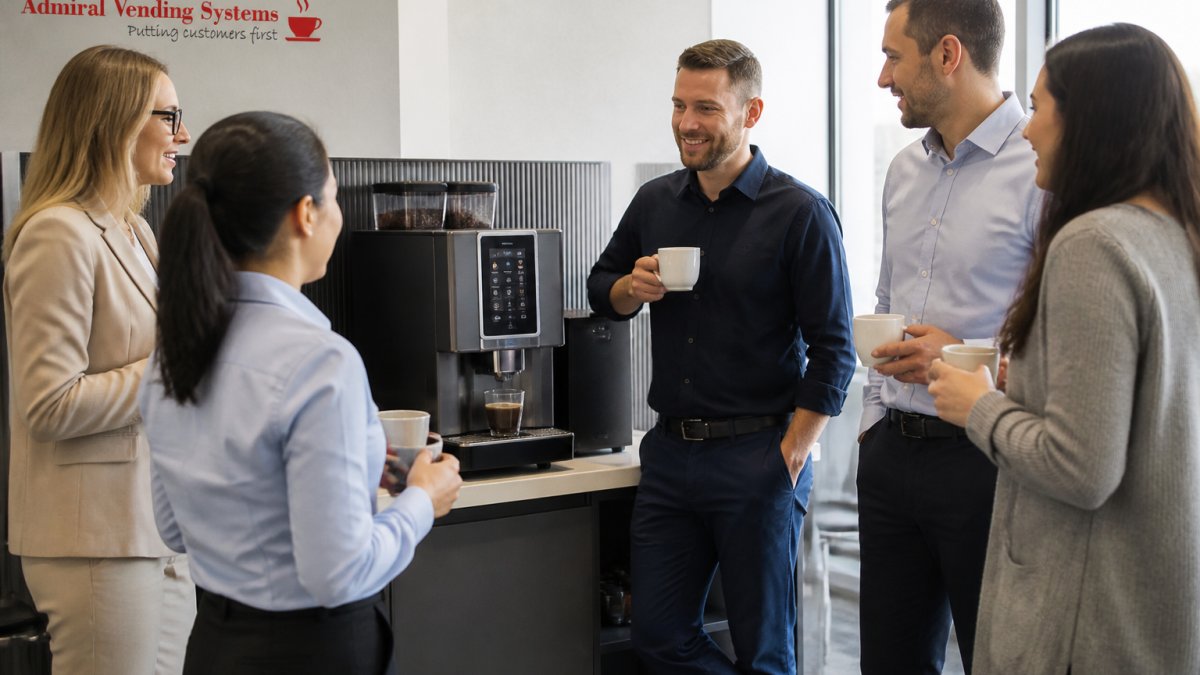
Machine capacity should match daily usage, not just team headcount. A 150-person office does not necessarily need a 500-cup machine if half the team brings coffee from home or visits external cafés. The practical approach is to estimate cups per day, then check peak demand and water or bean capacity before shortlisting.
Estimate daily cups
Start with a simple count. How many staff drink coffee or tea at work, and how many drinks each do they have? A common pattern is one to two hot drinks per person per day, with higher usage in offices that host clients or run long meetings. If 100 of 150 staff make one coffee daily, that is 100 cups needed. Add 20 percent for growth and peak periods, giving a target of 120 cups.
Check peak demand
Daily totals hide the morning rush. If most drinks are made between 8am and 10am, the machine must handle that window, not just the daily average. A machine rated at 200 cups per day may still queue if 60 of those cups are requested in 30 minutes. Look for the hourly output figure, sometimes listed as drinks per hour, and compare it with your busiest period.
Match water and bean capacity
A machine that makes great coffee but needs refilling every 40 cups creates work for staff. Check the water tank or direct water connection and the bean hopper size. Tabletop models often have 1.5 to 2 litre tanks and 250 to 500 gram hoppers. Floor-standing machines connected to mains water and drainage can run for hundreds of cups between refills. For teams above 50 people, mains-connected machines reduce daily maintenance.
Use a capacity guide
| Team Size | Daily Cups | Peak Demand | Recommended Machine | Machine Type |
|---|---|---|---|---|
| 20-50 | 40-80 | 20-30 per hour | 200-cup tabletop | Bean-to-cup compact |
| 50-100 | 80-150 | 30-50 per hour | 300-cup tabletop | Bean-to-cup standard |
| 100-250 | 150-300 | 50-80 per hour | 400-cup floor-standing | Bean-to-cup high-capacity |
| 250+ | 300-500+ | 80-120 per hour | 500-cup floor-standing | Bean-to-cup premium |
Undersizing creates queues and frustration. Match capacity to realistic demand, then add 20 percent for growth and peak usage periods.
Consider location and workflow
Usage patterns matter. Morning arrival typically sees peak demand. Afternoon slumps see lower usage. A machine sized for average daily usage handles morning peaks reasonably well if positioned accessibly.
Location affects usage. A machine in a central break area sees higher usage than one in a remote corner. Machines positioned near high-traffic areas like reception or meeting rooms attract more users. Visibility matters, staff use machines they see and remember.
Admiral Vending helps match machine capacity to your actual needs through AI-powered instant quoting and expert consultation. We analyse your team size, usage patterns, and workplace layout to recommend the right machine.
Conclusion
Workplace coffee machines improve morale, boost productivity, and enhance professional reputation. The right machine matches your team size, daily demand, and workplace type. Bean-to-cup machines deliver café-quality drinks for offices and showrooms. Vending machines suit high-volume, unattended environments. Espresso machines serve hospitality settings where quality and customisation matter.
Supplier selection determines long-term success. Choose a supplier with proven industry experience, strong customer ratings, and comprehensive support. Professional installation, operator training, and ongoing maintenance keep machines reliable and staff satisfied. Admiral Vending delivers eight years of industry experience, nationwide support, and expertly selected equipment that serves exceptional fresh hot drinks on demand.
Frequently Asked Questions
What type of coffee machine is best for an office?
The best choice depends on your team size and daily usage. Bean-to-cup machines deliver café-quality espresso, cappuccino, and latte drinks automatically, making them ideal for offices where quality and variety matter. For smaller teams under 40 people, compact tabletop models work well. Larger offices with 100+ staff benefit from high capacity or floor standing machines that can handle hundreds of drinks daily without queues. Espresso machines suit showrooms and hospitality settings where skilled operation is available.
Are bean to cup coffee machines suitable for small offices?
Yes. Compact tabletop bean-to-cup machines are specifically designed for smaller workplaces and meeting rooms. They grind fresh beans on demand, deliver consistent quality, and require minimal operator training. For offices with 20-50 staff, these machines eliminate the need for staff to leave the building for coffee, boosting morale and productivity. They take up minimal counter space and integrate easily into existing break areas.
How do I choose the right capacity coffee machine for my workplace?
Calculate your daily cup volume: multiply your team size by average drinks per person per day (typically 1-2 cups). A 150-person office might need 150-300 drinks daily. Tabletop machines suit 50-150 daily cups; floor standing machines handle 300+ cups. Consider peak times too, morning rushes demand faster service. A supplier with experience matching capacity to your specific business type can recommend the right model, preventing both undersizing (queues) and oversizing (wasted investment).
What should I look for in a commercial coffee machine supplier?
Prioritise suppliers with proven industry experience, nationwide service coverage, and a track record of reliability. Verify they offer professional installation, staff training, and ongoing maintenance support. Check whether they provide a complete solution including coffee supplies and spare parts. An instant quote system that understands your business type and team size saves time. Read customer reviews and ask about their response times for repairs, downtime directly impacts employee satisfaction.