Table of Contents
- How to Choose the Best Bean to Cup Machines for Offices
- Bean to Cup Machine Capacity Requirements: Matching Output to Your Team
- Office Coffee Machine Rental vs Purchase: Which Makes Sense?
- Commercial Coffee Machine Maintenance: Schedules, Descaling, and Service Contracts
- Total Cost of Ownership: Beyond the Upfront Price
- Troubleshooting Common Bean to Cup Machine Failures
- Sustainability and Waste Management in Office Coffee
- Conclusion
- Frequently Asked Questions
Last Updated: September 15, 2026
How to Choose the Best Bean to Cup Machines for Offices
Choosing the best bean to cup machines for offices comes down to three variables: daily drink volume, available space, and how much staff time you can spare on cleaning. This guide from Admiral Vending draws on eight years of supplying and installing commercial machines across workplaces of every size to break down what actually matters.
Most buying guides obsess over drink menus. Office managers should obsess over throughput and reliability instead, because a machine that makes a beautiful flat white but queues ten deep at 9am has failed at its one job.
Key Features That Matter in an Office Setting
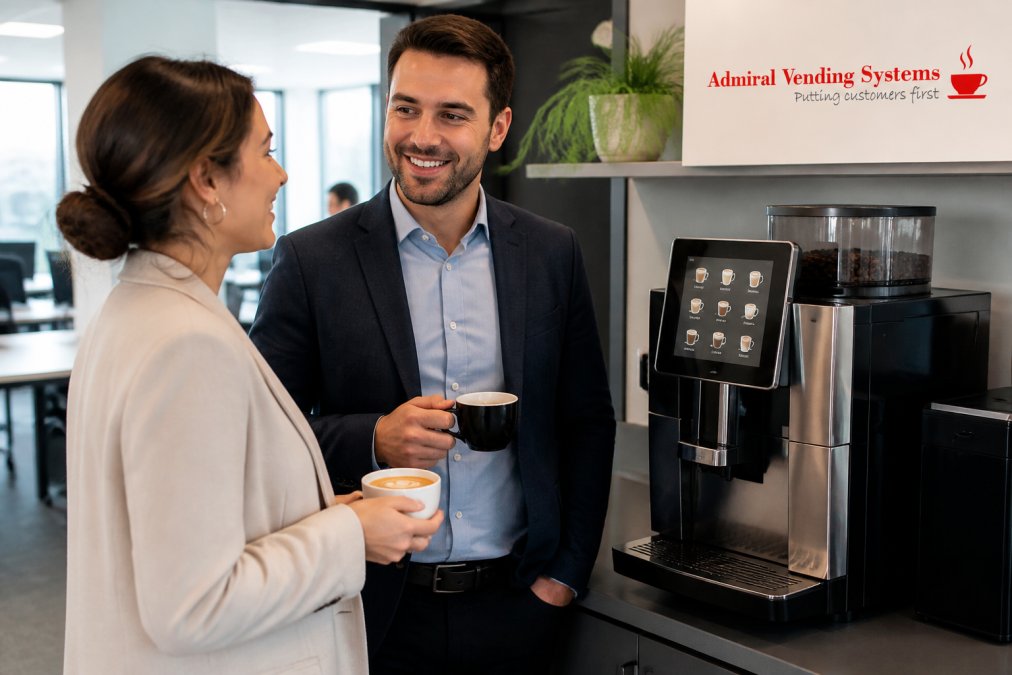
Grind size adjustment, milk frothing system, and brewing temperature control separate machines that cope with office life from those that do not. A fully automatic machine grinds fresh beans per drink, so consistency never depends on who is pressing the button.
Look for a touchscreen interface with coffee strength settings, a hot water dispenser for tea drinkers, and a cappuccino system that self-cleans. Barista quality matters less than repeatability when fifty people are making their own drinks.
Space, Plumbing, and Installation Requirements
Compact footprint models suit meeting rooms and smaller kitchens, while plumbed-in machines remove the need to refill a water tank mid-morning. Water tank models offer flexibility where plumbing is impractical, but someone has to top them up daily.
Check installation requirements early: ventilation, a nearby power supply, and a stable surface rated for the machine’s weight. A drip tray that pulls out fully makes cleaning far easier in a tight office kitchen layout.
Bean to Cup Machine Capacity Requirements: Matching Output to Your Team
Capacity is where most office coffee projects go wrong. A machine rated for a small team will buckle under showroom traffic, and an oversized unit wastes energy and counter space. The mistake is sizing on the daily average rather than the morning peak.
Daily Drink Volume and Peak Demand
Daily output capacity should be judged on peak demand, not averages. If 80 staff take coffee between 8:30 and 10:00, size for that window rather than the full day. A machine that claims 200 drinks a day may only manage 40 in a single hour once boiler recovery and grind time are factored in.
As a rule of thumb:
- Up to 50 drinks per day: compact tabletop models
- 50 to 150 drinks per day: higher capacity tabletop machines
- 150+ drinks per day: floor standing commercial machines
Recovery Time and Boiler Type
Recovery time is the spec most buyers overlook. After pulling a shot and steaming milk, a machine needs to return the boiler to temperature before the next drink. A single boiler machine may need 20 to 40 seconds between milk drinks; a twin boiler or thermoblock system can cut that to a few seconds (Best espresso machines 2026: expert-tested for all budgets). In a 50 person office with a 9am rush, that difference decides whether the queue clears in ten minutes or thirty.
Ask suppliers for the hourly throughput figure, not just the daily one. A machine rated for 150 drinks a day but only 30 an hour will fail a 60 person morning peak even though the daily number looks comfortable.
Worked Example: Sizing a 60 Person Office
Suppose 60 staff, 70 per cent of whom take one coffee before 10am. That is 42 drinks in a 90 minute window, or roughly one every two minutes. A machine with a 30 second recovery time can serve two drinks a minute in theory, but real world pauses for milk, cup changes and cleaning bring that closer to one a minute. A single boiler tabletop unit will fall behind; a twin boiler machine with a 60 drink hourly rating will cope with headroom. Size for the worst 90 minutes, then add 20 per cent.
Bean Hopper and Waste Bin Sizing
Bean hopper capacity and waste bin volume determine how often someone has to intervene. Small hoppers mean daily refills; larger hoppers and waste bins stretch that to several days, which matters in busy offices where nobody owns the coffee run. As a guide, a 1kg hopper covers roughly 120 to 140 single shots depending on dose, so a 60 person office will likely need a refill every two to three days. Consistent replenishment of these hoppers remains essential for maintaining flavor integrity, especially when sourcing high-quality small batch coffee to ensure every cup meets the expectations of a demanding workplace.
Match your waste bin volume to your busiest day, not your average one. A bin that fills by Thursday afternoon turns into a Friday morning problem.
Water Tank vs Plumbed In
A plumbed in machine removes the daily refill task entirely, which matters once you pass roughly 80 drinks a day (RR1177: Risk control for small pressure vessels: café boilers, bench-top autoclaves, and…). Tank models suit smaller sites or where plumbing is impractical, but someone must top them up daily and the tank becomes a bottleneck during peak demand. If your capacity calculation shows more than two tank refills a day, plan for a plumbed connection.
Office Coffee Machine Rental vs Purchase: Which Makes Sense?
Rental wins for most offices because it bundles maintenance, servicing, and supplies into one predictable arrangement, while purchase suits businesses with stable long-term premises and appetite for managing upkeep themselves.

The choice hinges on cash flow and risk appetite. Buying means a larger upfront outlay and full responsibility for breakdowns. Leasing options spread cost across the term and typically include a service contract, so a fault is someone else’s problem to fix.
For SMEs, rental also avoids the trap of an ageing machine that becomes uneconomical to repair. For larger sites with high footfall, ownership can pay off over several years if usage is genuinely predictable.
Commercial Coffee Machine Maintenance: Schedules, Descaling, and Service Contracts
Commercial coffee machine maintenance is not optional. Neglect it and you get scale buildup, clogged milk lines, and a machine that tastes off within weeks. The sections below cover the routine schedule, then the failure points that cause most callouts, so an office manager can fix the common issues before booking an engineer.
Daily and Weekly Cleaning Routines
Daily tasks cover rinsing the drip tray, emptying the waste bin, and running the automatic rinse cycle. Weekly, clean the milk frothing system thoroughly and wipe down the brewing unit. A maintenance schedule pinned near the machine keeps staff accountable. Assign an owner; shared responsibility usually means no responsibility.
Descaling Cycles and Water Filtration
Descaling cycles remove limescale from the boiler and pipework, and hard water areas need them more often. Water filtration is the cheapest insurance against premature failure. In hard water areas, descale every two to three months; in soft water areas, every four to six months is usually enough (the NHS). A filter cartridge typically needs changing every three to six months depending on volume and water hardness.
Skipping descaling is the single most common cause of machine failure we see. Scale restricts flow, overheats components, and turns a routine service into a costly repair.
Troubleshooting Common Failure Points
Most callouts trace back to a short list of causes. Working through these before booking an engineer saves downtime and callout charges.
Weak or watery coffee. Usually a grind size adjustment is overdue, the beans are stale, or the group is clogged. Adjust the grind one step finer, check the bean roast date, then run a cleaning cycle on the group.
Machine will not heat or cuts out mid drink. Almost always scale on the element or a tripped thermal cutout. Descale, then reset the cutout if the machine has one.
What a Service Contract Should Cover
Train one or two staff as machine champions. Most callouts we attend are user fixable issues that a confident operator resolves in minutes.
Total Cost of Ownership: Beyond the Upfront Price
Troubleshooting Common Bean to Cup Machine Failures
Train one or two staff as machine champions. Most callouts we attend are user-fixable issues that a confident operator resolves in minutes.
Sustainability and Waste Management in Office Coffee
Conclusion
Frequently Asked Questions
What is the best bean to cup coffee machine for a small office?
For a small office of up to 30 people, a compact tabletop bean to cup machine with a 1.5 to 2 litre water tank and a 250g bean hopper usually works well. Look for one-touch milk frothing, a removable drip tray, and simple descaling. Machines with a smaller footprint fit easily on a kitchen counter. Admiral Vending supplies tabletop models designed for smaller offices and meeting rooms, with options that balance capacity against space.
How many cups per day should an office coffee machine handle?
As a rule, plan for 3 to 5 drinks per person per day. A 50-person office might need 150 to 250 drinks daily, so choose a machine rated for at least 200 cups. For 100 or more people, a floor-standing commercial bean to cup machine with a high daily output capacity and large waste bin is more reliable. Admiral Vending’s range includes models for lower volumes through to hundreds of drinks per day.
What maintenance is required for office bean to cup machines?
Daily tasks include emptying the drip tray and waste bin, rinsing the milk system if used, and wiping the steam wand. Weekly cleaning involves running the automatic rinse cycle and cleaning the brew group. Descaling is needed every 2 to 3 months depending on water hardness, and water filters should be changed as recommended. A service contract covers annual or bi-annual professional servicing, including seals and grinder checks.
Do I need a plumbed-in coffee machine for my office?
A plumbed-in machine connects directly to your water supply, so you never refill a tank. It suits offices with 50 or more daily coffee drinkers and where a water line is accessible. For smaller offices or rented spaces without plumbing, a machine with a removable water tank is simpler to install. Admiral Vending offers both plumbed-in and tank-fed commercial bean to cup machines, with professional installation available.