Last Updated: November 7, 2026
Quick Summary
Commercial coffee equipment electrical requirements depend on the machine type: instant machines often run on a standard socket, bean to cup models sit mid range, and traditional espresso machines with large boilers draw the most power. Always check the manufacturer specification sheet for exact wattage, voltage, amperage and connection type before ordering.
- Convert watts to amps using amps = watts ÷ voltage; a 3,000 watt machine on 230 volts draws roughly 13 amps.
- Use simultaneous demand, not connected load, when comparing total amps against the main fuse rating.
- A dedicated circuit needs a breaker and cable sized to the machine’s current draw with appropriate headroom.
- Smaller bean to cup models drawing under about 10 amps may run on an existing socket circuit with spare capacity.
- Confirm supply type, circuit rating and connection point with a qualified electrician before the machine arrives.
Table of Contents
- Why Commercial Coffee Equipment Electrical Requirements Decide Your Machine Choice
- Wattage, Voltage and Amperage Ranges by Machine Type
- Single-Phase Versus Three-Phase Supply for a Commercial Coffee Machine
- Commercial Coffee Machine Installation Requirements on Site
- Does a Commercial Coffee Machine Need a Dedicated Circuit?
- Commercial Coffee Machine Plug or Hardwire: Which Connection Fits Your Site
- A Coffee Machine Pre Installation Checklist for Facilities Managers
- Get Your Machine Spec Checked Before You Order
- Frequently Asked Questions
Why Commercial Coffee Equipment Electrical Requirements Decide Your Machine Choice
Get the electrical requirements for commercial coffee equipment wrong and the machine you ordered may not run at all.
Commercial coffee equipment draws significant power because it heats water fast and grinds beans on demand.
Below, we explain how to read a specification sheet, work out your supply, and confirm the site is ready before you order. We also cover what to do when the existing supply falls short.
Wattage, Voltage and Amperage Ranges by Machine Type
Power draw varies widely by machine type. A compact tabletop model suits a small office, while a high output floor standing machine draws far more current and needs a stronger supply.
As a general guide:
- Instant coffee machines tend to draw the least power and often run on a standard socket
- Bean to cup machines sit mid range, with compact models drawing less than high capacity units
- Traditional espresso machines with large boilers draw the most, especially during heat up
Voltage in commercial premises is standard single phase mains. Three phase supply delivers more capacity for heavy equipment.
If you want to check whether a bean to cup machine’s capacity and power draw suits your site, see our guide to bean to cup machine capacity requirements.
How to Read a Manufacturer Specification Sheet
The specification sheet is the single most useful document in this process. It lists the rated wattage, voltage, amperage and connection type for that exact model.
Read it in this order:
- Find the rated power in watts or kilowatts
- Note the voltage and whether it is single or three phase
- Check the amperage or current draw
- Confirm the connection type: plug or hardwired
- Look for any note on dedicated circuit requirements
A common mistake is reading the wattage and ignoring the connection type. A machine can look modest on paper but still need a hardwired supply.
Power draw varies widely by machine type, so match the model to your supply.
| Machine type | Power draw | Note |
|---|---|---|
| Instant coffee machines | Least power | Often run on a standard socket |
| Bean to cup machines | Mid range | Compact models draw less than high capacity units |
| Traditional espresso machines | Most power | Especially during heat up with large boilers |
| Floor standing vending machines | More overall | Combine brewing, refrigeration and sometimes payment systems |
Single-Phase Versus Three-Phase Supply for a Commercial Coffee Machine
Single phase supply is what most offices and small sites have. It delivers power over two wires and suits compact and mid range bean to cup machines, which plug into a standard socket or a dedicated circuit.

The practical rule is to match the machine to the supply you actually have, not the one you wish you had. But that rule only works if you know what your existing supply can carry.
How to Calculate Whether Your Supply Can Carry the Machine
A commercial coffee machine rarely runs alone. On the same distribution board you may have grinders, refrigeration, a dishwasher, a microwave, and general socket circuits.
Work through this calculation with your electrician:
- List every appliance that will run at the same time as the coffee machine. Include grinders, fridges, dishwashers, water boilers, and any other equipment on the same distribution board.
- Note the rated wattage of each from its specification plate or manual.
- Convert watts to amps using the formula: amps = watts ÷ voltage. On a 230 volt single phase supply, a 3,000 watt machine draws roughly 13 amps.
- Add the amps together to get the simultaneous demand. This is not the same as adding every appliance in the building, only those likely to run together.
- Compare that total against the rating of the main fuse or circuit breaker supplying the area. A standard single phase office supply often has a 60 amp or 100 amp main fuse. If your simultaneous demand approaches that figure, you have little headroom.
A common pattern is a site with a 100 amp single phase supply where the existing load already sits at 70 to 80 amps.
Watch out: adding up the wattage of every appliance on site and comparing it to the main fuse will overstate the load, because not everything runs at once.
What to Do When the Supply Falls Short
If the calculation shows the supply cannot carry the machine you want, you have three realistic paths:
- Choose a lower draw model. A compact bean to cup machine on a 13 amp plug may deliver the drink quality you need without touching the supply.
- Arrange an electrical upgrade. A qualified electrician can assess whether the supply can be upgraded, for example from single phase to three phase, and what that involves in terms of cabling, metering, and disruption. This adds cost and lead time, so start early.
- Confirm an approved alternative with the manufacturer. Some machines have a lower power mode or a different element configuration for sites with limited supply. Ask the manufacturer before you assume the model is unsuitable.
If your site has three phase available, larger machines become an option. If it does not, you are limited to single phase models unless you upgrade. To see which floor standing machines are available, view our range of floor standing coffee machines for commercial use.
Commercial Coffee Machine Installation Requirements on Site
Good commercial coffee machine installation requirements start with the electrical assessment, not the delivery date. Confirming the supply and connection point early also makes it easier to distinguish a coffee machine’s needs from the electrical infrastructure requirements of other equipment sharing the site.
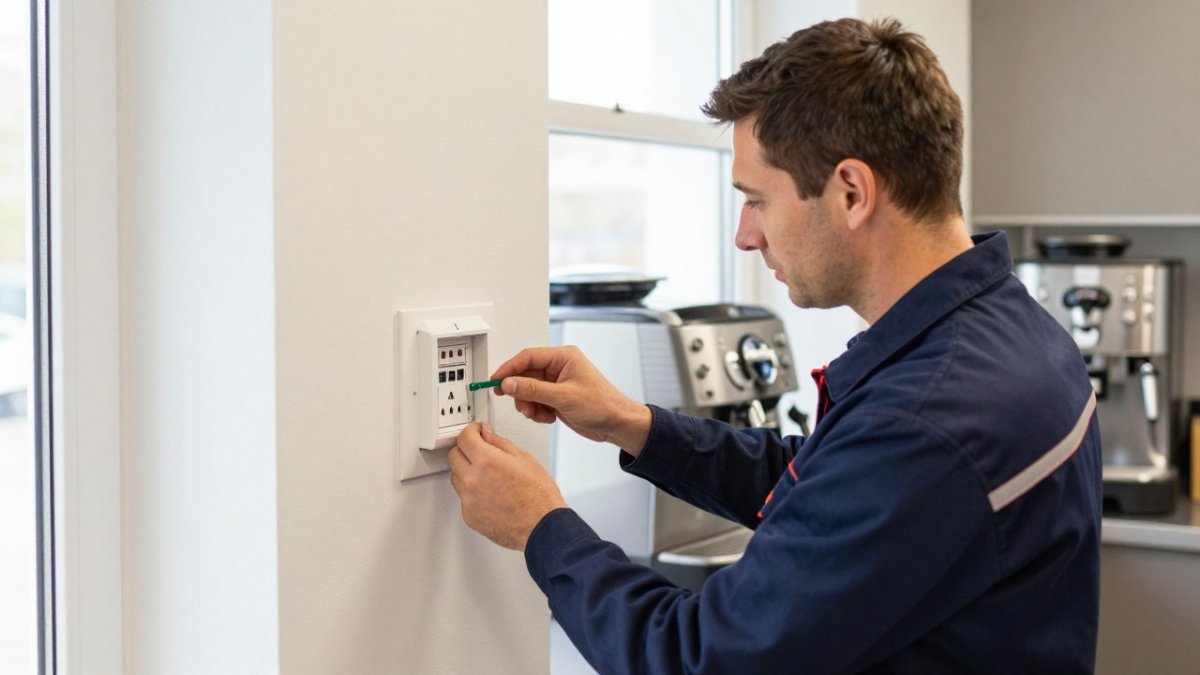
Work through these site checks:
- Confirm the supply type matches the machine
- Check the socket or connection point is within reach of the machine’s cable
- Verify the circuit can carry the machine’s current draw
A qualified electrician should carry out the electrical assessment. For practical installation guidance on a vending machine before you commit to a survey, read how to install an office coffee vending machine.
Does a Commercial Coffee Machine Need a Dedicated Circuit?
A commercial coffee machine often needs a dedicated circuit, meaning a circuit used only by that machine. High draw equipment should not share a circuit with other appliances, because combined load can overload it. But whether your machine needs one depends on its amperage and your site’s wiring, and the detail behind that answer is where most guides stop short.
What a Dedicated Circuit Actually Involves
A dedicated circuit is not just a spare socket. It is a circuit run from the distribution board to the machine’s connection point, with its own protective device (a circuit breaker or fuse) sized to the machine’s current draw, and cable rated to carry that current over the run length.
For a machine drawing 13 amps, a dedicated circuit would typically use a 16 amp or 20 amp breaker and cable rated for at least 16 amps.
Your electrician will confirm three things:
- The breaker rating matches the machine’s current draw with appropriate headroom
- The cable size is adequate for the run length and installation method (cable buried in insulation carries less current than clipped direct)
- The protective device type is suitable for the machine’s start-up characteristics, since heating elements can draw a brief surge
A common mistake is sizing the breaker to the machine’s rated current exactly, with no margin.
When a Shared Circuit Is Acceptable
Smaller bean to cup models drawing under about 10 amps may run happily on an existing socket circuit, provided the circuit has spare capacity and the machine is not competing with high draw appliances at the same time. A machine on a circuit shared with a dishwasher and a water boiler is asking for trouble. A machine on a circuit shared with a few low draw items is usually fine.
Ask your electrician to confirm the circuit rating against the machine’s current draw and the other loads on that circuit. If the machine is hardwired, the circuit and protection must be sized to suit it, and the circuit should be dedicated.
Watch out: a socket circuit that looks spare may already be loaded by equipment you have forgotten about, such as hand dryers, space heaters, or cleaning equipment. Your electrician should test the actual load, not just count the sockets.
Commercial Coffee Machine Plug or Hardwire: Which Connection Fits Your Site
Plug or hardwire comes down to the machine’s power draw and the manufacturer’s instructions. Lower draw machines usually come with a plug for a standard socket.
Plug connection is simpler. It needs a suitable socket, ideally on its own circuit, and no fixed wiring work.
The manufacturer’s specification sheet states which connection the model requires. Do not swap one for the other without advice.
A Coffee Machine Pre Installation Checklist for Facilities Managers
A coffee machine pre installation checklist keeps the project on schedule. Facilities managers who run through it early avoid the delays that come from discovering a supply problem on installation day.
- Machine model and specification sheet confirmed
- Supply type checked: single or three phase
- Circuit rating confirmed by a qualified electrician
For a broader buyer’s guide to confirm the machine type and setup before ordering, see our coffee machine for business buyer’s guide.
Get Your Machine Spec Checked Before You Order
The electrical requirements for commercial coffee equipment are the most common reason a workplace coffee project stalls. A machine that suits your staff but not your supply is no use to anyone.
At Admiral Vending, we supply commercial bean to cup coffee machines to businesses across the UK, with eight years of industry experience and nationwide support. We help you match the machine to your site, handle professional installation, train your operators and provide ongoing service and coffee supplies. Our AI powered instant quote system makes it simple to start.
Get your machine spec checked before you order. If you are ready to request a quote and want to start that process online, see how to get a coffee machine quote online for your office.
A workplace coffee setup only works when the machine, the supply and the site all match.
Frequently Asked Questions
What electrical supply does a commercial coffee machine need?
It depends on the machine type. Compact tabletop bean to cup models often run on a standard 230V single-phase supply, while higher-output and floor-standing commercial coffee machines may need a higher amperage single-phase circuit or a three-phase supply. Always check the manufacturer specification sheet for the exact wattage, voltage and current draw, then have a qualified electrician confirm your site can deliver it before you order.
Do commercial coffee machines need a dedicated circuit?
Most commercial machines should have their own dedicated circuit. A commercial coffee machine dedicated circuit stops the machine sharing demand with kettles, dishwashers or fridges, which is what causes nuisance tripping. The circuit rating, cable size and protective device must be sized to the machine’s current draw and the length of the cable run, so this is a job for a qualified electrician working from the specification sheet.
Can a commercial coffee machine plug into a standard socket?
Some smaller tabletop models can, where the manufacturer supplies a plug and the current draw stays within the rating of a standard socket circuit. Larger machines usually need a higher-rated connection or a hardwired supply. Never assume a 13A socket will cope with a commercial machine just because the plug fits. Check the specification sheet and let an electrician confirm the circuit can carry the load.
What should I check before installing a commercial coffee machine?
Work through the coffee machine pre installation checklist: confirm the machine’s wattage and current draw, confirm the supply type and voltage, check a suitable circuit is available or can be installed, agree socket or hardwire connection, plan the counter position and clearance, and confirm the water supply and drainage if the machine needs it. Give the specification sheet to your electrician early so any supply upgrade is priced before installation day.