Table of Contents
- Automatic vs Manual Coffee Machines for High Footfall: The Core Difference
- Commercial Coffee Machines for Busy Offices: Matching Capacity to Daily Volume
- Bean to Cup vs Traditional Espresso Machines: Which Handles Peak Demand Better
- Automatic Coffee Machine Capacity: What Output Really Looks Like at Peak Hours
- Staffing, Training and Workflow in High Footfall Venues
- Commercial Coffee Machine Maintenance: Downtime, Servicing and Reliability
- Cost per Cup and Total Cost of Ownership
- Frequently Asked Questions
Automatic vs Manual Coffee Machines for High Footfall: The Core Difference
Choosing between automatic and manual coffee machines for high footfall settings comes down to one question: who makes the coffee, and how fast? At Admiral Vending, we have spent eight years fitting commercial bean to cup machines into busy offices, showrooms and factory floors, and the pattern is consistent. Automatic machines grind, dose and extract at the press of a button. Manual and semi-automatic espresso machines put every step in the operator’s hands.
That single distinction drives everything else: speed, consistency, training time, staffing and cost per cup. Below, we compare the two approaches across the factors that actually decide whether a busy site copes at 9am or queues out of the door. The automatic vs manual coffee machines for high footfall decision rarely hinges on coffee romance. It hinges on throughput.
For most high footfall sites, the deciding factor is not which machine makes better espresso. It is how many drinks you can serve per hour without a trained operator standing at the machine.
Commercial Coffee Machines for Busy Offices: Matching Capacity to Daily Volume
Capacity planning starts with honest daily volume, not headcount. A site with 150 people does not need 150 drinks; it needs enough capacity to clear the morning rush without a queue forming. We advise counting drinks at peak hour, not across the day, because peak demand is what breaks a machine’s recovery time.
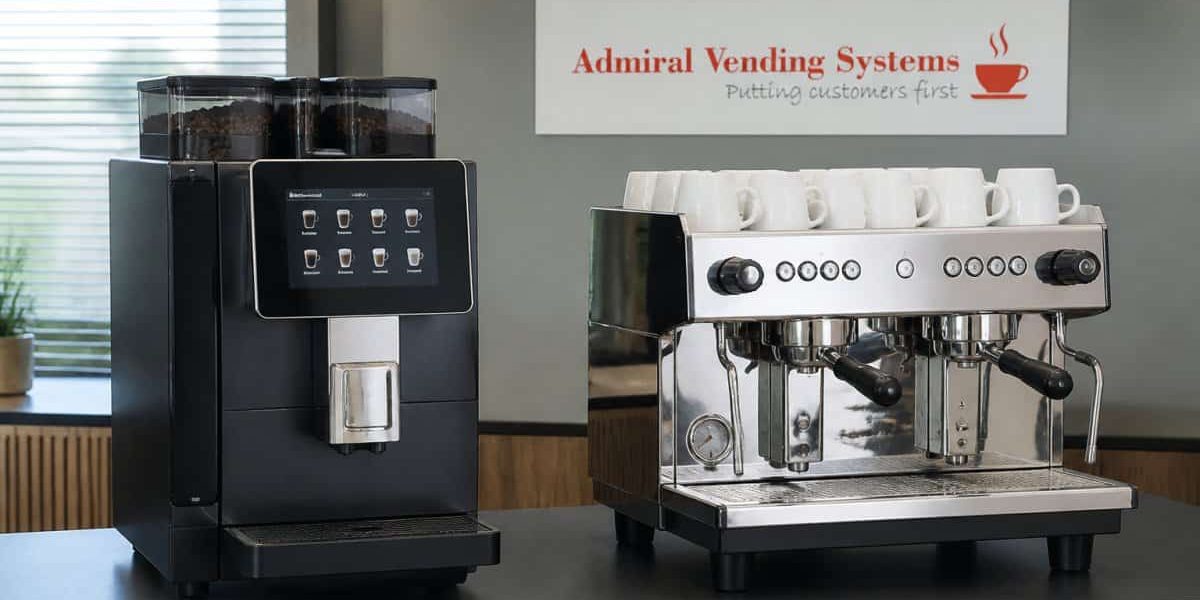
Bean to cup machines grind fresh beans on demand and handle a wide drink menu, from espresso and americano to cappuccino, latte and hot chocolate. Traditional espresso machines rely on the operator to grind, dose, tamp and steam milk for each drink. Filter and instant systems sit at the low-effort end but limit drink customisation.
| Machine type | Operator effort | Consistency | Best for |
|---|---|---|---|
| Bean to cup (automatic) | Push-button | High, recipe-locked | Busy offices, showrooms, high footfall |
| Semi-automatic espresso | Hands-on per drink | Depends on barista skill | Coffee shops with trained staff |
| Traditional espresso | Fully manual | Varies with operator | Low-volume, quality-led venues |
| Filter/instant | Minimal | Moderate | Small teams, low daily volume |
Bean to Cup vs Traditional Espresso Machines: Which Handles Peak Demand Better
Bean to cup wins on peak demand in almost every high footfall setting, but the useful comparison is not a slogan about speed. It is a worked peak period. Take a site that serves 120 drinks between 8am and 10am, with 70 of them landing in the 8:30 to 9:15 window. That is the shape of demand that decides whether a machine copes.

On a traditional espresso machine, one operator is tied to the group head for each drink: grind, dose, tamp, lock in, extract, purge, steam milk, pour, wipe. A practised barista can hold a rhythm on simple drinks, but milk based orders stretch the cycle because steaming runs alongside extraction and the pitcher has to be cleaned between rounds.
On a bean to cup machine, the same sequence happens inside the casing while the operator serves the next person. Grind size, dose, extraction time and milk volume are set once as a recipe and repeated. Recovery time between drinks stays short and predictable, so the queue clears at a steady rate rather than in lurches. The practical effect at peak is that one person can keep the machine fed, restock cups and milk, and still serve a continuous line.
| Peak factor | Bean to cup (automatic) | Traditional espresso (manual) |
|---|---|---|
| Operator time per drink | Seconds to select and serve | Tens of seconds to minutes, depending on drink |
| Recovery between drinks | Short and consistent, recipe locked | Variable, driven by operator pace and milk steaming |
| Queue behaviour at peak | Steady, predictable clearing | Bursty, sensitive to order complexity |
| People needed at the machine | One, and often none once trained | One dedicated operator per drink in progress |
| Effect of an untrained cover | Minimal, recipe holds | Quality and speed both drop |
Traditional espresso still earns its place. In a coffee shop with skilled baristas and a queue that expects theatre, hands on operation delivers a drink a machine cannot quite match, and the operator can react to a difficult order in a way a locked recipe cannot.
The honest test is to watch your own busiest fifteen minutes. Count how many drinks leave the counter, how long the queue is at its worst, and how many people are involved. If the answer is one person and a queue that clears without stress, a bean to cup machine will hold that pattern as volume grows.
If your site has no dedicated barista and coffee is a perk rather than a product, a bean to cup machine removes the biggest source of user error at peak: an untrained operator rushing at 9am while the queue watches.
Automatic Coffee Machine Capacity: What Output Really Looks Like at Peak Hours
Automatic coffee machine capacity is best judged by drinks per hour at peak, not by the number on the spec sheet. The spec sheet describes an ideal cycle; a busy site describes a queue. The gap between the two is where most capacity plans fail.
A useful way to model it is to think in terms of the peak quarter hour rather than the day. If 40 people arrive between 8:30 and 8:45 and each wants a milk based drink, the question is not whether the machine can make 160 drinks in a day. It is whether it can clear 40 drinks in fifteen minutes without the queue backing into the corridor. That depends on three things: the time each drink occupies the machine, the time the operator spends on each customer, and how quickly the machine recovers between orders.
On a bean to cup machine, the drink cycle runs internally while the operator handles payment, cups and the next person. Because the recipe is locked, the cycle time is consistent, so the queue clears at a predictable rate. On a traditional machine, the operator is part of the cycle, and milk steaming becomes the bottleneck when several lattes land at once. The machine may be capable of the volume, but the person is not, and the queue reflects the person.
Capacity planning by venue type is where this becomes practical:
- Offices and workplaces: demand is concentrated into a short morning window and a smaller afternoon bump. A countertop bean to cup machine with a modest hourly output usually clears the morning rush, provided it is restocked before the peak rather than during it.
- Cafés and coffee led sites: demand is spread across the day but order complexity is higher. A floor standing bean to cup model protects throughput on simple drinks, while a traditional machine alongside it handles the orders that need a barista’s judgement.
- Hotels and hospitality: demand arrives in waves around breakfast and events. Capacity should be sized to the wave, not the average, and a second machine or a larger bean hopper often matters more than a faster single unit.
- Self service locations: the machine is the operator. Clear interfaces, simple drink selection and reliable milk options matter more than raw output, because a confused customer at the screen is a queue forming behind them.
Machine capacity is only half the story; the other half is how many people it takes to run it and what happens when it stops. A machine that clears the peak but needs an engineer for two days when a grinder fails has not solved the capacity problem, it has deferred it. For sites needing hundreds of drinks a day, a floor standing bean to cup model with a planned service contract and a clear downtime plan keeps throughput predictable through the morning rush and through the week the machine is unavailable.
Size capacity to your busiest quarter hour, not your daily average, and plan for the day the machine is down as carefully as the day it is busy.
Staffing, Training and Workflow in High Footfall Venues
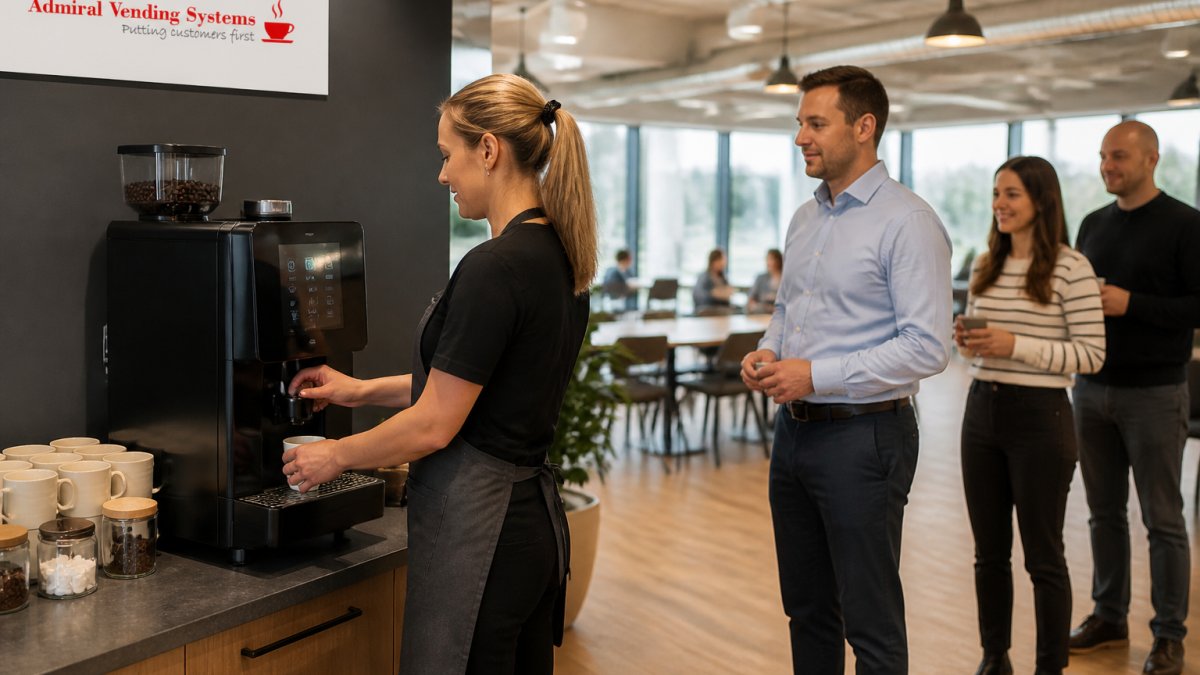
Staffing is where the two approaches diverge most sharply. A bean to cup machine needs minutes of training, not days. Staff press a button, select a drink and serve. That means anyone on shift can cover the machine, and workflow does not collapse when the usual person is off.
Manual and semi-automatic machines demand barista skill: grind size, dose, tamping pressure, extraction timing and milk frothing all affect the cup. In a high footfall venue, that skill requirement becomes a staffing constraint. You cannot let an untrained colleague cover a break, and consistency depends on who is standing at the machine. Labour requirements rise, and so does user error.
Commercial Coffee Machine Maintenance: Downtime, Servicing and Reliability
Reliability decides whether a busy site keeps serving. Automatic machines have more components, so planned servicing matters, but their cleaning cycles are largely automated and daily care is simple. Traditional machines need more hands-on cleaning and backflushing, and a missed routine shows up quickly in coffee quality.
Downtime planning is the angle most buyers overlook. Ask what happens when a machine stops: how fast can an engineer attend, and is there a loan unit? At Admiral Vending, nationwide support and ongoing service cover sit alongside installation and operator training. Build servicing into the plan from day one, whatever machine type you choose.
Cost per Cup and Total Cost of Ownership
Cost per cup is not the purchase price divided by drinks. It is beans, milk, cups, energy, servicing, labour and downtime, spread across daily volume. Manual machines look cheaper to buy but carry a hidden labour cost: every drink consumes operator time, and that time has a wage attached.
Automatic machines often cost more upfront, yet they reduce operator involvement and waste, because the recipe is fixed and drinks are consistent. Higher daily volume spreads the purchase cost thinner, so cost per cup falls as throughput rises. We always ask buyers to model total cost of ownership over three years, not just the invoice. Pricing depends on machine, volume and support package, so ask for a quote rather than guessing.
Frequently Asked Questions
Are automatic coffee machines better than manual machines for high footfall?
For most high footfall settings, automatic coffee machines are the more practical choice. They grind, dose and extract at the touch of a button, so staff without barista training can serve consistent drinks quickly. Manual and traditional espresso machines rely on hands-on skills such as grinding, dosing, tamping and milk steaming, which slows service when queues build. The trade-off is that automatic machines cost more upfront and need planned servicing, but the speed and consistency usually justify it in busy offices, showrooms and hospitality venues.
How many coffees can an automatic coffee machine make per day?
Output depends on the model and its capacity. Compact tabletop bean to cup machines suit lower daily volumes, while higher capacity tabletop and floor standing models are built for hundreds of drinks per day in busy workplaces. When planning, look at peak-hour demand rather than the daily total, because recovery time between drinks and milk system performance decide queue length. Ask your supplier to match machine capacity to your busiest period, not just your average daily volume.
Do automatic coffee machines need more maintenance than manual machines?
Automatic machines have more components, including grinders, brew units and milk systems, so they need regular cleaning cycles and scheduled servicing. Manual machines need daily cleaning and skilled operation, and faults often trace back to user error. In high footfall venues, planned commercial coffee machine maintenance matters most: a servicing agreement with a defined response time keeps downtime short. Daily rinse and clean routines, plus descaling on schedule, prevent most avoidable breakdowns.
What should a business consider when choosing a coffee machine for high footfall?
Start with peak-hour throughput and queue time, then weigh labour requirements, staff training, drink customisation and the drink menu you want to offer. Check the machine’s recovery time, milk system, water and power requirements, and the supplier’s service response. Also compare total cost of ownership, including purchase, consumables and servicing, rather than purchase cost alone. A supplier with installation, operator training and nationwide support makes the switch easier for busy sites.
High footfall exposes weak coffee setups fast. If your site needs consistent drinks, minimal training and predictable throughput, a commercial bean to cup machine from Admiral Vending is the practical choice. Our range covers compact tabletop models through to floor standing machines built for hundreds of drinks a day, backed by professional installation, operator training and nationwide service support. Get your instant quote and see which machine fits your daily volume.