
Last Updated: November 2, 2026
Quick Summary
To improve office coffee, work through the cheapest fixes first: taste the water, check the bean date, check the grind, run a cleaning cycle and watch how people use the machine. Stale beans are the number one cause of dull office coffee, and filtered water is the single biggest upgrade most offices can make.
- Beans lose their aroma within weeks of roasting, and pre-ground coffee fades even faster.
- Store beans in an airtight container away from light, heat and moisture, and never in the fridge or freezer.
- Whole-bean coffee beats pre-ground because the oils and aromas stay locked inside the bean.
- Wipe the steam wand and drip tray daily, and deep clean and backflush weekly.
- Measure drinks made per week and outside coffee runs before and after the upgrade.
Table of Contents
- Why Does Office Coffee Taste Bad? A Step-by-Step Diagnosis
- How to Store Coffee Beans at Work
- Grind Fresh: Why Whole-Bean Coffee Beats Pre-Ground
- Water Quality and Brewing Variables That Change the Taste
- Office Coffee Machine Cleaning: A Simple Weekly Schedule
- Choosing a Bean to Cup Coffee Machine for Office Use
- Measuring Whether Your Coffee Upgrade Worked
- Get Your Instant Quote from Admiral Vending
- Frequently Asked Questions
Why Does Office Coffee Taste Bad? A Step-by-Step Diagnosis
Most office coffee problems come down to one of five things: stale beans, the wrong grind, poor water, a dirty machine, or bad storage. Work through them in that order and you will usually find the culprit before you spend a penny on new equipment.
This guide sets out how to improve office coffee in a way that lasts. Here is how to diagnose a bad brew.
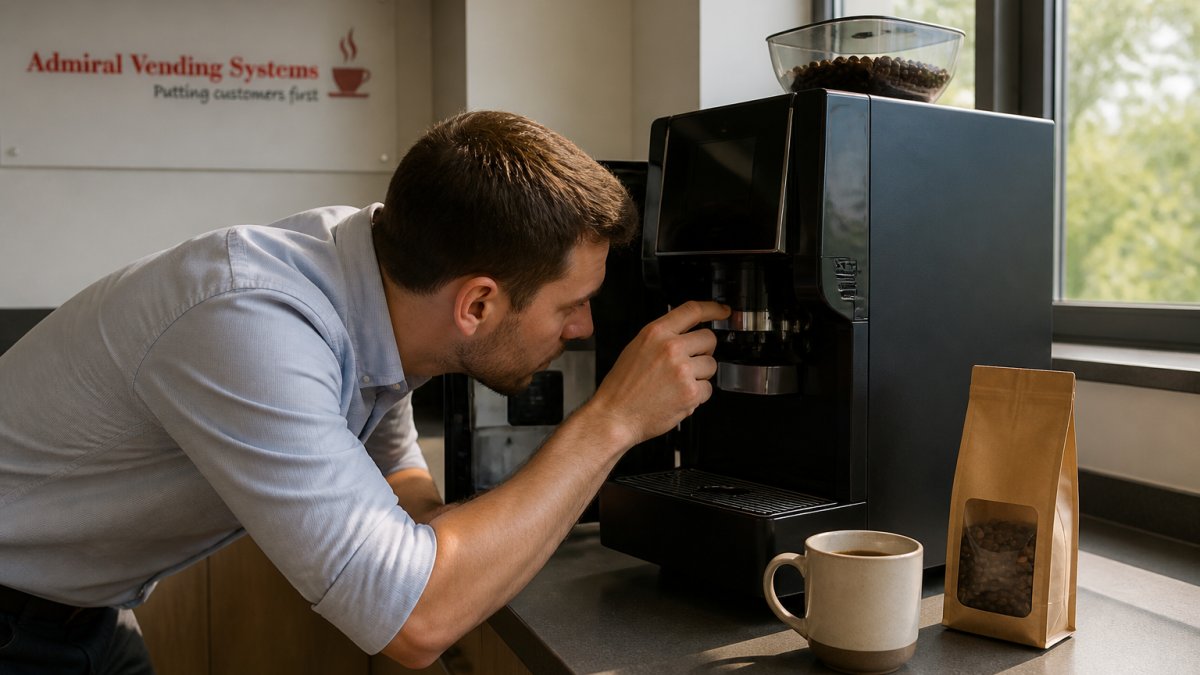
Start with the cheapest fixes first:
- Taste the water on its own. If it tastes odd, the coffee will too.
- Check the bean date. Anything past its best-before window will taste flat.
- Look at the grind. Too fine and it turns bitter, too coarse and it tastes weak.
- Run a cleaning cycle. Old oils and scale ruin flavour fast.
- Watch how people use the machine. Wrong settings get pressed every day.
Check the beans first
Stale beans are the number one cause of dull office coffee. Beans lose their aroma within weeks of roasting, and pre-ground coffee fades even faster. A common mistake is buying in bulk to save money, then leaving the surplus sitting in a warm cupboard for months.
Check the water and the machine
Hard water leaves scale inside the boiler and pipework, which dulls the taste and slows the machine. Old coffee oils in the brewing path turn rancid (How much of an impact does equipment condition actually have on coffee quality?). If nobody has descaled the kit in months, that alone can explain a bitter cup.
How to Store Coffee Beans at Work
Store coffee beans in an airtight container, away from light, heat and moisture, and use them within a few weeks of opening. How to store coffee beans matters more than most offices realise, because a good bean spoils quickly once the bag is open.
The mechanism is straightforward: once roasted beans meet oxygen, the volatile oils that carry aroma begin to oxidise, and moisture accelerates the process. Heat speeds it up further. That is why a bag left open beside a radiator or a sunny window tastes flat within days, while the same beans kept sealed and cool stay lively for weeks.
A practical office routine looks like this:
- Buy smaller bags more often, sized to your weekly consumption rather than a quarterly bulk order
- Keep beans in the original sealed bag with the valve, or decant into an airtight tin that blocks light
- Store away from the kettle, radiator, window and any heat-generating equipment
- Never keep beans in the fridge or freezer, where condensation and food odours contaminate them
- Label the opening date on the bag or tin so nobody uses old stock
- Keep a small scoop in the container rather than tipping the bag directly into the hopper
Watch out: tipping beans into an open hopper and leaving them there for a fortnight is a slow way to waste money, because the hopper exposes beans to light and air every time the machine runs. Fill the hopper little and often, and keep the reserve sealed.
For shared kitchens, the biggest risk is not the storage method but the handover. A simple label with the roast date and the opening date gives everyone a clear signal about what is fresh and what should be used first. Rotate stock so older bags sit at the front, and agree who checks the hopper each week.
Grind Fresh: Why Whole-Bean Coffee Beats Pre-Ground
Whole-bean coffee beats pre-ground because the oils and aromas stay locked inside the bean until the moment you grind. Freshly ground coffee releases those flavours into the cup, while pre-ground coffee has already lost much of them by the time it reaches your kitchen.

Grind size has to match the brew method. A hand grinder or a machine with a built-in grinder gives you control. For most offices, a bean to cup machine that grinds on demand is the practical answer, because it removes the guesswork and keeps every cup consistent.
Water Quality and Brewing Variables That Change the Taste
Filtered water is the single biggest upgrade most offices can make. Water makes up almost all of the cup, so any chlorine, hardness or off-note carries straight through into the flavour.
Three variables decide how the cup tastes:
- Water: filtered, fresh and free of scale
- Coffee-to-water ratio: too little coffee tastes weak, too much tastes harsh
- Water temperature: too cool under-extracts, too hot scorches
If you run a large or busy site, our guide on how to improve coffee quality in high volume sites covers the extra pressures that come with hundreds of drinks a day.
Office Coffee Machine Cleaning: A Simple Weekly Schedule
Office coffee machine cleaning is the habit that protects flavour, and it takes minutes rather than hours. Most bad coffee in shared kitchens traces back to skipped cleaning, not cheap beans.
| Task | How often | Time needed |
|---|---|---|
| Wipe the steam wand and drip tray | Daily | 2 minutes |
| Rinse the group head and flush the system | Daily | 3 minutes |
| Clean the milk system | Daily | 5 minutes |
| Deep clean and backflush | Weekly | 15 minutes |
| Descale | As the machine advises | 30 minutes |
For the full method, follow our 7 steps to clean office coffee machines properly. It walks through each stage so anyone on the team can do it.
Choosing a Bean to Cup Coffee Machine for Office Use
A bean to cup coffee machine for office use should match your headcount, your daily drink volume and the space you have. Buy for the demand you actually have, not the demand you hope for.
Our rule of thumb:
- Small offices and meeting rooms: a compact tabletop machine
- Busy offices and showrooms: a higher capacity tabletop model
- Large sites and high footfall areas: a floor standing machine
Our bean to cup machines grind fresh beans on demand and can serve a range of café style drinks including espresso, americano, cappuccino and latte. You can browse the full commercial bean to cup coffee machines range to see what fits your site. For a wider view of the category, the office coffee machines collection covers every option.
Measuring Whether Your Coffee Upgrade Worked
Measure the upgrade before and after, or you will never know if it paid off. Pick two or three simple signals and track them for a month either side, using the same method each time so the comparison is fair.
A workable baseline takes an hour to set up:
- Count drinks made per week from the machine’s own counter, or ask the team to tally for one week
- Note how many staff still buy coffee out, using a quick anonymous poll
- Log complaints in a shared note, including the date and the issue
- Record machine downtime, meaning any period the machine is out of action or erroring
- Time the queue at peak periods, such as mid-morning, with a stopwatch on your phone
After the change, repeat the same measurements over the same length of period. A short staff survey before and after tells you more than any sales pitch, provided the questions stay identical so the answers are comparable.
What the signals mean in practice:
- Rising drinks made per week suggests the machine is being used and trusted
- Falling outside coffee runs suggests staff prefer what is on site
- Fewer complaints, or a shift from taste complaints to requests for variety, suggests the core problem is solved
- Stable or falling downtime suggests the equipment suits your volume
- Shorter queues at peak suggest the machine’s capacity matches demand
Watch out: measuring only complaints can mislead, because a quiet team may simply have given up rather than been satisfied. Pair complaints with usage and outside coffee runs to get a balanced picture.
If usage rises and outside coffee runs fall, the change is working. If usage stays flat while complaints fall, the upgrade may have improved quality without changing habits, which is still a gain but points to a communication or placement issue rather than a coffee issue.
Get Your Instant Quote from Admiral Vending
Getting the right machine is easier when someone matches it to your site. We have eight years of industry experience supplying commercial bean to cup machines, with professional installation, operator training and ongoing service support.
Our range covers compact tabletop machines for smaller teams through to floor standing models for high footfall sites. Our machines can grind fresh beans on demand and serve café style drinks, including espresso, latte and hot chocolate. Our AI powered instant quote system gives you a fast answer on the right setup for your workplace.
Get your instant quote and we will help you work out what your office actually needs.
Frequently Asked Questions
How can I make office coffee taste better?
Start with fresh whole-bean coffee and grind it just before brewing. Use filtered water and check the brew temperature and coffee-to-water ratio. Clean the machine regularly, because old oils and scale ruin flavour.
What is the best way to store coffee at work?
Keep beans in an airtight container away from light, heat and moisture. A cool cupboard is better than a windowsill or the top of the machine. Buy in quantities you will use within a few weeks, and avoid storing beans in the fridge where condensation and food odours affect the taste. Whole beans stay fresher longer than pre-ground coffee.
How often should an office coffee machine be cleaned?
Wipe the steam wand and drip tray daily, flush the group head and run a cleaning cycle weekly, and descale according to your water hardness and the manufacturer’s schedule. Busy shared machines need more frequent cleaning than a small office setup. Keep a simple log so office coffee machine cleaning does not get skipped when the person who usually does it is away.
What coffee machine is best for a busy office?
A bean to cup coffee machine suits busy workplaces because it grinds fresh beans on demand and can serve espresso, americano, cappuccino and latte. Match capacity to daily drink volume, check the machine can keep up at peak times, and confirm service and support are included. Admiral Vending can advise on the right model for your headcount.
The gap between mediocre office coffee and a genuinely good cup is usually small: fresh beans, clean kit, filtered water and a machine that suits your headcount. Get those right and the complaints stop. Get started with Admiral Vending and give your team café style coffee without the queue.