Last Updated: October 23, 2026
Quick Summary
Leasing commercial coffee machines means paying a fixed monthly amount for a set term, usually two to five years, after which you return, upgrade, or sometimes buy the machine. It preserves working capital and often bundles servicing, but costs more over the full term than buying outright and commits you for the duration.
- Leasing costs more over the full term than buying outright, and you typically own nothing at the end.
- Never sign a machine lease longer than your building lease or expected stay on site.
- Ask whether the lease includes consumables or just the hardware before comparing monthly payments.
- Check early termination charges, automatic renewal and end-of-term ownership clauses before signing.
- Above 200 drinks a day, downtime becomes an operational problem, so replacement-machine cover is essential.
Table of Contents
- Leasing vs Buying vs Renting: What’s the Difference?
- Advantages of Leasing Commercial Coffee Machines
- Disadvantages and Risks of Leasing
- Tax Benefits of Leasing Coffee Machines UK
- Bean to Cup Coffee Machine Maintenance Contracts
- Commercial Coffee Machine Rental vs Lease
- How to Decide: A Business-Specific Framework
- Conclusion
- Frequently Asked Questions
Leasing vs Buying vs Renting: What’s the Difference?
Leasing commercial coffee machines means paying a fixed monthly amount for a set term, usually two to five years, after which you return, upgrade, or sometimes buy the machine. It sits between renting, which is rolling and cancellable, and buying, which means you own the asset from day one.
The distinction matters. A lease is a financial commitment, a rental is a service arrangement, and a free-on-loan deal is neither: the supplier owns the machine and recovers its cost through the coffee you buy.
Lease, Rental, and Free-on-Loan Explained
A lease is a fixed-term agreement with fixed monthly payments. You are committed for the duration, and early termination usually carries a penalty.
A rental rolls month to month or year to year with shorter notice periods. You pay more per month for that flexibility.
Free-on-loan places a machine on your site at no equipment charge, tied to a consumables contract.
| Arrangement | Upfront Cost | Commitment | You Own It? | Best For |
|---|---|---|---|---|
| Lease | Low | Fixed term, typically 2-5 years | Usually no | Predictable budgets, premium machines |
| Rental | Low | Short notice period | No | Seasonal or uncertain demand |
| Free-on-loan | None | Tied to consumables | No | Lower-volume sites |
| Buying outright | Full machine cost | None | Yes | Long-term, high-volume use |
At Admiral Vending, we supply bean to cup machines across all three routes, so we have no incentive to push one over another. The right answer depends on your cash position and how long you expect to keep the machine.
Advantages of Leasing Commercial Coffee Machines
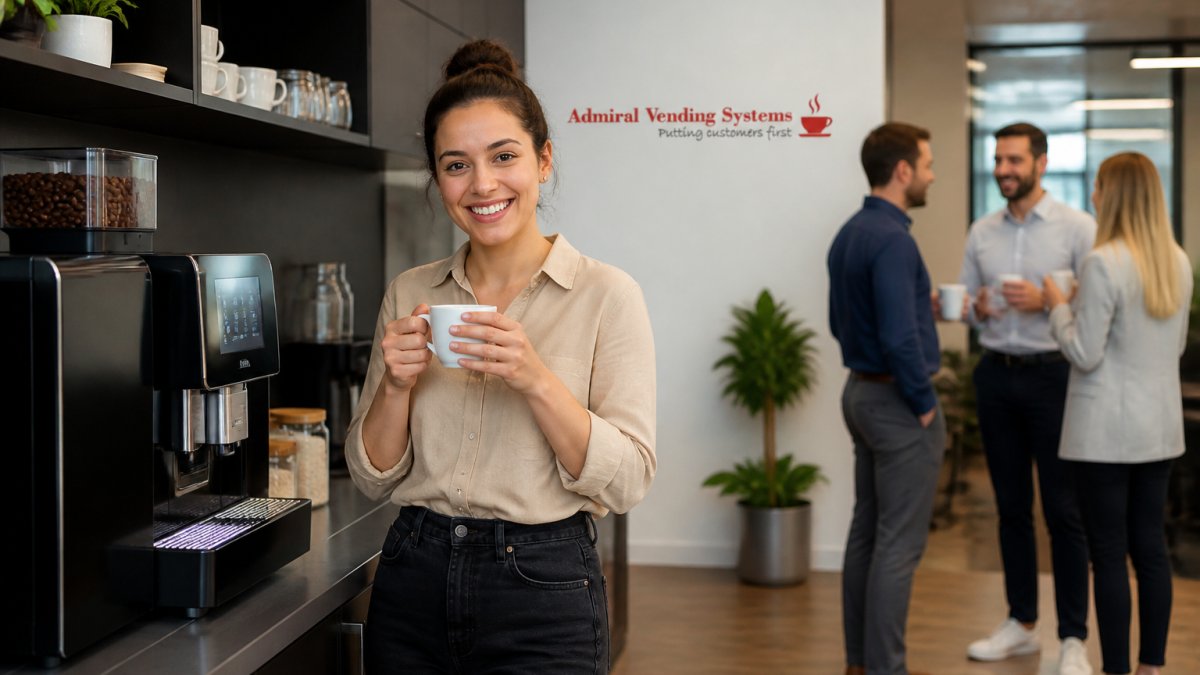
The strongest argument for leasing is cash flow. You preserve working capital and spread the cost across predictable monthly payments instead of absorbing a large capital expenditure in one financial year.
For growing businesses, a machine that would otherwise sit in your capital budget becomes an operating cost, which is easier to approve and forecast.
Preserve Working Capital and Spread the Cost
Monthly payments turn a lump sum into a line item, the difference between a purchase order needing board sign-off and a routine expense.
Leasing also bundles servicing into most commercial agreements, so maintenance stops being a surprise cost. To see what your coffee costs per cup before you commit, our guide on how to calculate office coffee costs breaks the numbers down.
Ask whether the lease includes consumables or just the hardware. A lower monthly payment that excludes coffee, cups and cleaning materials often costs more in practice than a slightly higher all-in figure.
Disadvantages and Risks of Leasing
Leasing costs more over the full term than buying outright. You pay for the use of the machine, not the machine itself, and typically own nothing at the end.

The bigger risk is the contract. Fixed terms mean fixed obligations, and a business that downsizes, relocates or closes a site mid-term still owes the remaining payments.
Our article on commercial coffee machine reliability covers what to check before you sign anything.
Contract Clauses and Exit Risks to Watch
Read the exit terms before the payment terms. Three clauses cause most problems:
- Early termination charges. Some agreements require the full remaining balance, not a reduced settlement. Others calculate a termination fee as a percentage of remaining payments, which can still run into thousands of pounds on a long contract. Ask for the exact formula in writing.
- Automatic renewal. Contracts that roll over silently unless you give notice 60 or 90 days before the end date. Diarise the notice date the day you sign.
- Ownership at term end. “Lease purchase” and “lease” are different products. Confirm in writing whether a final payment transfers title, and whether that payment is a nominal sum or a significant balloon payment.
Also check these less obvious terms:
- Price increases. Many leases allow the supplier to increase monthly payments annually, often linked to an inflation index. A fixed payment for the full term is safer for budgeting.
- Minimum coffee purchases. Some agreements tie the lease to a minimum spend on consumables. If your usage drops, you may still pay for coffee you do not need.
- Equipment return conditions. You may be charged for cleaning, missing parts or cosmetic damage at the end of the term. Ask for the return checklist upfront.
A lease signed for a five-year term on a site with a three-year lease is a mismatch. If your premises agreement is shorter than the machine contract, negotiate a break clause or choose a shorter term. The same applies if you expect headcount to change significantly: a machine sized for today’s team may be wrong in two years.
Total Cost of Ownership: A Worked Comparison
Monthly payment is not the full cost. To compare lease, rental and purchase fairly, add up every cost over the same period. The table below shows the categories to include; actual figures depend on the machine, supplier and contract terms.
| Cost category | Lease | Rental | Purchase |
|---|---|---|---|
| Upfront payment | Low or none | Low or none | Full machine cost |
| Monthly payments | Fixed for term | Higher, flexible | None |
| Servicing and repairs | Often included | Often included | Pay as you go or contract |
| Consumables | Sometimes included | Sometimes included | Your responsibility |
| End-of-term charges | Return or balloon payment | None | None |
| Early exit cost | Remaining balance or fee | Notice period only | Resale value only |
A lease typically costs more than purchase over five years but less than rental, because rental carries a flexibility premium. The crossover point depends on how long you keep the machine and how much you value bundled service. Ask each supplier for a total cost over the full term, including all fees.
Request a quote that separates hardware, service and consumables. A single all-in monthly figure is convenient but makes it hard to see where the money goes and whether you are paying over the odds for any element.
Tax Benefits of Leasing Coffee Machines UK
Tax treatment depends on how the agreement is structured, so confirm the detail with your accountant before you sign.
That is the main appeal for limited companies: the cost hits the profit and loss account rather than the balance sheet, with no large capital outlay to depreciate.
HMRC guidance on capital allowances sets out how outright purchases are treated differently, and the rules change, so check the current position rather than relying on last year’s advice.
The tax advantage of leasing is timing, not magnitude. You get relief spread across the term instead of a capital allowance on the purchase. For most SMEs the cash flow benefit is worth more than the tax difference.
Bean to Cup Coffee Machine Maintenance Contracts
A maintenance contract separates a good lease from an expensive mistake. Bean to cup coffee machine maintenance contracts should specify response times, what counts as a callout, and whether parts and labour are included.
Most commercial agreements cover scheduled servicing and breakdown repairs.
If servicing is your main concern, our guide to commercial coffee machine suppliers and service explains what proper support looks like.
A contract that promises “repairs included” but excludes callout charges is not a maintenance contract. Ask for the response time in hours and the callout policy in writing.
Commercial Coffee Machine Rental vs Lease
Rental wins on flexibility, leasing wins on monthly cost. A commercial coffee machine rental vs lease comparison comes down to one question: how certain are you about the next three years?
For a permanent office with stable headcount, a lease gives you a better machine for less per month.
For a straight look at the rental option we offer, see coffee machine rental.
How to Decide: A Business-Specific Framework
Work through these questions in order. The answers usually make the decision obvious and force you to confront the trade-offs that matter: cash, commitment and downtime tolerance.
Step 1: Estimate Daily Cups
Count the drinks your site actually makes, not the number of people. A 50-person office typically makes 40 to 60 drinks a day, while a busy cafe or co-working space can make several hundred. Under about 50 drinks a day, a free-on-loan or compact tabletop machine fits. Above 100, you need matching capacity and a service contract. Above 200, downtime becomes an operational problem, so replacement-machine cover is essential.
Step 2: Match the Machine Term to Your Premises Commitment
Never sign a machine lease longer than your building lease or expected stay. If your premises agreement has three years to run, a three-year lease with a break clause beats a five-year lease with no exit. If unsure about headcount or location, rental or a shorter lease with renewal options gives room to change course.
Step 3: Assess Your Capital Position and Appetite for Ownership
If cash is tight or better used elsewhere, lease or rent. If you have the budget and expect to keep the machine five years or more, buying usually costs less overall, even after servicing. It is not just about the monthly payment: it is whether you want the asset on your balance sheet and are willing to manage maintenance yourself.
Step 4: Decide How Much Downtime You Can Tolerate
High-traffic sites need replacement-machine cover in the contract; low-volume sites can tolerate a day or two without one. A broken machine in a busy cafe is a revenue problem, while in a small office it is an inconvenience. Let the service level you need drive the contract, not the reverse.
A Simple Decision Tree
Use this sequence to narrow the options:
- Is your premises commitment shorter than two years, or are you unsure about headcount? Choose rental or a short lease with renewal options.
- Is your daily volume under 50 drinks and your coffee spend enough to justify a consumables contract? Consider free-on-loan.
- Do you have the capital and expect to keep the machine five years or more? Buying outright is usually the lowest total cost.
- Do you want a premium machine without the upfront cost, and can you commit for three to five years? A lease with servicing included is the best fit.
- Is downtime unacceptable and you need guaranteed replacement cover? Prioritise the service level in any lease or rental contract, even if the monthly cost is higher.
For a wider view of the options, our coffee machine buyer’s guide covers machine types and volumes in more detail.
The right choice is the one that matches your commitment horizon and your tolerance for risk. A cheap lease on the wrong term is more expensive than a slightly higher monthly payment on the right one.
Conclusion
The hardest part of leasing is not the monthly payment, it is knowing which contract terms will still suit you in year three.
At Admiral Vending, we supply bean to cup machines on terms that match how your site actually operates, backed by professional installation, operator training and ongoing service support.
Get started with Admiral Vending and get the right machine, on the right terms, without the guesswork.
Frequently Asked Questions
Is it better to lease or buy a commercial coffee machine?
Leasing spreads the cost over monthly payments and preserves cash for other business needs, while buying means you own the machine outright and avoid ongoing finance charges. Leasing suits businesses that want access to higher-specification equipment without a large initial outlay. Buying can be more cost-effective long term if you plan to keep the machine for many years. Consider your cash flow, expected usage, and how often you might want to upgrade before deciding.
What are the tax benefits of leasing coffee equipment in the UK?
Lease payments may be treated as a deductible business expense, reducing your taxable profit, but the exact treatment depends on the type of lease and your accounting basis. VAT rules also apply, and you should confirm how input tax is handled with your accountant. Tax benefits of leasing coffee machines UK businesses often cite include spreading the cost and potential relief on rentals, but always seek professional advice for your specific circumstances.
Does leasing a coffee machine include maintenance and repairs?
Many commercial coffee machine leases include servicing and repairs as part of the monthly fee, but this varies by provider and contract. Some agreements cover routine maintenance and breakdown support, while others charge separately for parts or call-outs. Always check what a bean to cup coffee machine maintenance contract includes, such as response times, replacement machine guarantees, and whether consumables are covered, before signing.
How does a commercial coffee machine lease agreement work?
A lease agreement sets a fixed term, usually two to five years, with monthly payments for use of the machine. You do not own the equipment unless you choose a lease purchase option. The agreement should specify who handles servicing, what happens if the machine breaks down, and any end-of-term options such as renewal, upgrade, or return. Read the exit clauses carefully to avoid unexpected charges.
What are the hidden costs of leasing coffee machines?
Watch for excess usage charges, out-of-contract repair fees, delivery or installation costs, and penalties for early termination. Some leases exclude consumables or charge for filter replacements. Insurance and damage liability may also sit with you. Compare the total cost over the full term, not just the monthly figure, and ask for a written breakdown of what is and is not included before you commit.