Table of Contents
- What Drives Commercial Coffee Machine Repair Pricing
- Commercial Coffee Machine Servicing: What a Standard Visit Includes
- Understanding the Commercial Coffee Machine Call Out Charge
- Coffee Machine Troubleshooting: Faults That Affect Repair Costs
- Repair or Replace Commercial Coffee Machine: Making the Call
- Building an Annual Maintenance Budget and Comparing Quotes
- Conclusion
- Frequently Asked Questions
Last Updated: October 18, 2026
What Drives Commercial Coffee Machine Repair Pricing
Repair pricing for a commercial coffee machine is not a single number. It is a stack of charges: a call out fee, labour, parts, and sometimes a diagnostic charge, and each one moves depending on the machine and the fault.
The biggest cost driver is access to the fault. A blocked group head on a tabletop machine in a meeting room takes minutes to reach. A circuit board failure inside a floor standing unit wedged into a tight service corridor takes considerably longer, and labour is charged by time.
The Diagnostic Process and Cost Drivers
Fault finding is the stage that sets the rest of the bill. A technician works through power supply, water supply, grinder calibration, brewing pressure and electronics in sequence, and the point at which the fault appears determines how much dismantling follows.
Four things push a repair quote up:
- Machine complexity, since bean to cup units carry more sensors and electronics than traditional espresso machines
- Parts availability, because a common wear item ships quickly while a model specific board may need ordering
- Site access, including parking, stairs and whether the machine can be isolated without closing a service point
- Urgency, since out of hours attendance usually carries a premium
Itemised Pricing Structure
A transparent quote separates the components. Here is how a typical repair bill breaks down:
| Charge type | What it covers | Typical range (GBP) |
|---|---|---|
| Call out fee | Travel and first portion of time on site | 50 to 120 |
| Labour (per hour) | Technician time after the call out | 40 to 90 |
| Diagnostic fee | Fault finding only, sometimes credited against repair | 30 to 80 |
| Common parts | Seals, gaskets, grinder burrs, shower screens | 10 to 60 |
| Major parts | Control boards, boilers, pumps | 150 to 500+ |
Always ask for a written quote that separates these lines so you can compare like for like.
Ask for the diagnostic charge to be credited against the repair if you proceed, and it stops you paying twice for the same visit.
Commercial Coffee Machine Servicing: What a Standard Visit Includes
A standard service visit is preventative, not reactive. It covers descaling, group head and shower screen cleaning, grinder burr inspection, seal and gasket checks, water filter replacement where fitted, and a calibration run to confirm shot consistency.
Servicing is the cheapest line in your maintenance budget. It is also the one most often deferred, and deferred servicing is the single most reliable way to turn a routine visit into an emergency repair.
Front-End Service vs Full Service
A front-end service addresses what the operator touches: the group head, steam wand, drip tray, grind chute and exterior. It keeps the machine hygienic and the coffee tasting right.
A full service goes further, stripping the brewing unit, checking pump pressure, inspecting the boiler and testing the electronics. Full service costs more and takes longer, but it catches wear before it becomes a breakdown.
| Service type | What it covers | Best for | Typical frequency |
|---|---|---|---|
| Front-end service | Group head, steam wand, drip tray, grind chute, hygiene | Low volume sites, meeting rooms | Quarterly |
| Full service | Brewing unit strip down, pump pressure, boiler, electronics | High volume sites, showrooms | Twice yearly |
| Diagnostic visit | Fault finding only, no repair | Any breakdown | As needed |
Understanding the Commercial Coffee Machine Call Out Charge
A commercial coffee machine call out charge is the fee for a technician to attend your site, and it is usually separate from the labour and parts that follow. It covers travel and the first portion of time on site, whether or not a repair is completed.

Always ask three questions before booking:
- Does the call out charge include the first hour of labour?
- Is the diagnostic fee separate, and is it credited against the repair?
- Are parts charged at cost plus a margin, or at a fixed schedule price?
Get those three answers in writing and you can compare quotes honestly. Without them, you are comparing numbers that measure different things.
Coffee Machine Troubleshooting: Faults That Affect Repair Costs
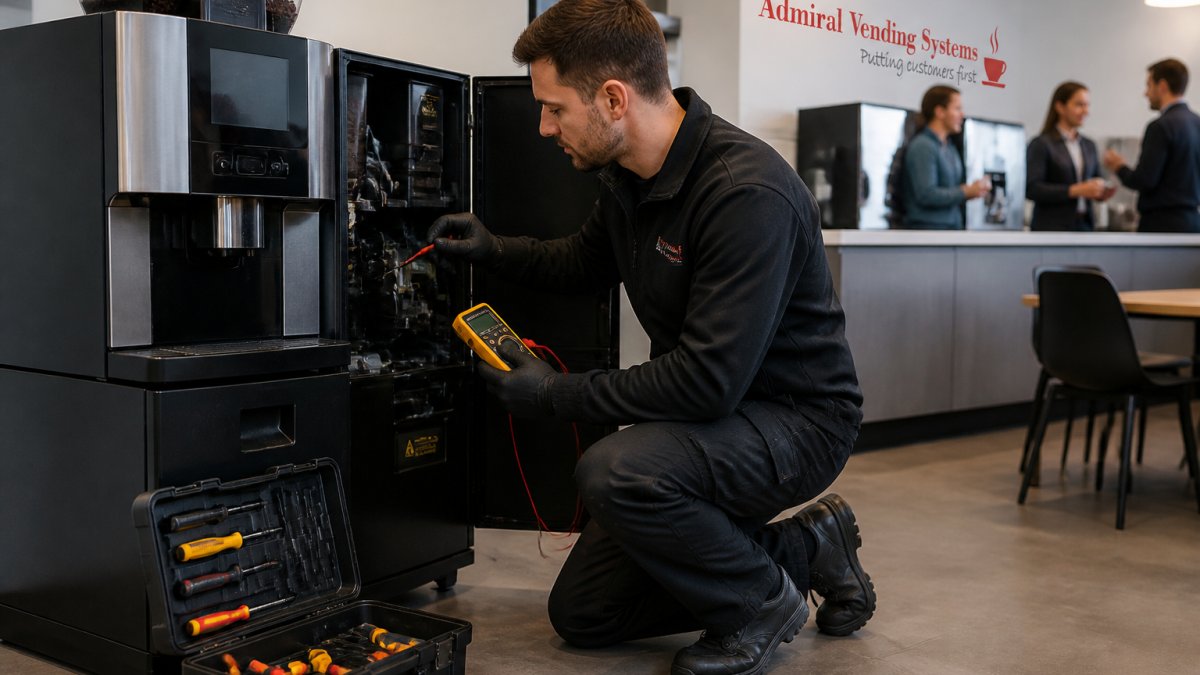
Regular maintenance often prevents these internal electrical and mechanical failures, as consistent cleaning brewing equipment remains the most effective way to extend the operational lifespan of your machine.
Some faults are cheap and some are not, and knowing which is which helps you decide how quickly to call an engineer. Coffee machine troubleshooting starts with the obvious: is the water supply open, is the bean hopper empty, has a filter clogged.
The faults that move a repair bill most:
- Leaks. Often a worn seal or gasket, which is inexpensive. A leak that has been running for weeks can corrode the chassis and take the repair into a different bracket entirely.
- Brewing inconsistencies. Usually grinder burr wear or a scaled group head. Routine servicing prevents most of these.
- Power failures. Can be as simple as a tripped circuit or as serious as a failed control board, and the difference in cost is substantial.
- Blocked or slow service. Frequently scale build up, which descaling resolves if caught early.
Ignoring a slow drip is an expensive mistake. A seal that costs little to replace can, once water has reached the electronics, turn into a board replacement and a machine out of action for days.
Repair or Replace Commercial Coffee Machine: Making the Call
The repair or replace decision comes down to one comparison: the cost of the repair against the cost of a replacement machine, weighted by the age and condition of what you have. A repair that costs a meaningful fraction of a new machine, on a unit already past its expected working life, is usually money spent twice.
Work through this checklist before you commit:
- Is the machine more than six or seven years old?
- Has it needed more than two call outs in the past twelve months?
- Is the failed part a control board or boiler rather than a wear item?
- Are parts still readily available for this make and model?
- Would a replacement reduce downtime and improve drink quality for staff or customers?
Two or more ticks point toward replacement. Fewer, and a repair is usually the sensible call. Admiral Vending supplies commercial bean to cup coffee machines across a range of capacities, so if replacement is the answer, the next step is matching machine size to your daily drink volume rather than guessing.
Building an Annual Maintenance Budget and Comparing Quotes
Add together scheduled servicing, an allowance for one or two call outs, and a contingency for parts, then review it against actual spend each year.
Fixed monthly costs make the budget predictable, and regular servicing reduces the frequency of the emergency repairs that blow a budget apart. Ask what the package covers, what it excludes, and whether parts and labour are both included.
Total Cost of Ownership Model
To budget beyond a single repair, build a yearly cost model that includes:
- Scheduled servicing (one or two visits per year, depending on volume)
- Likely repairs (based on machine age and fault history)
- Downtime cost (lost sales or staff time during breakdowns)
- Replacement planning (sinking fund for eventual machine replacement)
A mid-volume site with a bean to cup machine might budget:
| Cost category | Annual estimate (GBP) |
|---|---|
| Servicing (two visits) | 300 to 600 |
| Call outs and repairs (allowance) | 200 to 500 |
| Parts contingency | 100 to 300 |
| Downtime (estimated lost sales) | 500 to 1500 |
| Replacement fund (over 5 years) | 600 to 1200 per year |
The key is to plan for the full cost of ownership, not just the repair bill.
When comparing repair quotes, check that each one states:
| Quote element | Why it matters |
|---|---|
| Call out charge | Confirms whether the first hour of labour is included |
| Labour rate | Hourly or fixed, and whether it changes out of hours |
| Parts pricing | Cost plus margin, or a fixed schedule |
| Diagnostic fee | Whether it is separate and whether it is credited |
| Warranty on the repair | How long the work and parts are covered |
A transparent quote you can compare line by line is worth more than a low headline figure with the detail buried.
Conclusion
Unpredictable repair bills are the fastest way to lose control of a coffee budget, and the fix is transparency before the technician arrives. Admiral Vending supplies commercial bean to cup machines with professional installation, operator training and ongoing service support, backed by eight years of industry experience and nationwide coverage. Our AI powered instant quote system gives you clear figures up front, so you can plan maintenance rather than react to it. Get your instant quote and put your coffee costs on a firm footing for the year ahead.
Frequently Asked Questions
How much does it cost to repair a commercial coffee machine?
There is no single figure because repair pricing depends on the fault, the machine make and model, and the parts required. A straightforward fix such as a blocked group head or a worn seal sits at the lower end, while a circuit board replacement or a failed boiler pushes costs higher. Most providers quote a call-out charge plus labour plus parts. Always ask for an itemised quote before work begins so you can see exactly what you are paying for, and confirm whether the diagnostic visit is deducted from the final bill.
What does a commercial coffee machine service include?
A standard commercial coffee machine servicing visit usually covers descaling, backflushing the group heads, cleaning or replacing seals and gaskets, checking and adjusting the grinder, testing the boiler and thermostat, inspecting water filters and hoses, and verifying drink temperature and pressure. A front-end service handles the visible, routine items, while a full service also strips down internal components. Ask which tasks are included before booking so you are not surprised by extras on the invoice.
How often should a commercial bean to cup coffee machine be serviced?
Most commercial bean to cup machines need a service every six to twelve months, depending on daily drink volume and water hardness. A high-footfall site producing hundreds of drinks a day should lean towards the six-month mark, while a smaller office may manage on an annual visit. Hard water areas need more frequent descaling. Sticking to the manufacturer’s schedule protects your warranty and cuts the chance of a breakdown that takes the machine out of action during your busiest period.
Is it cheaper to repair or replace a commercial coffee machine?
It depends on the age of the machine, the cost of the repair relative to a new unit, and how often it has failed recently. A single mid-range repair on a machine that has otherwise been reliable is usually worth doing. If the repair quote approaches a significant share of a new machine’s price, or the unit is failing repeatedly, replacement often works out cheaper once downtime and lost productivity are counted. Weigh the repair cost against the total cost of ownership over the next two to three years.
Does a commercial coffee machine warranty cover repairs?
Warranty cover varies by provider and by machine. Many warranties cover manufacturing defects and parts but exclude damage caused by limescale, missed servicing, or misuse. Some service contracts bundle parts and labour into a fixed monthly fee, which spreads the cost and removes surprise bills. Check the small print for what is excluded, whether servicing must be carried out by an approved technician to keep cover valid, and how long the warranty runs before you commit.
Can I maintain a commercial coffee machine myself?
Daily tasks such as emptying the grounds bin, rinsing the drip tray, and running the machine’s cleaning cycle are safe for staff to handle and will extend the machine’s life. Deeper work, including descaling, opening the boiler, or touching electrical components, should be left to a qualified technician. Attempting it yourself can void the warranty and risks damaging sensitive parts. Keep a simple daily and weekly cleaning log so you can show the machine has been looked after.