Table of Contents
- Assess Your Space and Team Size
- Choose the Right Coffee Brewer for Office Use
- Select Commercial Bean to Cup Coffee Machines That Fit Your Needs
- Plan Your Office Coffee Station Layout Ideas
- Set Up Essential Coffee Station Accessories
- Establish Maintenance and Hygiene Standards
- Optimise Your Design for How to Design an Office Coffee Station Success
- Frequently Asked Questions
Last Updated: September 27, 2026
How to Design an Office Coffee Station
A well-designed office coffee station boosts morale, keeps teams energised, and creates a space where colleagues naturally connect. A poorly planned setup wastes space, frustrates users, and sits unused. The difference between success and failure comes down to three things: choosing the right equipment, planning your layout carefully, and thinking about how people will actually use the space.
Assess Your Space and Team Size
Measure your space and count your people before buying anything. Small teams can use compact tabletop machines; larger offices need floor-standing equipment that handles high volume. Measure counter space, ceiling height, power outlet locations, and water access. A cramped station creates workflow problems and staff will avoid it.
Ask: How many people will use this station daily? How much counter space is available? Is water access nearby? Where are power outlets? What’s the ceiling height? These answers determine whether you need a compact tabletop machine or a floor-standing unit, and whether you can fit storage and accessories without clutter.
Choose the Right Coffee Brewer for Office Use
Your coffee brewer must be reliable, fast, and capable of handling your team’s volume. For offices under 50 people, a compact tabletop bean to cup machine works well. For 50 to 150 people, a higher-capacity tabletop machine handles increased demand. For 150+ people or high-footfall locations, floor-standing machines are essential.
Key features: fresh bean grinding on demand, fast brew times (under 90 seconds), wide drink selection, easy cleaning cycles, reliable performance, and good warranty support. Commercial bean to cup coffee machines from Admiral Vending are designed for office environments with professional installation and ongoing support included.
Select Commercial Bean to Cup Coffee Machines That Fit Your Needs
Compact tabletop models serve 30 to 50 drinks daily and work for small offices with limited space. Mid-range tabletop machines handle 50 to 200 drinks daily and are popular for busy offices and showrooms. Floor-standing machines serve 200 to 500+ drinks daily for high-volume environments.

Consider actual usage patterns, not just team size. A 100-person office with remote workers might use under 50 drinks daily, while a 50-person showroom might use 200 daily. Admiral Vending’s AI-powered quote system matches the right machine to your specific needs, preventing costly mistakes.
Plan Your Office Coffee Station Layout Ideas
Layout determines whether your station feels welcoming or chaotic. A good layout flows naturally, keeps traffic moving, and prevents bottlenecks during peak usage.
Workflow Efficiency and Traffic Flow
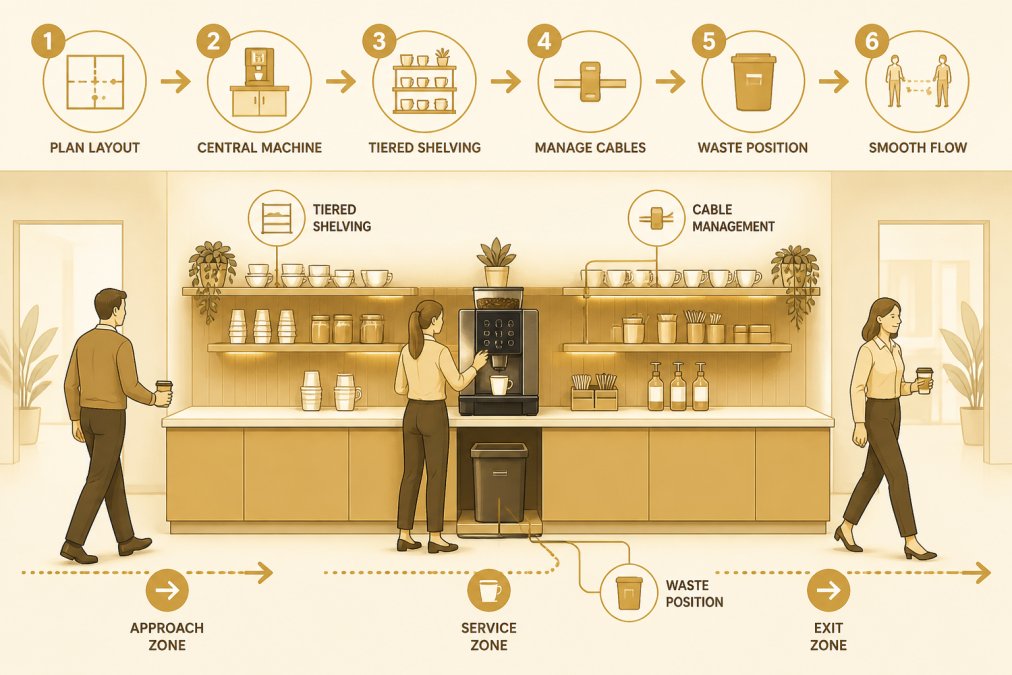
Most stations fail because they don’t account for how people actually move through the space. Design using a linear or parallel workflow model. In a linear model, users approach from one side, select their drink, and exit from the other. In a parallel model, position two machines side by side, each with its own approach and exit path, doubling capacity without more floor space.
Measure peak-hour demand. A machine brewing one drink every 90 seconds serves only 40 drinks in 60 minutes. If demand exceeds supply, add a second machine or upgrade to a faster model. This is essential for offices above 75 people.
Position the machine at standard counter height (90 centimetres). For teams with different heights or mobility needs, consider an adjustable-height counter. Create clear zones: approach zone (queuing), interaction zone (selecting and collecting), and exit zone (leaving). Each zone should be at least 60 centimetres wide. If total space is less than 180 centimetres, a single machine will create bottlenecks.
Counter Space and Supply Positioning
Aim for at least 60 centimetres of clear counter space on either side of the machine. Arrange supplies in order of use: cups closest to the machine, then milk and milk alternatives, then sugar and sweeteners. This sequence mirrors natural workflow and reduces congestion.
Use tiered shelving at 120 and 150 centimetres height to maximise vertical space. Avoid shelves above 180 centimetres. Label every shelf and container clearly with text and icons. Assign one person to monitor stock levels and reorder supplies before they run out.
Cable Management and Power Supply
Plan your power supply before installation. Locate outlets near the machine. Work with a qualified electrician to ensure sufficient capacity and a dedicated circuit. Use cable management solutions (clips, covers, conduit) to keep wires tidy and safe. Ensure cables do not cross walkways. Consider a power distribution unit (PDU) with surge protection for multiple devices.
Storage and Organisation for Different Team Sizes
Storage needs scale with team size. Under 50 people: use a single wall-mounted shelf or small cabinet. 50 to 150 people: use multiple shelves or a cabinet system with separate zones for beans, cups, napkins, milk alternatives, and cleaning supplies. Add a small undercounter fridge (60 centimetres wide) for perishables. Above 150 people: use a dedicated storage unit separate from the station and rotate items as needed.
Use a dedicated waste bin positioned under or beside the machine. Choose a bin with a lid to contain odours. For larger offices, use a 50-litre bin emptied daily; for smaller offices, a 20-litre bin emptied every 2 to 3 days. Label everything clearly using a consistent system.
Set Up Essential Coffee Station Accessories
Essential accessories: a drip tray to catch spills, a milk frother or dispenser for cappuccinos and lattes, a creamer station with milk and sweeteners, quality cups (reusable ceramic or glass preferred), and cleaning supplies stored near the machine. Assign someone to run cleaning cycles weekly.
Establish Maintenance and Hygiene Standards
Regular maintenance keeps your machine running reliably and prevents downtime. Shared office coffee stations must meet food hygiene standards and electrical safety requirements.
Regulatory Compliance and Health Standards
Office coffee stations must meet basic hygiene standards for any food or beverage preparation in a shared workplace.
Key compliance requirements include:
Water quality and filtration: Replace water filters regularly. Keep a maintenance log showing filter replacement dates to protect against bacterial growth and mineral buildup.
Milk system hygiene: Clean daily to prevent bacterial growth. Ensure the automatic milk-cleaning cycle runs after each use. Weekly deep cleaning involves removing all removable parts and soaking in hot water with cleaning tablets. Monthly inspection should check for cracks, discolouration, or mould. Replace any compromised components immediately.
Temperature control: Store fresh milk or milk alternatives at appropriate temperatures. Check fridge temperature daily and replace milk regularly.
Electrical safety: Your machine must be installed by a qualified electrician and tested regularly. Keep the Portable Appliance Test (PAT) certificate on file. If your machine fails PAT testing, it must not be used until repaired.
Cleaning and sanitation: Clean all surfaces that contact food or drink daily, including the group head, drip tray, and removable parts. Use only food-safe cleaning products and manufacturer-approved cleaning tablets and descaling powder.
Daily, Weekly, and Monthly Maintenance Schedules
Establish a structured maintenance schedule and assign clear responsibility to one person.
Daily maintenance: Empty grounds container, wipe group head, run milk-cleaning cycle, empty drip tray, check supplies, inspect for leaks.
Weekly maintenance: Run descaling cycle, deep clean milk system, wipe external surfaces, check water filter, inspect drip tray, verify supplies and labels.
Monthly maintenance: Inspect all removable parts for cracks or wear, replace worn seals or gaskets, run full cleaning cycle, check electrical connections, test all functions.
Quarterly maintenance: Replace water filter, deep clean internal pipes, inspect milk frother nozzle, check bean hopper, verify seals and gaskets.
Maintenance Logs and Record-Keeping
Keep a detailed maintenance log to demonstrate compliance, spot recurring issues, and protect warranty claims. Record the date, task completed, who completed it, and any observations. Use a simple spreadsheet or maintenance app.
Scaling Maintenance for Different Team Sizes
Small offices (under 50 people): One person assigned to daily maintenance, weekly deep cleaning, monthly inspection, and annual professional service.
Medium offices (50 to 150 people): Daily maintenance on a rotating roster, weekly deep cleaning, monthly inspection, quarterly professional service, and consider a second machine.
Hygiene Standards for Shared Spaces
A dirty coffee station discourages use and spreads bacteria. A clean, well-maintained station is used more frequently and improves workplace morale.
Optimise Your Design for How to Design an Office Coffee Station Success
A successful office coffee station needs ongoing attention. After the first few weeks, observe how your team actually uses the space.
Frequently Asked Questions
What are the essential components of a professional office coffee station?
A professional office coffee station needs a quality coffee brewer (bean to cup or espresso machine), a dedicated countertop with adequate workspace, storage for coffee pods or beans, a water filtration system, cups and accessories, a waste bin for used pods, and proper cable management. The specific components depend on your team size and daily drink volume. A barista station should also include a drip tray, creamer station, and cleaning supplies within easy reach.
How do I choose the right coffee machine for a busy workplace?
Match the machine’s capacity to your team size and usage. Small offices under 50 people typically need tabletop bean to cup machines; larger teams of 100+ benefit from higher-capacity floor standing models. Consider daily drink volume, available countertop space, and whether you need café-style variety (espresso, cappuccino, latte). Commercial bean to cup coffee machines offer consistency and speed, while traditional espresso requires more skill. Test machines if possible before committing.
What’s the best way to organise a coffee station in a small office space?
Use vertical storage with floating shelves above the machine to maximise countertop space. Choose a compact tabletop coffee brewer rather than floor standing models. Position the station near a power outlet and water supply to simplify installation and workflow. Keep only daily essentials on the counter: cups, creamer, sugar. Store backup supplies in a nearby cupboard. A small waste bin integrated beneath the counter saves floor space. This minimalist design keeps the office coffee station functional without clutter.
How often should an office coffee station be cleaned and maintained?
Daily cleaning includes emptying the drip tray, wiping the group head or nozzle, and removing used coffee grounds. Weekly deep cleaning covers internal components. Monthly professional maintenance prevents scale buildup and ensures the machine delivers quality drinks. Most commercial bean to cup coffee machines include self-cleaning cycles. Follow your machine’s maintenance schedule strictly; poor hygiene reduces drink quality and can create health and safety issues. Assign a team member responsibility for daily checks.