Quick Summary
Sustainable coffee can pay off for restaurants, but only when the changes are chosen with care. Low-cost steps like reducing unused stock and offering reusable cups often save money, while certified beans usually carry a higher price per kilo that has to be absorbed or passed on.
- Ask suppliers for farm names, certificate numbers and a clear pricing mechanism, not just general ethical claims.
- Check certificate numbers against the certifying body’s public register before printing any claim on the menu.
- Calculate bean cost per serving for both conventional and certified coffee, not just the price per kilo.
- Start with reusable cups and better waste sorting, then add certified beans once costs are clear.
- Track coffee waste, reusable-cup uptake and bean spend before and after each change to judge results.
Table of Contents
- Why Sustainable Coffee Matters for Restaurant Menus
- Sourcing Sustainable Coffee Beans for Restaurants
- Fairtrade Coffee for Businesses: Costs, Margins and Trade-offs
- Reducing Cups, Lids and Packaging Waste
- Coffee Waste Reduction in Restaurants
- Choosing Energy-Efficient Commercial Bean to Cup Coffee Machines
- Planning Your Sustainable Coffee Switch and Measuring Results
- Frequently Asked Questions
Sustainable coffee is no longer a niche concern for restaurant owners. Customers notice how a business sources its beans, what its cups are made of, and whether its waste ends up in landfill.
The short answer is that sustainable coffee options can pay off, but only when they are chosen with care. Some changes cost little and can save money, such as reducing unused stock. Others, like certified beans, may carry a higher price per kilo that has to be absorbed or passed on.
Last Updated: November 17, 2026
Why Sustainable Coffee Matters for Restaurant Menus
Diners increasingly judge a restaurant by small details, and the coffee served after a meal is one of them. A cup that arrives in a disposable lid, made from beans with no traceable origin, tells a customer something about the kitchen’s priorities.
Sustainability also affects operations. Lower packaging use can reduce waste collection costs, and better-managed stock can reduce spoilage.
Sourcing Sustainable Coffee Beans for Restaurants
Responsible sourcing covers where beans come from, how growers are paid, and whether the supply chain can be traced. A supplier that can name the farms or cooperatives behind its beans is generally easier to trust than one that offers only general promises.
Ask suppliers for documentation rather than accepting marketing language alone. You can explore our guide on coffee for restaurants, covering suppliers, beans and machines to see how these choices fit together. For bean selection specifically, our list of the best coffee beans for commercial machines is a useful starting point.
A practical supplier evaluation checklist
Most restaurant buyers find it helps to score suppliers against the same short list, so the comparison is like for like rather than a matter of which sales rep was most persuasive.
- Traceability: Can the supplier name the country, region and, where possible, the farm or cooperative for each lot? Ask for the harvest period and the lot reference.
- Certification evidence: Request the certificate number and the certifying body, then check the number against the certifier’s public register. A logo on a bag is not the same as a valid certificate.
- Chain of custody: Ask whether the beans are certified under a segregated or mass-balance model. Mass balance allows certified and non-certified beans to be mixed in the supply chain, which matters if you plan to make a specific claim on the menu.
- Pricing structure: Ask how the farmgate price is set and whether a premium reaches the grower. A supplier that cannot explain the mechanism is unlikely to be able to substantiate an ethical claim.
- Consistency and lead time: Confirm minimum order sizes, delivery frequency, stock availability across the year and what happens if a lot sells out.
- Roast and profile support: Check whether the supplier will supply samples, help you dial in the grind and support staff training, because a sustainable bean that tastes poor will not sell.
Watch out: a supplier that offers only a generic “ethically sourced” statement, with no farm names, certificate numbers or pricing mechanism, is giving you nothing you can verify or repeat to a customer.
Comparing certifications and supplier claims
Certifications give buyers a common reference point, but they differ in scope and strictness. The table below summarises the main schemes a restaurant is likely to encounter.
| Certification | What it covers | Best for | Typical limitation |
|---|---|---|---|
| Fairtrade | Minimum prices and a premium paid to growers | Visible ethical sourcing | Covers price, not environmental practice |
| Organic | Farming without synthetic pesticides or fertilisers | Customers who prioritise chemical-free products | Does not guarantee fair pay |
| Rainforest Alliance | Biodiversity and farm-worker welfare | Environmental and social standards | Audit quality varies |
| Direct trade (supplier-verified) | Relationship with named growers | Full traceability | Depends on supplier transparency |
Treat unverified claims such as “ethically sourced” or “eco-friendly” with caution. Ask for the certificate number and check it with the certifying body. Where a supplier uses a mass-balance model, be careful about implying that every bean in the cup comes from a named farm.
Verifying environmental claims before they reach the menu
A claim on a menu is a claim to a customer, and vague wording is the most common way restaurants get into trouble. Before you print anything, separate verified certifications and measurable actions from unsupported marketing.
- Prefer specific, checkable statements, such as the name of the certification and the fact that the beans are certified, over broad words like “sustainable” or “green”.
- Keep the certificate number and supplier documentation on file so you can answer a customer or staff question.
- If you cannot verify a claim, do not make it. A weaker but accurate statement is safer than a stronger one you cannot support.
- Train staff on what the claim means, because customers often ask the person making the coffee rather than the manager.
Fairtrade Coffee for Businesses: Costs, Margins and Trade-offs
Fairtrade coffee usually costs more to buy than conventional coffee, and the difference affects your margin on every cup. Whether that gap is manageable depends on your volume, your pricing and how your customers respond.

Consider the trade-offs before you commit:
- Cost per cup: Calculate the bean cost per serving for both options, not just the price per kilo.
- Pricing: Many restaurants absorb a small increase or add a modest premium for certified coffee and name it on the menu.
- Customer value: Some customers will pay more for visible ethical sourcing. Others will not, so test before you change prices across the board.
- Supplier terms: Check minimum order sizes, delivery frequency and whether the supplier can keep stock consistent.
Pricing depends on quantity, dates and delivery, so request a quote for your own setup from Admiral Vending’s website.
Reducing Cups, Lids and Packaging Waste
Single-use cups and lids are among the most visible sources of waste in a restaurant. The simplest improvement is to offer a discount or small incentive for customers who bring their own reusable cup, which many diners will accept.
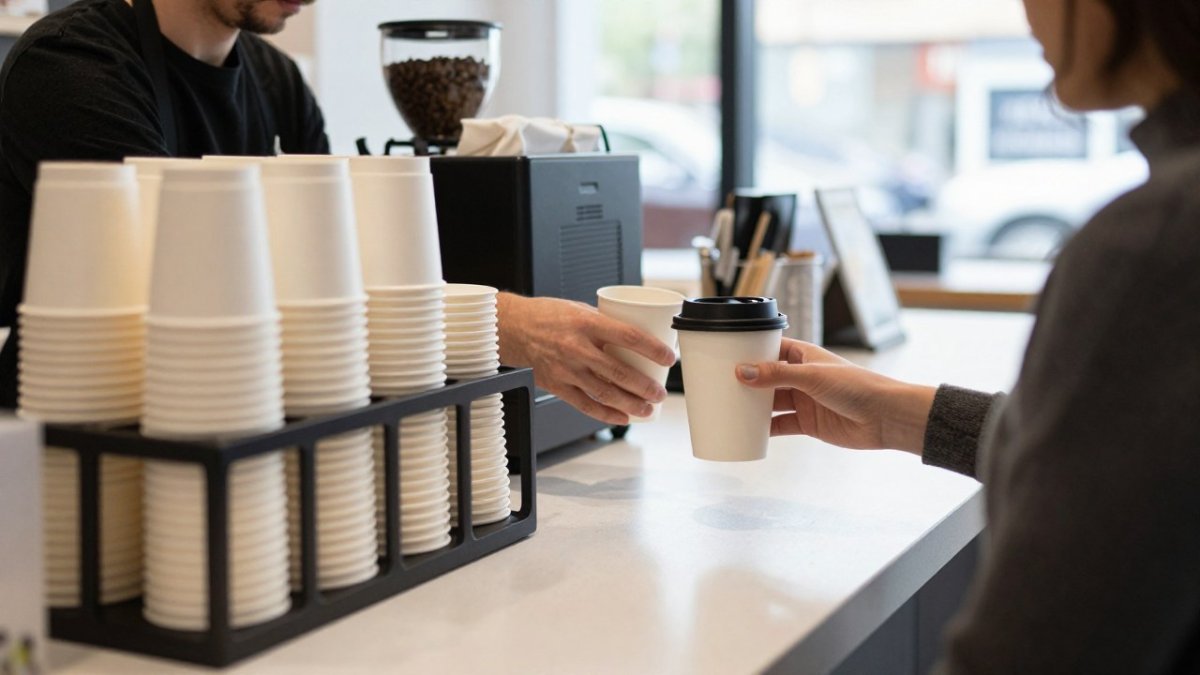
For takeaway, look at the packaging you actually use. Lids often outnumber the cups they go on, so a sized-down or recyclable option can cut waste quickly.
Coffee Waste Reduction in Restaurants
Waste starts with over-ordering and poor stock rotation. Track how much coffee and milk you discard each week and adjust your orders to match real demand.
Spent coffee grounds can be reused rather than thrown away. Some restaurants offer them to customers or local gardeners for composting, and others use them in kitchen recipes. Check local council guidance on food waste before you set up collection.
Choosing Energy-Efficient Commercial Bean to Cup Coffee Machines
Your machine has a large effect on energy use. Bean to cup machines grind fresh beans on demand, and some models offer energy-saving or standby modes.
When comparing machines, look at:
- Daily output against your peak service volume
- Standby and energy-saving settings
- Water filtration and descaling needs
- Service support and parts availability
Our commercial bean to cup coffee machines range covers different output levels, and you can compare the options in our bean to cup coffee machine guide. If you want a quote for your site, coffee machines in Watford is the place to start.
Planning Your Sustainable Coffee Switch and Measuring Results
Start with one or two changes rather than rebuilding the whole coffee offer at once. Reusable cups and better waste sorting are low-risk first steps, and certified beans can follow once you have a clear view of costs.
Measure what you change. Record cups used, waste collected, bean spend per cup and customer feedback before and after each switch. Those figures will tell you whether the change is worth keeping, and they give you something concrete to share with customers.
A phased plan by service model
The right sequence depends on how you serve coffee. A dine-in restaurant with table service faces different constraints from a takeaway-led site or a high-volume operation.
Dine-in and table service
- Switch dine-in service to reusable cups and glasses first, since this is the lowest-cost change and removes single-use waste at the table.
- Review milk waste from jugs and jugs left on tables, and move to made-to-order drinks where practical.
- Trial one certified bean on the after-dinner menu with a short menu note, and track whether dessert coffee sales hold.
Takeaway-led sites
- Introduce a reusable-cup incentive and make it visible at the counter and on the menu board.
- Audit lids separately from cups, because lids are often the larger waste stream and a sized-down or recyclable lid can cut volume quickly.
- Check that front-of-house bins match the packaging you actually buy, so a recyclable cup is not placed in general waste.
High-volume operations
- Start with stock control and rotation, because over-ordering is usually the largest hidden waste cost at volume.
- Compare machine output and standby settings against your peak service, and use energy-saving modes outside peak hours.
- Trial certified beans on one line or one daypart before rolling out across the estate.
Watch out: rolling out a certified bean across every site at once makes it hard to tell whether a fall in sales is due to the bean, the price or the season, so keep the trial contained.
What to measure and how
Pick a small set of indicators you can actually collect without extra staff time, and record them before and after each change.
- Coffee waste: weight or count discarded shots and spoiled milk each week.
- Reusable-cup uptake: count reusable cups against total takeaway cups served.
- Packaging use: track cups, lids and bags ordered against covers or transactions.
- Energy and water: read the machine’s standby settings and log descaling and filtration cycles.
- Supplier coverage: record what share of your bean spend is certified or traceable to a named farm.
- Customer response: note menu mentions, staff questions and any feedback on the change.
A simple spreadsheet is enough. The point is to compare like with like over a fixed period, such as four weeks before and four weeks after, rather than relying on impressions.
Reviewing and deciding
After three months, review the figures against your original costs and customer response. Keep the changes that hold up commercially and environmentally, and drop or adjust the ones that do not. Sustainable coffee is worth it for many restaurants, but the right mix depends on your customers, volumes and margins. Admiral Vending can help you assess the machine, supply and service side of that decision, and you can get your instant quote to see what a switch would involve for your site.
Frequently Asked Questions
What makes coffee sustainable?
Sustainable coffee is grown and traded in ways that protect the environment, support the people who grow it and keep the supply chain traceable. In practice this covers responsible farming methods, fair prices paid to growers, certifications that can be checked and lower waste at the point of service. Restaurants can judge a supplier by asking where the beans come from, how the growers are paid and which independent certifications apply to the product they are buying.
How can restaurants source sustainable coffee?
Start by asking suppliers for the origin, the roaster and any independent certification on each blend. Compare the terms rather than the marketing, and ask for evidence of traceability. Many restaurants also trial one sustainable blend alongside their current coffee and track customer feedback and cost per cup before switching the whole menu.
What certifications should restaurants look for when buying coffee?
Look for recognised independent schemes such as Fairtrade and Rainforest Alliance, and check whether the certificate covers the specific product rather than the supplier in general. Ask for the certificate number so you can verify it. Be cautious of vague labels such as eco or natural that have no defined standard behind them.
Are reusable cups more sustainable than disposable cups?
Reusable cups can have a lower environmental footprint over their life, but only if customers use them repeatedly and they are washed efficiently. Disposable cups, even paper ones, create waste at every serving. Restaurants often pair a reusable cup discount with clear signage to encourage uptake.