
Quick Summary
Choose office coffee supplies by starting with your daily headcount and the busiest 30 minutes of the day, then size the machine and stock to that volume. Build a checklist of beans, milk, cups and cleaning products, and set a reorder level for each item so you never run short.
- Plan for the busiest 30 minutes of the day, not the average.
- Build in headroom of roughly 20 to 30 per cent where budget allows.
- Keep milk refrigerated below 5C and check use by dates daily.
- Set a reorder level so you reorder before items run out.
- Compare total cost of ownership, not just the machine price.
Table of Contents
- Start With Headcount and Daily Coffee Demand
- Office Coffee Supplies Checklist Beyond the Machine
- Choosing a Bean to Cup Coffee Machine for Office Use
- Checking Dimensions, Plumbing and Electrical Requirements
- Working Out Total Cost of Ownership
- Office Coffee Machine Maintenance and Hygiene
- Booking Your Office Coffee Setup With Admiral Vending
- Frequently Asked Questions
Start With Headcount and Daily Coffee Demand
Getting the machine right starts with a simple question: how many drinks does your team actually need each day? Many problems with office coffee supplies, including queues at 10 a.m. and empty milk jugs by lunch, come from buying for the wrong volume.
Count your people first. A team of 40 and a team of 150 need very different equipment, even if both sit in the same building. Then estimate how many people drink coffee, how many cups each one has, and whether visitors or clients use the same machine.
Our advice is to plan for the busiest 30 minutes of the day, not the average. A machine that copes at 9 a.m. but stalls at 11 a.m. will still frustrate staff. Ask whether drinks are needed in bursts, such as after meetings, or spread evenly across the day.
Watch out: a machine sized for today’s headcount can fail quickly if the team grows. Build in headroom of roughly 20 to 30 per cent where budget allows.
Office Coffee Supplies Checklist Beyond the Machine
The machine is only one part of the setup. A practical supplies list covers the items that run out most often and cause the most complaints, and it should be built around your daily cup count rather than a generic shopping list.
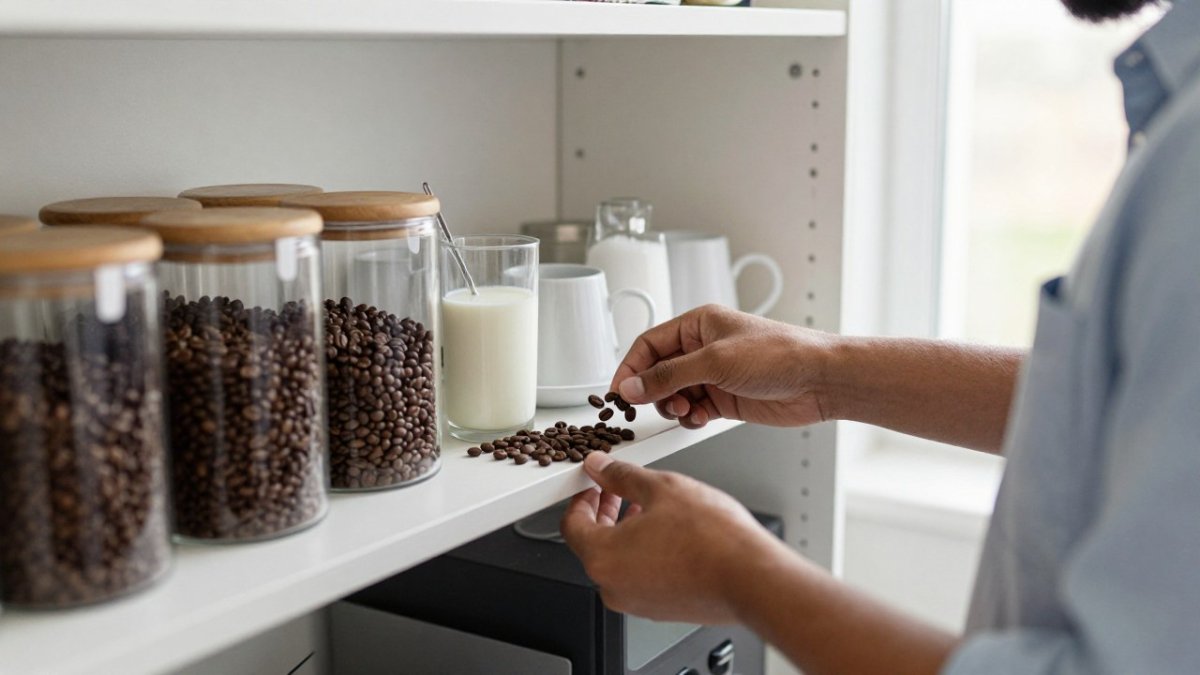
Use this as a starting checklist, then adjust to your team:
- Coffee beans or ground coffee, sized to your daily cup count plus a buffer for visitors
- Fresh milk and at least one milk alternative such as oat or soya
- Sugar, sweeteners and stirrers
- Cups, lids and sleeves, or reusable mugs with a washing plan
- Tea bags and a small selection of herbal teas for staff who do not drink coffee
- Hot chocolate sachets if the machine does not offer it
- Cleaning tablets, descaler, food safe sanitiser and cloths
- Spare drip trays, filters and waste containers
- Storage containers for open beans, sugar and tea, kept sealed and labelled
Set a reorder level for each item rather than waiting until the cupboard is empty. A common pattern is to count stock on the same day each week and reorder when an item falls below one week of expected use. For a team of 40 with roughly 30 coffee drinkers having two cups a day, that is about 300 cups a week, so milk, cups and beans need a weekly check rather than a monthly one.
Watch out: milk is the item most likely to cause problems. Keep it refrigerated below 5C, check use by dates daily, and never top up an old jug with fresh milk. Allergen information should stay on or near the packaging so staff can check soya, oat and nut based alternatives. Keeping milk safe is only part of a reliable coffee routine, so pair careful storage and clear allergen checks with thoughtful choices about fresh roasted coffee for your office.
Build the checklist into a simple stock sheet that names who checks it and when. That single habit prevents most of the mid morning shortages that make an otherwise good coffee setup feel unreliable.
Choosing a Bean to Cup Coffee Machine for Office Use
Bean to cup machines grind fresh beans for each drink. They suit offices that want café-style espresso, latte or cappuccino without the work of a barista.

When comparing bean to cup models, check these points:
- Daily output and how many drinks it makes in an hour
- Drink range, including whether it offers tea or hot chocolate
- Ease of cleaning and how often the grinder needs attention
- Whether the supplier offers installation, training and servicing
Checking Dimensions, Plumbing and Electrical Requirements
Measure the space before you choose a model. Include clearance for the drip tray, the bean hopper and the door or cabinet that opens for cleaning. Leave room for staff to reach the machine without queuing in a corridor.
If the machine connects to a water supply, confirm that a suitable outlet is nearby. Some models use a plumbed-in water feed, while others use a reservoir that needs refilling. Check the power requirement too, as larger commercial machines may need a dedicated socket.
Ask your supplier whether they will survey the site before installation. A short visit can catch problems that cost time later.
Working Out Total Cost of Ownership
The purchase price is only the start. Total cost of ownership includes the machine, supplies, servicing, cleaning products, water and electricity, and any downtime when the machine is out of action. Comparing machine prices alone can hide the differences that matter over a machine’s working life.
Start by estimating cost per drink. Take your daily drink count, multiply by the cost of beans or milk per cup, and add a monthly allowance for servicing, cleaning products and spare parts. Then add the machine cost spread over its expected life. A cheap machine with high supply costs can cost more per drink than a more expensive model with efficient extraction.
Compare the three common ways to buy:
- Purchase: you own the machine and pay for all supplies, servicing and repairs. Best if you plan to keep the same setup for several years and have someone to manage maintenance.
- Lease: a fixed monthly payment over an agreed term, often including servicing and sometimes supplies. Best if you want predictable costs and a refresh at the end of the term.
- Rental or supplier plan: the supplier owns the machine and you commit to buying supplies from them. Best if you want low upfront cost and a single point of contact, but check what happens if you want to change supplier.
For each option, ask the provider to state in writing what is included in any maintenance agreement, whether call outs and parts are covered, and whether prices change after the first year. A plan that looks cheaper in year one can cost more once servicing and supply uplifts are added.
Also account for the hidden costs: electricity for a plumbed in or high output machine, water filtration if your supply is hard, waste from spoiled milk and unused cups, and staff time spent cleaning and restocking. These are small per day but add up across a year.
Pricing for Admiral Vending depends on quantity, delivery and installation requirements, so we recommend requesting a quote for current figures. Give providers your headcount, daily drink estimate and preferred drink range so the comparison is like for like rather than a comparison of machine prices alone.
The three common ways to buy a coffee machine differ in who owns it, what is covered and how costs are paid.
| Option | Best for | Key difference |
|---|---|---|
| Purchase | Long-term setups with someone to manage maintenance | You own the machine and pay for all servicing and repairs |
| Lease | Predictable monthly costs | Fixed payment over an agreed term, often including servicing |
| Rental or supplier plan | Low upfront cost and a single contact | Supplier owns the machine and you buy supplies from them |
Office Coffee Machine Maintenance and Hygiene
Regular cleaning keeps drinks tasting good and protects staff from build-up in the machine. Most commercial machines need daily rinsing, weekly cleaning of the brew group and milk system, and periodic descaling.
Assign a named person to check the machine each week. Keep a simple log of cleaning and servicing so you can show that routine checks are happening. Staff should know how to report a fault quickly.
A common mistake is leaving milk residue in the frothing wand overnight. This causes unpleasant smells and blocked outlets, so rinse it after every busy period.
Booking Your Office Coffee Setup With Admiral Vending
Admiral Vending supplies commercial bean to cup coffee machines across the UK, with professional installation, operator training and ongoing support. Our team can help you match a machine to your headcount, drink range and space.
For an accurate figure, request an instant quote through our website. Tell us your team size, daily drink estimate and preferred drinks, and we will suggest suitable models. Our range covers compact tabletop bean to cup machines for smaller offices through to floor standing bean to cup machines for larger businesses and high footfall locations.
If you are unsure which machine fits, get in touch and we will talk through the options with you.
Frequently Asked Questions
How much coffee should an office order?
Start from headcount and the number of drinks each person is likely to have on a working day, then add a margin for visitors and busy periods. Stock levels depend on how often you can reorder, so check with your supplier how quickly deliveries arrive. Pricing depends on quantity, delivery frequency and the products chosen, so request a quote from Admiral Vending for current figures before you commit to a regular order.
Are bean to cup machines suitable for offices?
Yes. Bean to cup machines grind fresh beans for each drink, which suits offices that want espresso, americano, cappuccino or latte without staff handling grounds. Choose a model whose capacity matches your daily drink volume, and check that the installation space, water supply and power available in your office fit its requirements before ordering.
How often should an office restock coffee supplies?
Restocking depends on daily drink volume, the size of your team and how many sachets, cups and milk products you keep in reserve. Many offices set a minimum stock level and reorder when they reach it, rather than on a fixed date. Reviewing usage monthly helps you adjust the schedule as headcount changes.
What should I consider when choosing an office coffee supplier?
Look at how the supplier matches machine capacity to your headcount, whether installation and operator training are included, how quickly they respond when a machine needs servicing, and what ongoing costs apply after the first year. Ask about maintenance cover and support hours, and request a quote from Admiral Vending to compare current terms.