Quick Summary
To choose coffee equipment for peak demand, size the machine to your busiest 15-minute window, not your daily average. Work out your peak hour volume, then check the machine’s recovery time and capacity against it. Bean to cup machines usually suit mixed drink offices best because they need no trained operator.
- Peak hour demand is usually 25 to 35 percent of daily drinks.
- Divide your peak hour target by four to find peak 15-minute demand.
- Ask for recovery time after a full peak run, not just rated output.
- Bean to cup machines suit offices with many different drink orders.
- Agree response and fix times in a service level agreement before buying.
Table of Contents
- Why Peak Demand Breaks Most Office Coffee Setups
- Working Out Your Daily Coffee Volume and Peak Hour Demand
- Commercial Coffee Machine Capacity: Matching Output to Headcount
- Bean to Cup, Espresso or Filter: Which Type Copes Best With Queues
- Office Coffee Machine for Busy Offices: Recovery Time, Boiler Capacity and Workflow
- Office Coffee Machine Maintenance and Downtime Contingency
- Planning Your Next Step: Getting a Capacity-Matched Quote
- Frequently Asked Questions
Selecting Coffee Equipment for Peak Demand in Offices
Last Updated: November 9, 2026
Why Peak Demand Breaks Most Office Coffee Setups
Most office coffee setups work fine on a quiet Tuesday. The trouble starts at 9:15 on a Monday, when half the floor wants a drink at once. The same pattern shows up in offices of every size: the machine was chosen for average demand, not peak demand. Getting the right coffee equipment starts with sizing it to the busiest hour, not the average one.
That gap is where queues form, staff drift off to the café down the road, and morale quietly drops. The fix is not a bigger budget. It is choosing equipment against the busiest hour you actually have.
This guide walks through how to size that equipment. You will work out your peak hour volume, match machine capacity to headcount, pick the right machine type, and plan for recovery time, maintenance and downtime.
Working Out Your Daily Coffee Volume and Peak Hour Demand
Start with the numbers you already have. Count your headcount, then estimate how many hot drinks each person buys or makes in a typical day. Most offices find the answer is higher than expected once visitors and meetings are included.
Next, find the peak. Peak hour demand is usually the 60 to 90 minutes after the start of the working day, plus the mid-morning and mid-afternoon breaks. Your peak is what the machine must survive. Your daily total only tells you how often you need to refill beans and water.
A simple way to start:
- Daily drinks: headcount × average drinks per person per day
- Peak share: assume 25 to 35 percent of daily drinks fall in your busiest hour
- Peak hour target: daily drinks × peak share
Treat these as planning estimates, not measurements. If you can, log drink counts for one normal week before you commit to a machine.
Calculating cups per hour at your busiest period
Cups per hour is the figure machine specifications are written around, so convert your peak into it. Divide your peak hour target by 60 to get drinks per minute, then check that the machine’s rated output covers your busiest 15-minute window, not just the hour. Use the coffee profit calculator to estimate output and economics for your own demand.
Use this rule of thumb:
- Peak 15-minute demand: peak hour target ÷ 4
- Machine must deliver: at least peak 15-minute demand, with spare capacity for a queue to clear
A machine rated at 60 cups per hour sounds generous. Check whether that rating assumes a warm, ready boiler.
Commercial Coffee Machine Capacity: Matching Output to Headcount
Match output to headcount, then adjust upward for how your people actually behave. A team of 150 with a 10 a.m. meeting culture needs more capacity than the same team spread across remote days.

Rough guide for planning (adjust for your own data):
- Up to 25 people: a compact tabletop machine can cope if drinks are spread across the day
- 25 to 75 people: a higher-capacity tabletop or entry commercial bean to cup unit
- 75 to 150 people: a commercial bean to cup machine sized for sustained peak output
- 150+ people: a floor standing bean to cup machine, or two machines in separate break areas
Headcount alone misleads. A 40-person SME with a client-facing reception may need more than a 60-person back-office team. Use your peak hour figure from the previous section as the deciding number.
Admiral Vending offers tabletop, higher-capacity and floor standing machines, so the sizing conversation usually starts with your peak figure rather than a catalogue. Our office coffee machines range and commercial bean to cup coffee machines cover most of these bands.
Pricing depends on machine size, quantity, installation requirements and service terms, so we do not publish fixed figures here. Request a quote for current prices.
Bean to Cup, Espresso or Filter: Which Type Copes Best With Queues
The machine type decides how fast a queue moves, but not in the way most buyers think. Compare the office coffee machine options that suit each queue-handling approach. The critical factor is not the rated output on the spec sheet.
Bean to cup machines grind and brew on demand, so staff press one button and get a drink. That suits offices where many people want different drinks at the same time.
Espresso machines can produce excellent coffee, but they usually depend on a trained operator. In a busy office, that operator can become the bottleneck, and if the person making drinks is also answering the phone, the queue stops.
Filter machines brew large batches quickly. They work well for black coffee and tea, but they struggle with variety and fresh milk drinks.
A quick comparison:
| Type | Best at peak | Main drawback | Good fit |
|---|---|---|---|
| Bean to cup | Consistent drinks, no trained barista needed | Higher upfront cost than filter | Mixed drink offices, reception areas |
| Espresso (manual or semi auto) | Quality for skilled users | Slows down with untrained staff | Cafés, showrooms with a barista |
| Filter / batch | Fast volume of one drink type | Limited drink range | Black coffee and tea heavy offices |
The specification that matters most for queue speed is recovery time. This is how long the machine takes to return to brewing temperature after a run of drinks.
Watch out: a machine rated at sixty cups per hour may only achieve that output if the boiler is already at temperature and the user does not pause between drinks.
Workflow ergonomics also differ by type. Bean to cup machines typically require the user to place a cup, select a drink, and wait. Espresso machines require grinding, dosing, tamping, and steaming, which adds steps and time.
For most offices with peak queues, bean to cup machines give the best balance of speed and range.
Office Coffee Machine for Busy Offices: Recovery Time, Boiler Capacity and Workflow
Two specifications matter more than most buyers realise: recovery time and boiler capacity. Read why commercial espresso machines cost what they do before you compare boiler sizes. Recovery time is how long the machine takes to get back to brewing temperature after a run of drinks. Boiler capacity determines how many drinks it can make before that recovery is needed.
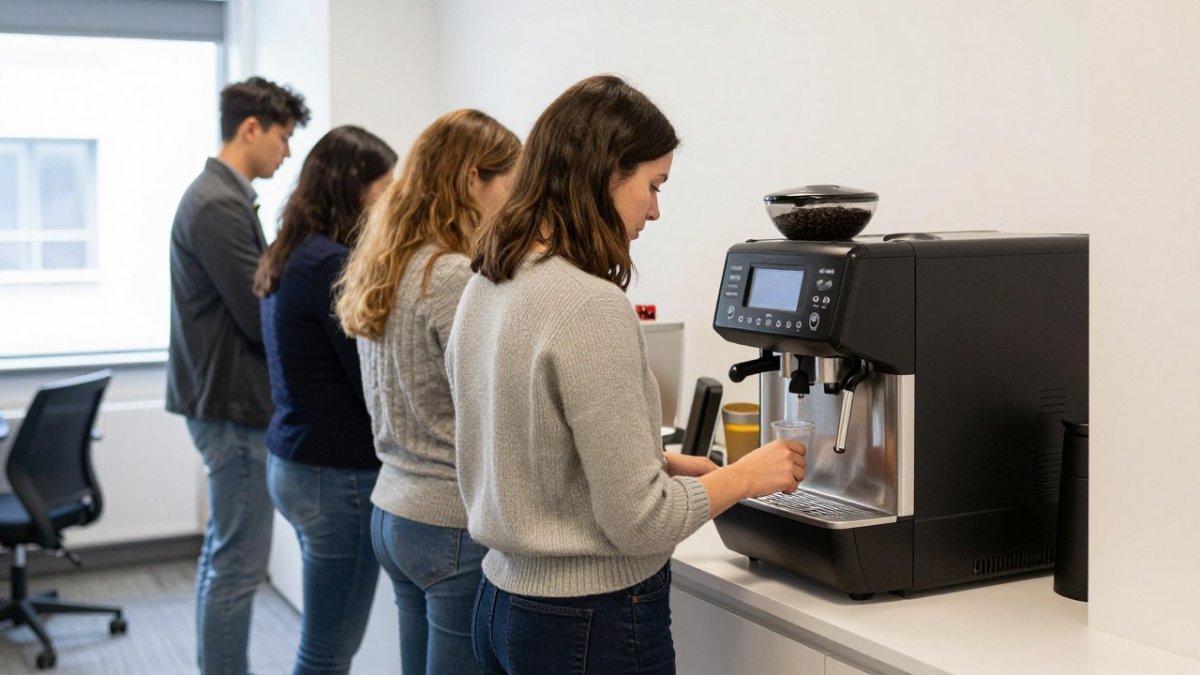
A machine with a large boiler and fast recovery keeps the queue moving. A small boiler that stalls after ten drinks creates the exact bottleneck you are trying to avoid.
Workflow matters too. Ask how many steps a user takes to make a drink, where the bean hopper and water tank refill, and whether the drip tray empties easily. Staff who can clear a machine in seconds are less likely to abandon a queue.
Practical checks before you buy:
- Ask for recovery time after a full peak run, not just the rated output
- Confirm boiler capacity matches your peak 15-minute demand
- Watch a demonstration of the full drink cycle, including cleaning
- Check where the machine sits relative to the queue and the sink
Office Coffee Machine Maintenance and Downtime Contingency
A machine that breaks at 9 a.m. on a Monday costs more than the repair. It costs the queue that forms, the staff who leave the building to find coffee, and the morale hit when the one thing that keeps the office running stops working.
Set up a simple routine:
- Daily: empty the drip tray, refill beans and water, run the automatic clean
- Weekly: check the milk system, clean the outlets and brew group as the manufacturer directs
- Regularly: arrange scheduled servicing and keep the service contact details to hand
That routine keeps the machine healthy, but it does not answer the question every office manager asks when the machine fails during peak hours: what now?
The answer is a service level agreement, or SLA. An SLA sets out the response time a service provider commits to when you report a fault. Response time is not the same as fix time.
A next business day response may suit low volume offices, while high traffic sites usually need a faster response to limit downtime. Match the response commitment to your peak demand.
Downtime contingency means deciding in advance what your team does if the machine fails. Options include a second machine in another break area, a temporary tabletop unit, or a support agreement with a fast response time. Confirm response times and what is covered before you sign.
Watch out: a cheap machine with a slow SLA can cost more over a year than a more expensive machine with a fast SLA, because the hidden cost of downtime during peak hours is rarely captured in the purchase price.
Service terms vary, so ask for the full maintenance schedule and what it includes. Ask your supplier for the full maintenance schedule and what it includes, and what applies to your site.
Planning Your Next Step: Getting a Capacity-Matched Quote
You now have the inputs: daily volume, peak hour demand, cups per hour, headcount bands, machine type, recovery time and a maintenance plan. Write them down in one place. That document is the brief a supplier needs to recommend the right machine.
Admiral Vending selects equipment against those numbers rather than offering one size for everyone. Our team can match a tabletop, higher-capacity or floor standing bean to cup machine to your site, arrange delivery and professional installation, train your staff and provide coffee supplies.
To get a capacity-matched recommendation, use our instant quote system or contact us with your peak hour figures. Get your instant quote from Admiral Vending and see which machine fits your office.
Admiral Vending: coffee machines matched to your peak demand. Tell us your headcount and busiest hour, and we will recommend a machine that keeps the queue short.
Frequently Asked Questions
How do I calculate how many coffees an office needs at peak times?
Start with your headcount and the share of staff who drink coffee at work, then estimate cups per person per day. Next, find the peak hour by noting when the queue is longest, typically mid-morning and just after lunch. Assume a large share of the day’s drinks fall into a single hour, then divide that figure by 60 to get cups per minute. Compare this against the machine’s rated output and recovery time to check whether one machine can keep pace or whether you need a second unit or a higher capacity model.
How many cups per hour can a bean to cup coffee machine make?
Output varies widely between models, so always check the manufacturer’s rated cups per hour rather than relying on a general figure. Rated output assumes the machine is at operating temperature and the hopper and milk supply are full. Real output during a rush is lower because of recovery time between drinks, cleaning cycles and the time needed to refill beans and water. Plan for a realistic figure below the headline rating, and ask your supplier to confirm performance at your peak volume.
Should I choose one high capacity machine or several smaller machines?
One high capacity machine is simpler to manage and suits a single, concentrated kitchen or break area. Several smaller machines spread the load, which reduces queues when demand is split across floors or zones, and they provide a backup if one unit needs service. The right choice depends on whether your peak is concentrated in one place and whether downtime would seriously disrupt staff. Many offices with 100 or more regular coffee drinkers use a combination of one high output machine and a smaller secondary unit.
How often does a commercial coffee machine need cleaning?
Daily tasks usually include emptying drip trays, cleaning milk lines and wiping outlets, while automated cleaning cycles should run as the manufacturer recommends. Deeper descaling and servicing follow a schedule set by the manufacturer and the water hardness at your site. Heavy use increases the frequency, so a busy office may need more frequent checks than the minimum. Check the manual for your model and agree a service contract that covers planned maintenance and call-out response times.