Last Updated: November 8, 2026
Quick Summary
Creating a wellness focused office breakroom means designing a shared space that actively supports rest, focus and healthier habits, not just providing a kettle and a biscuit tin. A proper wellness breakroom combines comfortable seating, calming lighting and reduced noise, healthy food and drink within easy reach, and a layout that separates quiet rest from social chat.
- Split the breakroom into zones for quiet rest, social chat and a central drinks station.
- Offer at least one gluten free and one dairy free snack option at all times.
- Keep nuts in a separate sealed container with a clear label for allergy safety.
- Place a visible water station near seating but away from the main walkway.
- Write down hygiene routines with named responsibility so nothing is left to chance.
Table of Contents
- What a Wellness Focused Breakroom Actually Includes
- Office Breakroom Ideas That Support Rest and Focus
- Healthy Office Snacks and Hydration That Staff Actually Eat
- Workplace Wellbeing Ideas Beyond the Kitchen Table
- Choosing a Bean to Cup Coffee Machine for Office Use
- Planning, Budget and Hygiene for Every Shift
- Get Your Instant Quote for a Wellness Breakroom
- Frequently Asked Questions
What a Wellness Focused Breakroom Actually Includes
Creating a wellness focused office breakroom means designing a shared space that actively supports rest, focus and healthier habits rather than just providing a kettle and a biscuit tin.
Most breakrooms fail for one simple reason. They are treated as leftover space, not designed space.
A proper wellness breakroom combines four elements:
- Comfortable seating that allows people to sit properly, not perch
- Calming lighting and reduced noise
- Healthy food and drink options within easy reach
- A layout that separates quiet rest from social chat
Get these right and the room earns its place. Get them wrong and staff will eat at their desks instead.
Below, we break down practical office breakroom ideas you can act on, whatever your budget or floor space.
Office Breakroom Ideas That Support Rest and Focus
The biggest mistake is treating the breakroom as one open room with one purpose. People need choice.
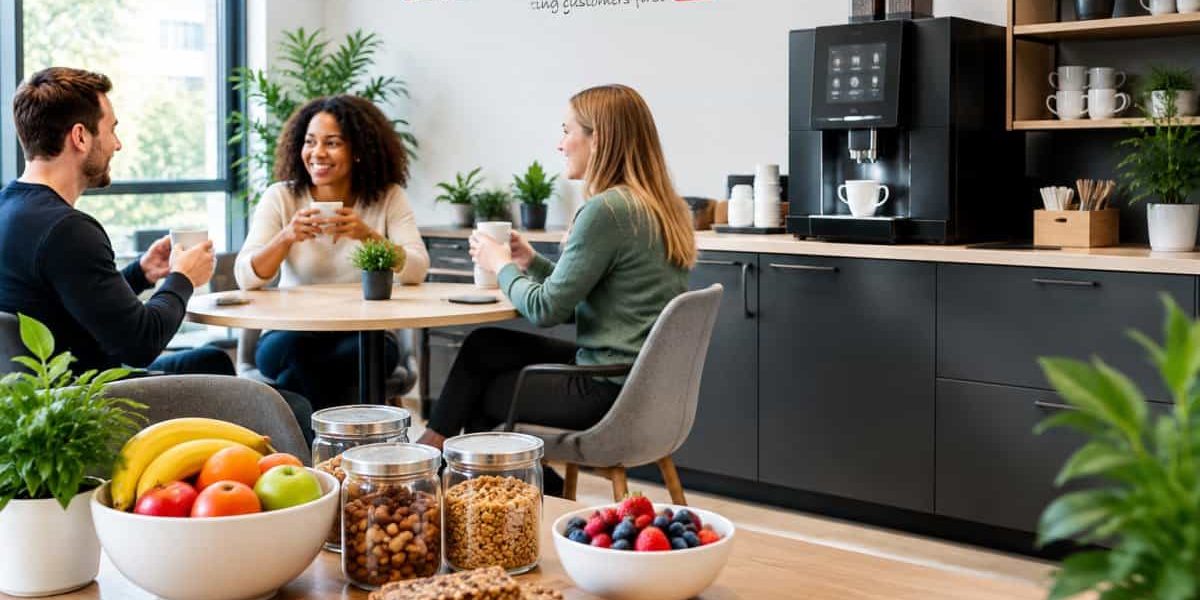
Split the space into zones where you can:
- Create a quiet corner with two or three armchairs away from the main walkway
- Add a social table for groups who want to talk over lunch
- Keep the drinks station central so nobody has to cross a quiet zone to get a coffee
- Use soft furnishings such as rugs and cushions to absorb sound
- Fit warmer lighting on a dimmer rather than harsh overhead strips
- Add a plant or two for visual calm
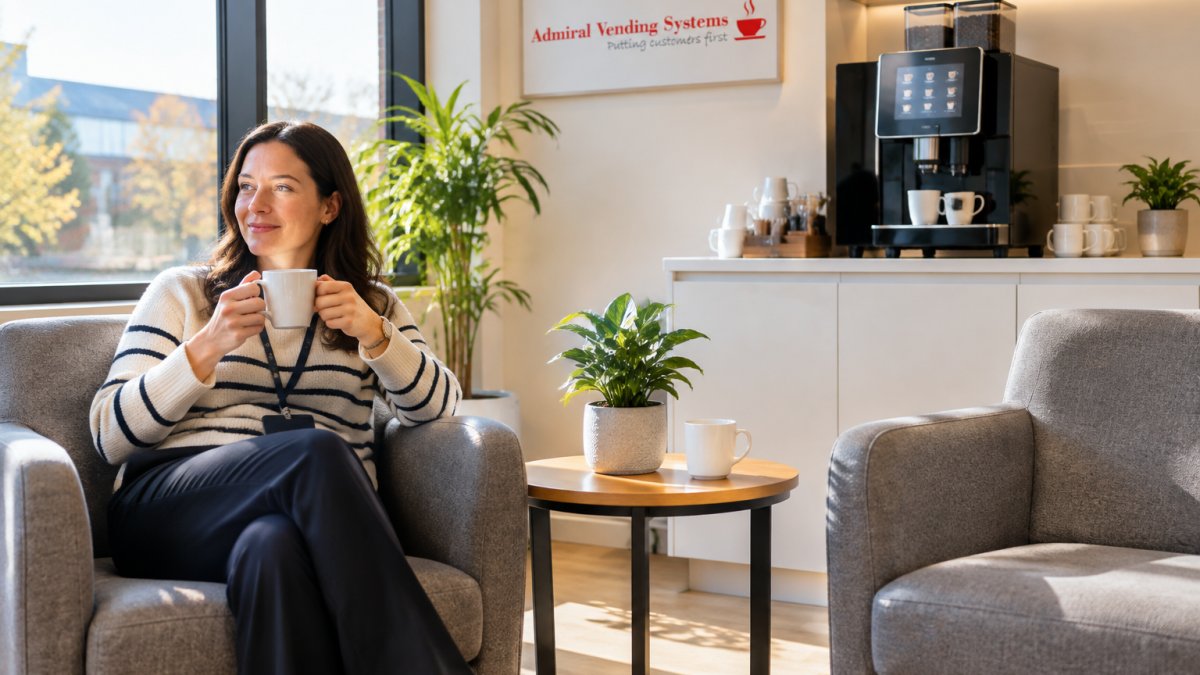
What most guides miss is noise. A breakroom that echoes will never feel restful, no matter how good the furniture looks. Soft surfaces do more for calm than a fresh coat of paint.
Healthy Office Snacks and Hydration That Staff Actually Eat
Healthy office snacks only work if people want to eat them and can eat them safely. Stock a bowl of rice cakes nobody touches and you have wasted money. Worse, stock snacks that exclude staff with allergies or dietary needs and you have created a room that feels unwelcoming.

Office Coffee Machines for UK Businesses | Barista Quality Coffee at Work | UK
Admiral Vending Systems
A common pattern among workplaces that get this right is to offer variety, label everything clearly, and let demand guide what you restock. Good options include:
- Fresh fruit that is easy to grab, such as apples, bananas and satsumas
- Nuts and seeds in small portions, kept in sealed containers
- Oatcakes, yoghurt pots and low sugar cereal bars
- Plain water, sparkling water and herbal teas
Dietary inclusion matters more than most guides admit. A breakroom that only stocks biscuits and crisps excludes anyone managing blood sugar, and a snack bowl that mixes nuts with dried fruit creates a risk for staff with allergies. Keep nuts in a separate sealed container with a clear label. Offer at least one gluten free and one dairy free option at all times, and display allergen information next to each snack so nobody has to guess. For staff who fast for religious reasons or work shifts that do not align with standard lunch hours, keep a shelf stable option available outside core hours.
Hydration deserves the same planning. A visible water station near the seating encourages people to drink more through the day. Place it away from the main walkway so nobody has to squeeze past to fill a bottle, and keep a stack of clean glasses or a supply of paper cups beside it. If your site has hard water, a filtered tap or a plumbed in water cooler makes a noticeable difference to how much people drink.
If you want to go further, a structured snack programme can take the guesswork out of ordering and rotating stock. You can explore the benefits of healthy office snack programs to see how a managed approach works in practice, including how to set a rotating menu that accounts for dietary needs without overordering.
Workplace Wellbeing Ideas Beyond the Kitchen Table
Wellbeing does not stop at food and drink. The room itself can support mental health and stress reduction if you plan it that way, but only if the additions are practical, inclusive and actually used. Most guides list a quiet corner and a bookshelf and stop there. The gap is in how you make those things work for a mixed workforce.
Start with a quiet space that has a clear purpose. A sign asking people to keep it phone free is a good start, but the space needs to be physically separated enough that a conversation at the coffee machine does not carry into it.
For staff with sensory needs, small adjustments make the difference between a room they can use and one they avoid. Offer a pair of ear defenders or foam earplugs in a discreet basket near the quiet seating. Avoid flickering fluorescent tubes in the rest area and use lamps or warm LED fittings instead.
A shelf of books or magazines for screen free breaks works best when it is curated rather than random. As the shelf changes, keep the same thoughtful approach to shared food at office gatherings, where even Knuckle Sandwiches should be considered alongside allergy needs.
A short guided breathing card pinned near the seating is a low cost addition, but it only helps if it is visible and simple. A card with three or four steps and a suggested duration of one to two minutes is more likely to be used than a poster with a long explanation.
A noticeboard for team walks or lunchtime activities can build connection, but it needs an owner. Without someone to update it, it becomes a faded sheet of paper nobody reads. Assign the noticeboard to a wellbeing champion or rotate responsibility monthly, and keep the information current.
For a deeper look at carving out genuine calm, read our guide on how to design a quiet zone in the workplace. It covers layout, sound and privacy in more detail.
The point is choice. Some staff recharge by chatting. Others need five minutes of silence. A wellness focused office breakroom gives both groups somewhere to go, but only if the quiet option is genuinely quiet and the social option is genuinely welcoming.
Choosing a Bean to Cup Coffee Machine for Office Use
A bean to cup coffee machine for office use is often the single upgrade staff notice most. Fresh coffee on demand keeps people in the building rather than queuing at a nearby café.
When choosing, work through these questions:
- How many drinks a day? A 40-person office has very different needs from a 150-person site.
- How much space do you have? Tabletop models suit smaller kitchens and meeting rooms.
- Which drinks do staff want? Espresso, americano, cappuccino, latte and hot chocolate cover most tastes.
- Who will maintain it? Choose a supplier who handles service and supplies.
Our range of commercial bean to cup coffee machines includes compact tabletop units for smaller offices and floor standing machines for high footfall locations.
The thing nobody tells you about machine choice is that capacity matters more than features. An underpowered machine creates queues, and queues kill the calm you are trying to build.
Planning, Budget and Hygiene for Every Shift
A wellness breakroom needs a plan, not just furniture. Start with a short written brief covering layout, budget and cleaning.
On budget, pricing depends on the equipment you choose, your site and your service needs. We recommend getting a tailored quote for current prices.
Hygiene is where many breakrooms quietly fail. Shared kitchens need clear routines:
- A daily wipe-down of counters and the drinks station
- Bin emptying at the end of each shift
- Fridge clear-outs on a fixed day each week
- Named responsibility so nothing is left to chance
Shift-based workplaces need this in writing. If the early shift and the late shift both assume the other cleaned up, neither will. Our guide to essential hygiene protocols for shared office kitchens sets out routines that hold up across shifts.
Also plan for accessibility and dietary needs. Step-free access, seating at different heights and clear allergen labelling on snacks make the room work for everyone.
A wellness breakroom runs on routines, so here are the hygiene tasks worth writing down.
| Task | Frequency |
|---|---|
| Wipe down counters and drinks station | Daily |
| Empty bins | End of each shift |
| Clear out the fridge | Fixed day each week |
| Assign named responsibility | Ongoing |
Get Your Instant Quote for a Wellness Breakroom
Creating a wellness focused office breakroom comes down to a handful of decisions: zoning the space, stocking food people want, choosing the right coffee machine and putting hygiene routines in writing.
Admiral Vending has eight years of experience supplying commercial coffee machines to workplaces across the UK. We handle machine selection, delivery, professional installation, operator training and ongoing service support. Our AI-powered instant quote system helps you get a tailored quote for your site.
If you are ready to move, see how to get a coffee machine quote online for your office and find out what details you need to hand.
A breakroom that supports rest, focus and healthier habits starts with one practical upgrade. Admiral Vending can help you choose a machine that matches your headcount and floor space, install it properly and keep it running with nationwide service support and coffee supplies. Get started with Admiral Vending and build a breakroom your staff actually use.
Frequently Asked Questions
What should a wellness focused office breakroom include?
A wellness breakroom combines three elements: a calm physical space, easy access to good food and drink, and a culture that lets people actually use it. Practical items include comfortable seating away from desks, soft lighting, a quiet corner for short breaks, healthy snacks, and a reliable bean to cup coffee machine for office use so people do not leave the building to get a decent drink. Add clear recycling and a simple cleaning routine, then gather feedback after a month to see what staff use most.
How can coffee facilities support a better breakroom experience?
A good coffee machine turns the breakroom into a destination rather than a corridor. Bean to cup models grind fresh on demand and offer espresso, americano, cappuccino, latte and hot chocolate at the press of a button, which removes queues and the temptation to go out for coffee. Match capacity to headcount: a compact tabletop machine suits a small office, while a floor standing model handles high footfall sites. Professional installation, operator training and ongoing service support are part of the complete solution Admiral Vending provides.
What are some healthy office breakroom ideas that staff will use?
Stock what people actually reach for: fruit, nuts, yoghurt, oatcakes and low-sugar cereal bars, plus a hydration station with still and sparkling water. Keep healthy options at eye level and within easy reach, and place less healthy items further away. A small fridge for milk and packed lunches helps, and clear labelling for allergens and dietary needs makes the space inclusive. Rotate the selection monthly and ask staff what they want rather than guessing, because participation rises when people feel consulted.
How do you design a breakroom for different workplace needs and shifts?
Start with how the space is used across the day and across shifts. Hybrid teams need flexible seating and enough power points for laptops, while shift based sites need the breakroom to work at 6am and 10pm, not just at lunch. Provide a mix of seating: upright chairs at tables for eating, softer chairs for a short rest, and a quiet corner away from the main traffic. Keep walkways clear for accessibility, and check that lighting and ventilation work on every shift. A short staff survey before you buy anything will show which needs matter most.