Last Updated: October 24, 2026
Quick Summary
To choose an office coffee machine, start with your daily cup count and peak hourly demand rather than the machine itself, then match the type to how your team drinks. Bean to cup suits most workplaces serving milk drinks, while filter suits black coffee drinkers on a budget. Always weigh total cost of ownership and check space, water, drainage and power before buying.
- Size the machine to daily cups but match serving speed to peak hourly demand.
- Bean to cup grinds fresh beans on demand and needs no barista skill.
- Compare total cost of ownership over three to five years, not just upfront price.
- A bean to cup machine typically needs 40 to 60cm of width and 50cm of depth.
- Ask suppliers for a three year total cost of ownership breakdown including consumables and servicing.
Table of Contents
- Start With Daily Cups and Peak Demand, Not the Machine
- Match the Machine Type to How Your Team Drinks Coffee
- Bean to Cup vs Filter Coffee Machine: Which Suits a Workplace?
- Choosing an Office Coffee Machine for a Small Office
- Weigh Up Total Cost of Ownership, Not Just the Upfront Price
- Check the Practicalities: Space, Water, Drainage and Power
- Plan Office Coffee Machine Maintenance Before You Buy
- Get a Site Survey and an Instant Quote
- Frequently Asked Questions
Start With Daily Cups and Peak Demand, Not the Machine
Most buyers start with a machine. That is the wrong end of the problem. At Admiral Vending, we have spent eight years watching workplaces pick equipment by looks or brand, then discover the queue at 9am tells a very different story. The first question is not which office coffee machine to buy. It is how many drinks your team actually needs, and how fast.
Work Out Cups per Day and Cups per Hour
Daily cups set the size of machine. Peak hourly demand sets the speed.
Count heads, then apply a realistic habit rate:
- Heavy coffee culture: most staff drink two or more cups a day
- Mixed team: roughly half drink coffee, half drink tea or nothing
- Meetings and visitors: add a buffer for client-facing spaces
Then look at the clock. A 100-person office does not drink 100 cups evenly across eight hours.
A machine that copes with the daily total but not the peak will still produce queues.
Watch out: sizing for average demand rather than peak demand is the single fastest way to recreate the queue you are trying to fix.
Match the Machine Type to How Your Team Drinks Coffee
The right machine type depends on drink habits, not budget alone. A team that wants flat whites and lattes needs a different setup from one that just wants a decent black coffee.
Bean to Cup, Pod, Filter, Instant and Traditional Espresso Compared
Each type trades off differently on speed, drink variety, and running costs. Here is how they line up.
| Machine type | Best for | Drink variety | Speed | Watch out for |
|---|---|---|---|---|
| Bean to cup | Busy offices wanting fresh coffee with no skill required | Espresso, americano, cappuccino, latte, hot chocolate | Fast, one-touch | Needs regular cleaning and descaling |
| Pod / capsule | Small teams, low volume, simple setup | Limited to pod range | Quick per drink | Ongoing pod cost, waste volume |
| Filter | Teams happy with black coffee, tight budgets | Black coffee only | Batch brew, good for volume | Sits out milk drinks |
| Instant | Very low volume, lowest cost | Limited | Instant | Noticeably different taste |
| Traditional espresso | Teams with a trained barista | Full range, in skilled hands | Slower per drink | Needs skill and practice |
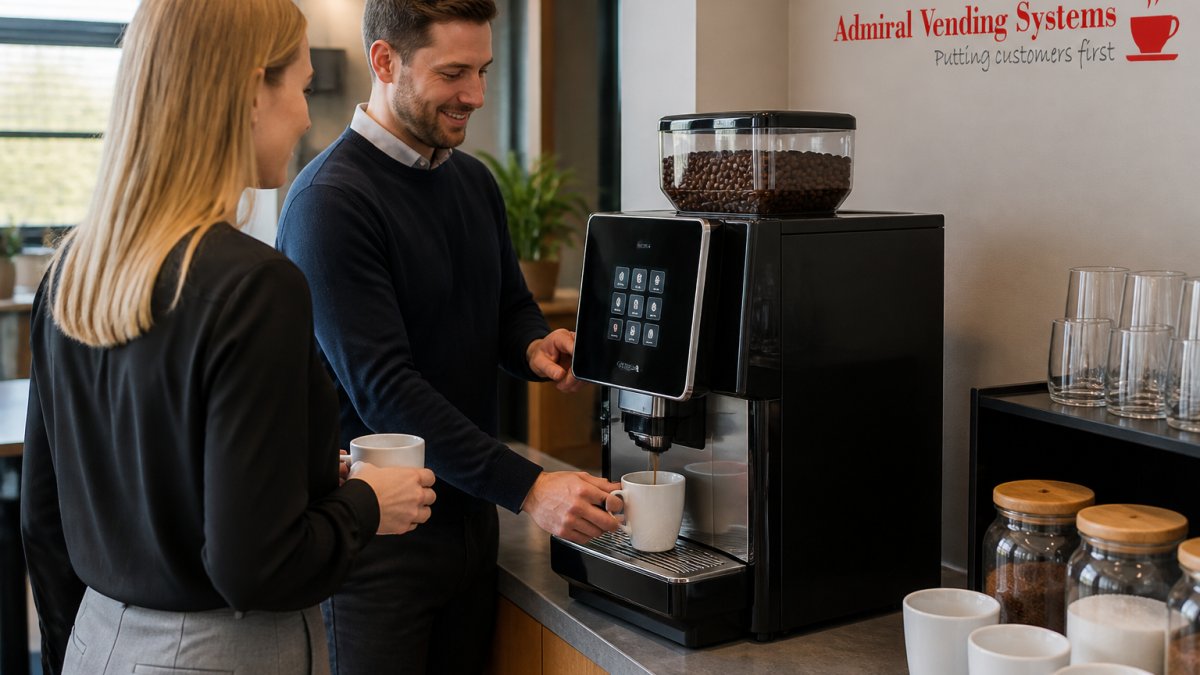
Bean to cup suits most workplaces because it grinds fresh beans on demand and delivers milk drinks at the touch of a button. No training, no waste, consistent results.
If you want to see how these fit different team sizes, you can browse the office coffee machine range and match a model to your headcount.
Bean to Cup vs Filter Coffee Machine: Which Suits a Workplace?
Bean to cup wins for most workplaces that serve milk drinks, while filter coffee suits teams that want simple black coffee at low cost. The deciding factor is drink variety, not price.

Office Coffee Machines for UK Businesses | Barista Quality Coffee at Work | UK
Admiral Vending Systems
Choose bean to cup if:
- Staff expect cappuccino, latte, or hot chocolate
- You want one-touch operation with no barista skill
- You value fresh ground coffee over batch brewing
- Visitors and clients use the machine
Choose filter if:
- The team drinks black coffee and is happy with it
- Volume is steady rather than spiky
- Simplicity matters more than variety
A common mistake is buying filter to save money, then watching staff walk out for lattes. The saving disappears fast.
Choosing an Office Coffee Machine for a Small Office
Small teams need a machine that scales down, not a cut-down version of a large one.
For an office coffee machine for small office settings, look for:
- A tabletop footprint that fits an existing kitchen counter
- Cup capacity matched to a modest daily total
- A milk system that is easy to clean, or none at all
- Simple maintenance you can do in-house
Compact bean to cup models handle this well. They still grind fresh beans and serve café-style drinks, without the bulk of a floor-standing unit.
If your team is on the smaller side, our small office coffee machine solutions guide covers the options in more detail.
Weigh Up Total Cost of Ownership, Not Just the Upfront Price
The purchase price is only part of the bill. Running costs, supplies, and servicing usually decide whether a machine is good value over its life. A machine that looks cheap on day one can cost far more by year three.
Break the cost into five parts:
- Upfront cost: purchase, lease, or rental
- Coffee and milk supplies: the biggest ongoing line for most offices
- Maintenance and servicing: cleaning, descaling, repairs
- Downtime: the hidden cost when a machine is out of action
- Utilities: energy and water consumption
Purchase, Lease or Rental: The Real Difference
Buying outright gives you the lowest long-term cost if you keep the machine for several years, but you carry the risk of breakdowns and obsolescence.
A common pattern is that workplaces with stable, high volume choose purchase or lease, while those with uncertain demand or a need for the latest model prefer rental. The key is to compare the total cost over the expected life, not just the monthly figure.
How to Build Your Own Numbers
Start with your daily cup count from the first section. Then estimate:
- Beans or pods: how many grams or pods per cup, and the cost per kilogram or pod. For bean to cup, a typical 7g dose per espresso and 15g for a milk drink gives a starting point. Pod costs vary widely by brand and roast.
- Milk: if you serve milk drinks, estimate litres per week based on the proportion of drinks that are milk-based.
- Cleaning and descaling: tablets, descaler, and filters, usually a modest annual cost.
- Servicing: an annual service contract or pay-per-visit, plus any parts.
- Energy: check the machine’s power rating and estimate hours of use. A bean to cup machine might draw 1,200-1,500W while heating, but only intermittently.
Add these up over three to five years and compare with the purchase price. You will often find that the cheapest machine to buy is not the cheapest to run.
Ask suppliers for a total cost of ownership breakdown over three years, including consumables and servicing. A good supplier will provide this without obligation.
For a step-by-step method, see our guide on how to calculate your office coffee budget.
Check the Practicalities: Space, Water, Drainage and Power
A machine only works if the room can take it. Check the site before you commit, not after delivery. This is where many installations go wrong, and the fix is usually simple if caught early.
Space and Footprint
Measure the counter gap, including clearance for the door to open and for a cup to sit under the spout. A bean to cup machine typically needs 40-60cm of width and 50cm of depth, but check the specific model. Also allow space for refilling beans and water, and for accessing the drip tray.
Water Supply and Quality
Plumbed machines need a nearby mains water supply and a drain for waste water. Tank models need refilling manually, which is fine for low volume but a chore for busy offices. Water hardness matters: hard water causes limescale, which reduces performance and increases descaling frequency. A water filter or softener can extend the machine’s life and improve taste. If you are on a plumbed supply, check the water pressure and whether a filter is needed.
Drainage
Some machines need a drain line for waste water. If you cannot plumb a drain, choose a model with a removable waste tank. The trade-off is that someone must empty it regularly.
Power
Check the socket type and whether the circuit can take the load. A commercial bean to cup machine may draw 1,500-3,000W, so a dedicated circuit may be needed. Avoid extension leads for high-power machines.
Ventilation and Access
Allow room to open the machine for cleaning and refills. Good ventilation helps if the machine produces steam.
Getting this wrong means a machine that sits in a corridor or trips the electrics. A site survey settles it quickly and avoids costly returns.
For layout guidance around these constraints, see our article on how to design an office coffee station.
Plan Office Coffee Machine Maintenance Before You Buy
Reliability is decided before purchase, not after the first breakdown. Ask what cleaning and servicing the machine needs, and who does the work.
Daily and weekly routines keep a machine dependable:
- Empty and rinse the waste grounds
- Clean the milk system after use
- Run the built-in rinse cycles
- Descale on schedule
- Keep removable parts washed
Then confirm the support side: response times, service visits, and what happens when a machine fails. A good supplier builds maintenance into the plan from day one.
For a deeper look at what keeps equipment dependable, read our commercial coffee machine reliability guide.
Get a Site Survey and an Instant Quote
The final step is turning all of this into a firm recommendation. A site survey confirms space, plumbing, and power. A quote confirms the machine and support package that fit.
At Admiral Vending, we supply commercial bean to cup coffee machines to workplaces across the UK, backed by professional installation, operator training, and ongoing service support.
Our AI-powered instant quote system gives you a fast starting point, and our team handles the rest from survey to installation.
Frequently Asked Questions
How many cups can an office coffee machine make per day?
It depends on the model and its cup capacity. Compact tabletop machines suit lower daily volumes in smaller offices, while higher capacity tabletop and floor standing machines are built for busy workplaces needing hundreds of drinks a day. As a rule, work out your cups per day and peak hourly demand first, then match the machine’s serving speed and dispensing time to that. A supplier site survey will confirm whether a model keeps queues down at peak times.
Is a bean to cup machine suitable for a small office?
Yes, provided you choose a compact model. A bean to cup machine for a small office gives freshly ground coffee, milk drinks and a range of drink variety without staff training, and tabletop units fit limited counter space. For around 20 to 40 people, a compact tabletop bean to cup is usually enough. Check cup capacity, machine footprint and how often the grounds and water need emptying before deciding.
How much maintenance does an office coffee machine need?
Daily tasks are simple: emptying grounds, topping up beans and water, and wiping the milk system. Deeper work such as descaling and cleaning cycles depends on water hardness and daily usage, and most machines prompt you when it is due. A service plan covers routine maintenance, repairs and parts. Confirm what is included after the first year so you know the running costs and avoid surprise call-out fees.
What should I look for in a commercial coffee machine?
Look at daily usage and peak demand, drink variety including milk drinks, cup capacity and serving speed, machine footprint against your counter space, and water supply and drainage needs. Then weigh upfront cost against running costs, cleaning and descaling routines, and service support. A practical decision framework with weighted criteria, plus a site survey, stops you paying for capacity you do not need or buying a machine that cannot keep up.
Choosing an office coffee machine comes down to demand, drink habits, and honest running costs, not the brochure. Get those right and the queue problem solves itself. Get started with Admiral Vending and get a machine sized to your team, installed and supported from day one.