Table of Contents
- Why Coffee Quality Drops in High Volume Sites
- Commercial Bean to Cup Coffee Machine Maintenance That Protects Flavour
- The Impact of Water Filtration on Coffee Taste
- Selecting Coffee Beans for High Volume Sites
- Calibrating Grind, Dose and Brew Temperature
- Troubleshooting Common Flavour Defects
- Staff Training and Coffee Culture
- Frequently Asked Questions
Last Updated: September 28, 2026
Why Coffee Quality Drops in High Volume Sites
Coffee quality in high volume sites is the consistency of flavour, aroma and temperature across every drink served, all day long. Most sites lose it for three reasons: machines pushed past their cleaning cycle, water left untreated, and beans stored without rotation. This guide from Admiral Vending shows how to fix all three.
At Admiral Vending, we supply and support commercial bean to cup coffee machines across the country, so we see these problems daily. The pattern is predictable. A machine starts strong, then taste drifts. Nobody notices until staff start walking to the nearest café.
High volume changes the maths. A machine making 40 drinks a day can survive sloppy habits. One making 300 cannot.
High volume does not ruin coffee by itself. It simply exposes weak maintenance, poor water and stale beans faster than low volume ever will.
Commercial Bean to Cup Coffee Machine Maintenance That Protects Flavour
Commercial bean to cup coffee machine maintenance is the scheduled cleaning, rinsing and servicing that keeps every drink tasting the same. Skip it and oils build up in the brew group, which turns coffee bitter and flat. In high volume sites the failure is rarely sudden. It is a slow drift that starts with a slightly dull shot and ends with staff buying coffee elsewhere.
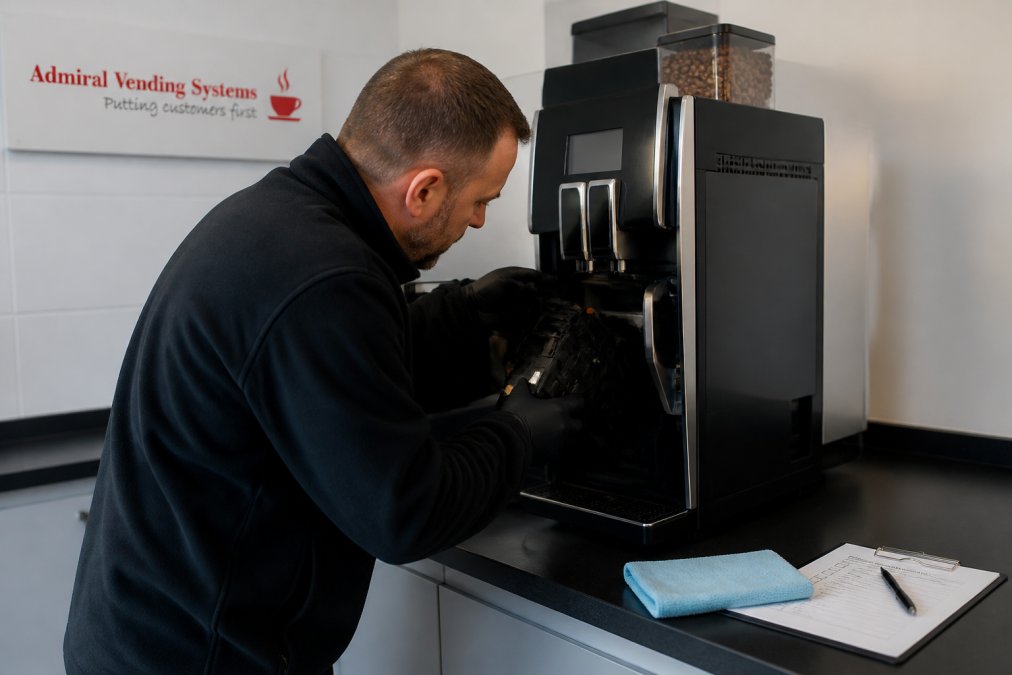
Preventative Maintenance Checklist for Facilities Managers
Most guides mention maintenance. Few give you a checklist you can print, laminate and pin next to the machine. Use this as a starting point, then adjust it to your drink volumes and water hardness.
Daily tasks
- Run the automatic rinse cycle at close of business
- Empty and rinse the drip tray and grounds bin
- Check the bean hopper for stale or bridging beans
- Wipe the steam wand and purge the milk lines after the last drink
Weekly tasks
- Clean the brew group with approved tablets
- Remove and rinse the milk system, including the pickup tube and frother
- Check the grinder burrs for visible wear or compacted grounds
- Inspect the door seals and gaskets for cracks or hardening
Monthly tasks
- Descale if your water hardness demands it, not simply because a month has passed
- Inspect seals, gaskets and the bean hopper for wear
- Test brew temperature with a calibrated probe
- Review filter life against actual litres used
Quarterly tasks
- Book a preventative maintenance visit
- Replace worn burrs if extraction times have drifted
- Deep clean the milk system with a dedicated cleaning cycle
- Audit the checklist against actual drink volumes and adjust
A checklist that is not signed off is just a poster. Assign one named person per shift to initial each task, and review the sheet weekly. Consistency comes from accountability, not from good intentions.
The Failure Mechanisms Behind Poor Maintenance
Understanding why each task matters makes staff far more likely to do it. Scale in the boiler reduces heat transfer, so brew temperature becomes unstable and coffee tastes dull or burnt. Oils in the brew group oxidise and turn rancid, which produces a bitter, flat cup even with fresh beans. Milk residue in the lines harbours bacteria and creates a sour note that no amount of grinding adjustment will fix.
The Impact of Water Filtration on Coffee Taste
Water makes up most of every cup, so the impact of water filtration on coffee taste is bigger than most managers expect. Untreated hard water leaves scale in the boiler, and scale breaks brew temperature stability.

Log your filter changes against actual litres used, not the calendar. High volume sites often burn through filters twice as fast as the label suggests.
Selecting Coffee Beans for High Volume Sites
Selecting coffee beans for high volume sites comes down to three things: freshness, consistency and a roast that suits milk drinks. Offices serve far more lattes and cappuccinos than espressos, so a medium roast usually works best. But the real challenge at volume is not choosing a bean. It is keeping that bean fresh from delivery to the hopper, across hundreds of drinks a day.
Supply Chain and Bulk Sourcing Without Losing Freshness
Most articles stop at “buy fresh beans”. That advice fails the moment you are ordering for a site serving 300 drinks a day. The gap is supply chain design. Here is how to source in bulk without sacrificing freshness.
- Order little and often. A weekly or fortnightly delivery of smaller bags beats a monthly pallet of large bags. Freshness is a function of time since roast, not bag size.
- Match order size to consumption. Calculate your average daily bean use in kilograms, then order enough for one to two weeks. Any more than that and the last bags will be stale before they are opened.
- Ask for roast date, not best before date. A best before date tells you nothing about when the beans were roasted. A roast date lets you plan rotation properly.
- Choose a supplier who roasts to order. A roaster who roasts after receiving your order will always beat one who ships from warehouse stock.
- Consider valve sealed bags. One way valves let beans degas without letting oxygen in. They protect aroma far better than standard packaging.
- Agree a standing order with a flexibility clause. High volume sites have unpredictable weeks. A standing order that can be adjusted up or down protects you from both running out and holding stale stock.
Freshness Rotation and Storage
- Store beans in sealed, cool, dark conditions, never in the fridge
- Keep bags closed between refills to protect aroma
- Label every delivery with its roast date
- Use the oldest beans first, every single time
- Order little and often rather than in bulk
- Never mix old and new beans in the same hopper
- Keep the hopper lid closed when the machine is not in use
A simple rotation rule works better than a complex system. When a new delivery arrives, move the older bags to the front of the shelf and the new bags to the back. Then always take from the front. This is the same first in, first out principle used in commercial kitchens, and it takes seconds to follow.
Sustainability and Waste in Bean Sourcing
High volume sites generate significant waste, from packaging to spent grounds. Choosing a supplier who offers recyclable packaging or a grounds collection scheme reduces your environmental impact and can support your wider sustainability reporting. Spent coffee grounds can be composted or used in landscaping, and some suppliers will collect them as part of a delivery round. This is a B2B value point that most coffee quality guides ignore entirely, yet it matters to facilities managers under pressure to demonstrate responsible sourcing.
Calibrating Grind, Dose and Brew Temperature
Calibration is where good equipment quietly wins or loses. Grind consistency, dose weight and brew temperature stability decide whether a bean reaches its full flavour profile.
Adjusting the grinder without rechecking the dose is the most common calibration error. Change one variable at a time, then taste before moving on.
Troubleshooting Common Flavour Defects
Most flavour problems trace back to one of four causes, and each has a clear fix:
| Taste Problem | Likely Cause | Fix |
|---|---|---|
| Bitter, harsh | Over-extraction or dirty brew group | Grind coarser, clean the group |
| Sour, sharp | Under-extraction or stale beans | Grind finer, check roast date |
| Weak, watery | Dose too low or worn burrs | Recheck dose, replace burrs |
| Flat, lifeless | Poor water quality or old filters | Test water, change filters |
Staff Training and Coffee Culture
Training is the difference between a machine that performs and one that underperforms. Staff who understand grind, dose and cleaning protect coffee quality far better than any manual on a shelf.
Frequently Asked Questions
How often should commercial bean to cup machines be serviced?
Commercial bean to cup machines in high volume sites typically need a professional service every three to six months, depending on daily throughput and water hardness. Between visits, daily rinsing of the drip tray and weekly cleaning of the brew group keep coffee quality stable. Admiral Vending provides nationwide service support and operator training so your team knows exactly what to check and when. Regular servicing also protects the grinder and water filtration systems from premature wear.
Does water quality affect coffee taste in commercial machines?
Yes. Water makes up around 98% of an espresso, so the impact of water filtration on coffee taste is significant. Hard water leaves limescale in the boiler and pipework, which reduces brew temperature stability and adds a chalky, flat flavour. Fitting a commercial water filtration system removes excess minerals and chlorine, giving a cleaner, sweeter cup. Test your water hardness first, then choose a filter matched to that reading and replace cartridges on schedule.
What are the most common causes of poor coffee quality in busy offices?
The usual culprits are stale beans, inconsistent grind, dirty equipment and poor water. Beans left in a hopper for weeks lose aroma and produce flat, bitter shots. Grinders that are not recalibrated drift away from the correct extraction time. Drip trays and brew groups that are not cleaned daily build up oils that taint every drink. Fixing these four areas delivers the biggest improvement in coffee quality for the least effort.
How can staff training improve the quality of coffee in a workplace?
Trained staff notice problems before they become complaints. Teaching a small team to check grind consistency, run a daily rinse cycle, log bean roast dates and report faults early keeps quality consistent across shifts. Admiral Vending includes operator training with every machine installation, covering cleaning routines, basic troubleshooting and when to call for service. This reduces downtime and keeps every cup at barista level.
Keeping coffee quality consistent across hundreds of daily drinks is a systems problem, not a luck problem. Water, beans, calibration and cleaning all have to work together, every day. Admiral Vending can take that off your plate with commercial bean to cup coffee machines, expert machine selection, professional installation, operator training and ongoing service support. Get started with Admiral Vending and serve fresh, consistent coffee your team actually looks forward to.