Table of Contents
- What Type of Coffee Machine for Business Fits Your Workplace?
- Why a Bean to Cup Coffee Machine for Office Use Beats Pod Systems
- Office Coffee Machine Leasing vs Buying: Which Makes Sense?
- Commercial Coffee Machine Maintenance: What’s Actually Required
- Features That Matter: Water Filtration, Grinder Integration and Remote Diagnostics
- Installation, Staff Training and Health and Safety Compliance
- Environmental Impact and Waste Management for Business Coffee Machines
- Frequently Asked Questions
Last Updated: September 23, 2026
What Type of Coffee Machine for Business Fits Your Workplace?
Choosing the right coffee machine for business starts with two numbers: how many people drink coffee and how many cups they get through daily. Get those wrong and you either pay for unused capacity or apologise for queues every morning.
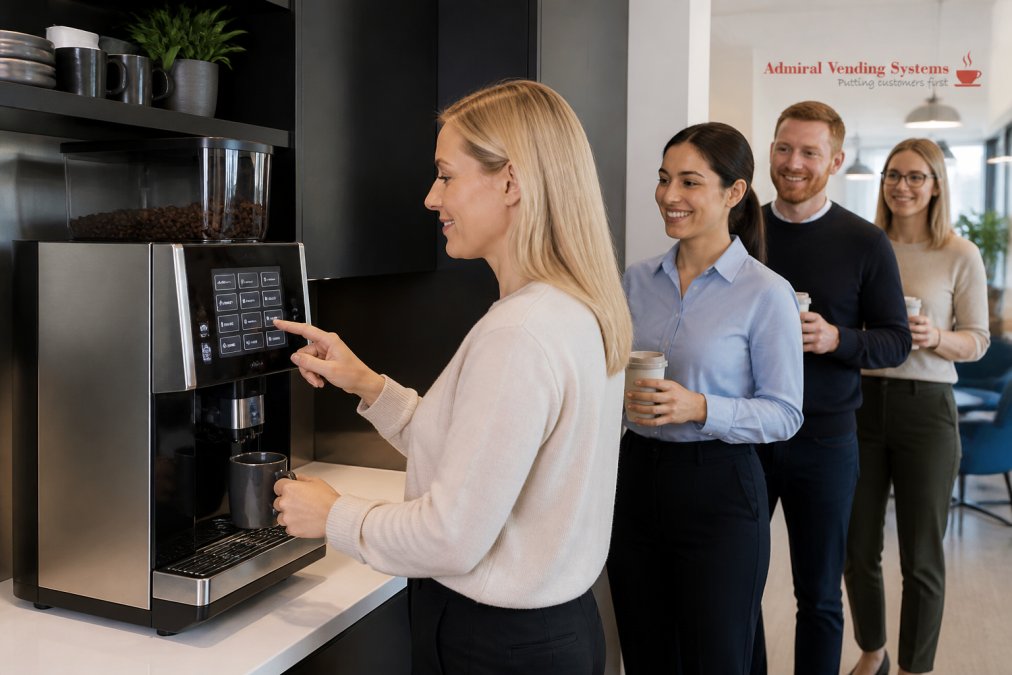
Tabletop vs Floor Standing Machines
Tabletop machines suit smaller teams and meeting rooms where counter space is tight. They are plumbed-in or tank-fed and handle light to moderate demand.
Matching Daily Drink Capacity to Staff Numbers
As a working rule, plan for two to three drinks per coffee drinker per day, then add headroom for meetings and visitors. A 150-person office where most staff drink coffee is closer to a 300 to 450-drink problem.
Why a Bean to Cup Coffee Machine for Office Use Beats Pod Systems
A bean to cup coffee machine for office use grinds fresh beans on demand and produces café style drinks at the press of a button, changing cost per cup, waste, and drink quality at once.
Check whether the machine is plumbed-in or tank-fed before you commit. Plumbed-in units never need manual refilling and suit high-volume sites, while tank-fed models give you placement flexibility where a water connection is not practical.
Office Coffee Machine Leasing vs Buying: Which Makes Sense?
Office coffee machine leasing vs buying comes down to cash flow and how much maintenance burden you want to own. Leasing spreads cost across a fixed monthly figure that typically bundles servicing, parts, and coffee supplies.

Total Cost of Ownership: What to Calculate Before You Commit
Before signing anything, work out the true cost of ownership rather than the headline figure: the machine, installation, water filtration, coffee beans, milk, cleaning materials, servicing, and staff time on refills and upkeep.
Do not compare lease quotes on the monthly figure alone. A low headline rate that excludes servicing, parts, or coffee supplies can end up costing significantly more than a slightly higher all-inclusive agreement.
Commercial Coffee Machine Maintenance: What’s Actually Required
Commercial coffee machine maintenance falls into two categories: daily tasks your staff handle and scheduled servicing a technician carries out. Skipping either shortens the machine’s life and affects drink quality. The real cost is lost productivity when a machine fails during the morning rush, inconsistent drinks, and compliance risk if you cannot produce maintenance records during a food safety inspection.
Daily and Weekly Tasks Your Team Can Manage
These are the non-negotiables. Assign them to named staff and build them into the opening or closing routine.
- Rinse the group head and run the automatic cleaning cycle before first service
- Empty and rinse the grounds bin before it overfills, which causes mould and blockages
- Wipe the steam wand after every use to prevent milk residue baking onto the metal
- Check the water filtration system and replace filters on schedule
- Descale on the manufacturer’s recommended interval, which for hard water areas may be monthly rather than quarterly
- Clean the drip tray and exterior surfaces daily
Scheduled Servicing: What a Technician Actually Does
Scheduled servicing covers the parts you cannot reach and the adjustments that keep extraction consistent. A typical visit includes:
- Inspecting and replacing internal seals and gaskets before they leak
- Checking grinder burrs for wear and recalibrating grind size
- Inspecting the boiler and descaling the internal system if required
- Testing water pressure and flow rates
- Calibrating brew temperature and extraction time
- Checking electrical connections and safety cut-outs
Documentation: What Inspectors Expect to See
If you serve coffee to the public, or to staff in a workplace with catering facilities, your local authority food safety team can ask to see your cleaning and maintenance records. Under food hygiene regulations, you must demonstrate that equipment is maintained in a clean and safe condition.
Keep a simple log that records:
- Daily cleaning tasks and who completed them
- Filter replacement dates
- Descale dates and products used
- Technician service visits and what was done
- Any faults reported and how they were resolved
Do not rely on the service provider to keep your records. You are responsible for demonstrating compliance. Ask for a copy of every service report and file it immediately.
The Real Cost of Skipping Maintenance
A poorly maintained machine does not fail suddenly; it degrades gradually. Extraction times drift, drinks taste bitter or weak, and staff start avoiding the machine or compensating with extra shots. By the time a breakdown happens, you have already lost weeks of consistent service.
Maintenance is not a cost centre. It is what keeps the machine producing consistent drinks, avoids unplanned downtime, and gives you the records you need if an inspector asks.
Features That Matter: Water Filtration, Grinder Integration and Remote Diagnostics
Three features separate a machine that lasts from one that frustrates. Water filtration protects the boiler from limescale, the leading cause of premature failure in hard water areas. Grinder integration means the machine grinds to order rather than using pre-ground coffee, so every drink is fresh.
Other features worth checking on the specification sheet:
- Boiler capacity and recovery time between drinks
- Cup warmer to keep drinks at temperature
- Pressure profiling for consistent extraction time
- Intuitive interface so staff need minimal training
- Durable construction, usually stainless steel, for commercial grade use
Water filtration and remote diagnostics are the two features most likely to reduce your long-term costs. Everything else is preference.
Installation, Staff Training and Health and Safety Compliance
Installation is not a plug-in-and-go job for most commercial machines. Plumbed-in units need a water connection and suitable power supply, and the machine must be sited where it can be serviced without moving half the kitchen. The bigger oversight is compliance: commercial coffee equipment sits at the intersection of food hygiene, health and safety, and electrical safety regulations, and getting this wrong creates risk no machine feature can offset.
Installation Requirements You Cannot Skip
Before the machine arrives, confirm three things:
- Water connection: Plumbed-in machines need a mains water supply with adequate pressure and a shut-off valve. If the water is hard, you will also need a water softener or filtration system to protect the boiler.
- Power supply: Commercial machines draw significant current. Check the available circuit and whether a dedicated supply is required. A machine that trips the circuit every morning is not a bargain.
- Ventilation and drainage: Some machines produce steam and waste water. Ensure the site has adequate ventilation and a drainage route for the drip tray or waste water outlet.
Siting matters too. Position the machine where staff can access it without crossing a busy walkway, and leave clearance for the technician to open panels. If the machine is boxed in, every service visit takes longer and costs more.
Staff Training: More Than Just Pressing Buttons
A machine with an intuitive interface takes minutes to learn. But training should cover more than making a drink. Staff need to know:
- How to run the daily cleaning cycle and why it matters
- How to change bean hoppers and recognise when the grinder needs attention
- What to do if the machine displays a fault code or stops mid-service
- How to spot early signs of a problem, such as unusual noises, leaks, or inconsistent shots
- Who to contact when something goes wrong, and what information to provide
Health and Safety Compliance: What Actually Applies
Any commercial coffee machine used in a workplace falls under general food hygiene and health and safety duties. The specific regulations include:
- Food Safety Act 1990 and related food hygiene regulations: You must ensure that food and drink preparation equipment is clean, maintained, and safe to use. This applies even if you only serve coffee to staff.
- Health and Safety at Work etc. Act 1974: You have a duty to ensure the safety of employees and anyone affected by your operations. This includes electrical safety, hot surfaces, and safe use of the equipment.
- Electricity at Work Regulations 1989: Portable appliance testing (PAT) is not a legal requirement for all equipment, but you must ensure electrical equipment is safe. Most commercial machines are hard-wired or on a dedicated circuit, so a qualified electrician should inspect the installation.
- Provision and Use of Work Equipment Regulations 1998 (PUWER): Equipment must be suitable for its intended use, maintained in a safe condition, and used only by trained staff.
Ask your supplier for a written handover that includes installation details, service contacts, and a recommended cleaning schedule. This becomes the foundation of your compliance records.
Water Safety and Legionella
If your coffee machine is plumbed into a mains water supply, it forms part of your water system. Under the Health and Safety Executive’s Approved Code of Practice for Legionella control (L8), you must assess and manage the risk of Legionella bacteria in water systems (Legionnaires’ disease. The control of legionella bacteria in water systems). Coffee machines are low risk because water is typically heated and not aerosolised in a way that creates exposure, but if the machine has a water tank that sits idle for long periods, or there are dead legs in the pipework, the risk increases.
Electrical Safety and PAT Testing
Commercial coffee machines are high-power appliances. Even if PAT testing is not a legal requirement for every item, you must show that electrical equipment is safe. For hard-wired machines, this means an electrical installation condition report (EICR) for the circuit, carried out by a qualified electrician. For plug-in machines, a visual inspection and periodic PAT test is good practice.
Compliance is not a one-off task. It is a set of habits: clean daily, document what you do, train your staff, and keep records. If an inspector asks, you should be able to show exactly how you are meeting your duties.
Environmental Impact and Waste Management for Business Coffee Machines
Bean to cup machines generally produce less waste than pod systems because there are no single-use capsules. The main waste streams are coffee grounds, milk packaging, and used water filters.
Frequently Asked Questions
What is the best coffee machine for a small office?
For offices with up to 40 staff, a compact tabletop bean to cup machine usually works best. Look for a model with a plumbed-in water supply or a decent tank capacity, a built-in grinder and an automatic cleaning cycle. Daily drink capacity matters more than physical size. A machine rated for 50 to 80 drinks per day handles most small offices without queues forming at peak times.
Should I lease or buy a coffee machine for my business?
Leasing spreads the cost and typically bundles servicing, coffee supplies and repairs into one monthly figure, which suits businesses that want predictable outgoings. Buying makes sense if you plan to keep the machine for many years and are comfortable covering maintenance separately. Compare the total cost of ownership over three to five years, including preventative maintenance, water filtration and callout charges, before deciding.
What maintenance is required for a business coffee machine?
Daily tasks include rinsing the group head, emptying the grounds bin and running the automatic cleaning cycle where fitted. Weekly jobs cover milk system flushing and drip tray cleaning. Professionally, you should book preventative maintenance every three to six months, including descaling, water filter replacement and seal checks. A service level agreement with defined response times keeps downtime short and protects your machine’s lifespan.
How do I choose a commercial bean to cup coffee machine?
Start with daily drink volume and peak-hour throughput, then match boiler capacity and grinder integration to that figure. Check whether the machine is plumbed-in or tank-fed, since plumbing suits high-volume sites. Confirm the drink menu covers what your team actually wants, such as espresso, americano, latte and hot chocolate. Finally, weigh installation, operator training and ongoing support, because a reliable service partner matters as much as the hardware.