Table of Contents
- Why Businesses Are Moving Beyond Traditional Office Catering
- Office Food Solutions That Fit Modern Work Patterns
- Fresh Office Snack Solutions and Refreshment Variety
- Premium Coffee and Beverage Provision for Workplace Engagement
- Creative Office Lunch Ideas for Flexible Workforces
- Smart Fridge for Office: Technology Enabled Food Access
- Comparing Cost, Flexibility and Employee Satisfaction
- Frequently Asked Questions
Last Updated: October 5, 2026
Why Businesses Are Moving Beyond Traditional Office Catering
The shift away from traditional office catering reflects a fundamental change in how people work. Hybrid schedules mean unpredictable attendance. Remote workers miss catered lunches entirely. Fixed meal times no longer fit modern workplaces.
Alternatives to traditional office catering are now essential for businesses that want flexibility without sacrificing employee satisfaction.
At Admiral Vending, we’ve observed that organisations increasingly need food and beverage solutions that adapt to their actual attendance patterns rather than forcing employees to adapt to rigid meal schedules.
The real benefit isn’t just cost savings. It’s giving employees choice, reducing waste, and building a culture where people feel their needs are considered.
Office Food Solutions That Fit Modern Work Patterns
Modern workplaces demand flexibility. Some employees arrive early, others work late, and many split their time between office and home. A one size fits all catering model cannot serve these varied schedules.
Alternatives to traditional office catering address this by offering food and beverages throughout the day rather than at fixed times. The best solutions combine convenience, quality, and choice.
Self Service Models and Micro Markets
Self service food solutions put control in employees’ hands. Micro markets are compact retail environments stocked with fresh snacks, sandwiches, salads, and beverages, with payment by card or mobile.
These models require no advance ordering and no staff coordination. An employee arriving at 7 a.m. or leaving at 7 p.m. can access quality food on their schedule.
The operational advantage is significant. Inventory rotates based on actual demand, so waste drops compared to traditional catering, where large portions often go unused when attendance is lower than expected.
Smart Fridges and Grab and Go Access
Smart fridges represent the next evolution in workplace food access. These refrigerated units stock fresh meals, snacks, and beverages. Employees scan a QR code, select items, and payment is processed automatically.
The technology tracks inventory in real time and alerts the supplier automatically when stock runs low, eliminating guesswork.
Smart fridges work well in offices with staggered schedules or unpredictable attendance. A salesperson returning from a client meeting at 3 p.m. can grab a fresh sandwich without waiting for a catering delivery, reducing the frustration of missing scheduled meal times.
Fresh Office Snack Solutions and Refreshment Variety
Office snacks are no longer an afterthought. They’re part of workplace wellness and employee satisfaction, and fresh snack solutions go beyond vending machine crisps and chocolate bars.
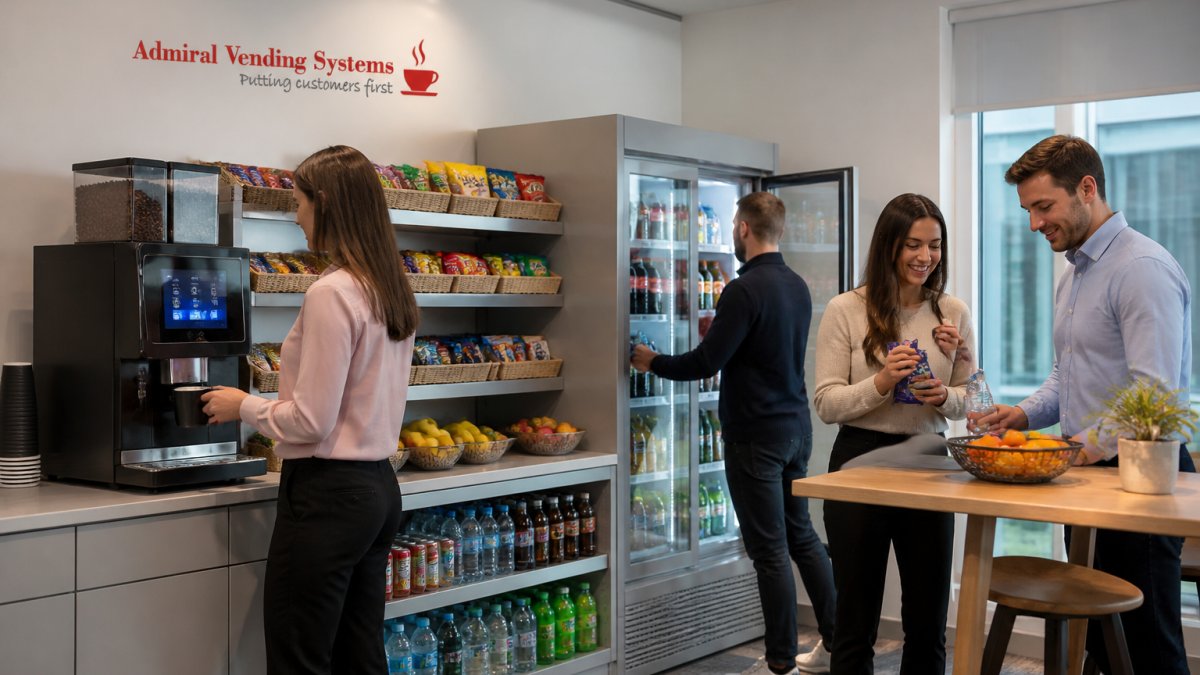
Modern office snack provision includes fresh fruit, nuts, yogurt, protein bars, and healthy alternatives alongside traditional favourites, because different employees have different dietary preferences, energy needs, and health goals.
Refreshment variety extends to beverages. Premium coffee, specialty teas, hot chocolate, and cold drinks should all be available.
The key is consistency and freshness. Stale snacks or mediocre coffee signal that the organisation doesn’t value employee experience. Fresh, quality options signal the opposite.
Premium Coffee and Beverage Provision for Workplace Engagement
Coffee is not just caffeine. It’s a ritual and often a social anchor in the office, and premium coffee provision directly impacts morale and workplace engagement.

Traditional office coffee, made in bulk and left in a flask, tastes poor and creates resentment. Employees leave the office to buy better coffee elsewhere, disrupting workflow and increasing costs.
Commercial Bean to Cup Coffee Machines change this equation. They grind fresh beans and brew individual drinks on demand, delivering café quality beverages in seconds.
The difference is measurable.
Creative Office Lunch Ideas for Flexible Workforces
Lunch no longer means a catered meal at noon. It means whatever employees choose, whenever they need it.
Creative lunch solutions recognise that flexible workforces have diverse needs. Some work through lunch and grab something quick at 2 p.m., others take a proper break at 12:30 p.m., and dietary needs vary.
Build Your Own Food Stations
Build your own stations help employees create meals that match their preferences and dietary requirements. A sandwich station, taco bar, pasta bar, or salad bar lets people customise their meal exactly as they want.
These stations work well for in office days when attendance will be high. They reduce waste because employees only take what they’ll eat, and customisation is more appealing than a pre made meal.
The operational requirement is clear: you need adequate staffing to keep stations fresh and well stocked. For organisations with consistent attendance, this investment pays off in employee satisfaction.
Customisable Meal Boxes and Dietary Accommodation
Meal boxes delivered to the office address dietary requirements and scheduling flexibility simultaneously. Employees pre order meals that arrive fresh on their preferred day.
Dietary accommodation is critical. Gluten free, plant based, low carb, and allergen free choices ensure no employee feels excluded, and employees feel valued when organisations accommodate diverse dietary needs.
Customisable boxes also solve the hybrid workplace problem. Employees working from home can have meals delivered to their address, while those in the office collect boxes at reception. Everyone gets quality nutrition on their schedule.
Smart Fridge for Office: Technology Enabled Food Access
A smart fridge is not just a refrigerator with a payment terminal. It is a self contained food retail unit combining refrigeration, inventory tracking, and cashless payment in one cabinet.
What you actually need to install one
A smart fridge needs three things: floor space, a standard power socket, and a reliable data connection. Most units are freestanding and roughly the size of a double door commercial refrigerator.
Space planning matters more than people expect. The unit needs clear access on all sides for restocking and browsing. A common mistake is tucking it into a corridor or dead corner where people feel awkward standing. A visible spot near a breakout area or kitchenette drives far higher use.
How replenishment and inventory work
Smart fridges use weight sensors, RFID tags, or camera based recognition to detect what has been taken. When an employee scans a QR code or taps a card, the system records the items removed and charges accordingly.
This is the operational advantage over traditional catering. There is no minimum order, no delivery window to manage, and no staff coordination on site. The supplier restocks when the data says it is needed.
Ask your supplier how they handle out of stock items and product rotation. A smart fridge that is frequently empty or that leaves short dated items on the shelf will lose employee trust quickly.
Food safety and compliance
Any business providing food in the workplace has responsibilities under food safety law (Running a food business: Your responsibilities). The supplier is usually responsible for the safety of the food they supply, but the organisation must still ensure the unit is kept clean, at the correct temperature, and free from contamination.
In practice this means:
- The unit should have a temperature log or alert system.
- Expiry dates should be checked and short dated stock removed.
- Allergen information should be available for every product, either on packaging or via the payment app.
- Cleaning schedules should be agreed in writing with the supplier.
Where smart fridges work best
Smart fridges suit workplaces where attendance is variable, shifts run outside standard hours, or employees need food at short notice. They are less suitable for very small offices where stock range would be limited, or for organisations wanting to provide food as a fully subsidised benefit, since the per item model puts the cost on the employee unless a subsidy is built in.
They also work well alongside other provision. A smart fridge for meals and snacks, paired with office coffee machines for drinks, covers the two most common workplace food needs without the waste of a full catering service.
Comparing Cost, Flexibility and Employee Satisfaction
Most workplace food comparisons stop at a feature table, which is not enough to make a decision. What matters is how each model behaves when attendance drops, who carries the cost, and what you need to run it day to day.
How the cost models actually work
There are three broad cost structures behind alternatives to traditional office catering. Each shifts risk in a different direction.
Employee funded. Micro markets and smart fridges typically operate on a per item purchase basis. The organisation provides space and power, the supplier stocks, replenishes, and maintains the unit, and employees pay for what they take.
Employer subsidised. Build your own stations, meal boxes, and snack programmes are usually funded or part funded by the organisation. Costs scale with headcount and attendance.
Hybrid. Premium coffee machines often sit here.
Ask every supplier to quote on a per person per day basis, not just a monthly rental.
Hidden costs to check before you commit
The headline price is rarely the full picture. Watch for these common additions.
- Installation and site survey fees. Some suppliers charge for the initial electrical or plumbing work, especially for bean to cup machines that need a water connection.
- Restocking minimums. A micro market may require a minimum weekly spend or a minimum number of employees on site before the supplier will service the location.
- Waste disposal. If the organisation handles food waste removal, that cost sits with you, not the supplier.
- Staff time. Build your own stations need someone to set up, monitor, and break down. That is usually an internal cost, not a supplier cost.
- Contract exit terms. Check notice periods and whether equipment removal is included.
Measuring return
Return on workplace food is not just financial. The measures most organisations track are:
- Take up rate. What percentage of people on site use the provision each day? A low rate suggests the offer is misaligned with the workforce.
- Waste volume. How much food is thrown away each week? A well matched alternative should reduce this compared with fixed catering.
- Spend per head. What is the organisation actually paying per employee per day, including hidden costs?
- Employee feedback. Are people using it, and would they notice if it disappeared?
A simple before and after comparison over one month is usually enough to see whether a change is working. If waste drops and take up rises, the model is doing its job.
Matching the model to your workplace
The right choice depends on three questions.
- How many people are on site on a typical day? Under 30, a smart fridge or snack programme is usually more practical than a staffed station. Over 100 with predictable attendance, build your own stations can work well.
- Is attendance predictable? If yes, subsidised meal services can be cost effective. If no, employee funded or hybrid models protect you from paying for food nobody eats.
- Is food expected daily or only for events? Daily provision points towards self service. Event only provision points towards a caterer or a one off delivery.
There is no single best answer. The weakest choice assumes everyone eats at the same time in the same place. The strongest matches how your people actually work.
Frequently Asked Questions
What are the main alternatives to traditional office catering?
The main alternatives to traditional office catering include self-service micro-markets, smart fridges with grab-and-go access, premium coffee and beverage machines, fresh snack stations, and customisable meal boxes. These options provide flexibility for hybrid workplaces where not all employees are present daily, reduce food waste through on-demand access, and allow staff to choose meals that suit their dietary requirements and preferences.
How can smart fridge for office improve employee experience?
A smart fridge for office provides 24/7 access to fresh meals and snacks without requiring staff to leave the building or rely on scheduled meal delivery times. Technology-enabled fridges track inventory automatically, ensure consistent freshness, and allow employees to select items that match their dietary needs. This flexibility boosts employee satisfaction and productivity, particularly in hybrid workplaces where attendance varies day to day.
Which office food solutions work best for smaller teams?
Smaller offices benefit most from office snack solutions combined with premium coffee provision rather than full meal programmes. A compact tabletop bean to cup coffee machine delivers fresh drinks on demand, whilst a small self-service snack station or smart fridge reduces waste by only stocking items employees actually consume. These solutions scale to your team size and avoid paying for unused capacity.
How do alternatives to traditional office catering reduce costs?
Alternatives reduce costs by eliminating scheduled delivery fees, minimising food waste through on-demand access, and allowing employees to purchase only what they consume. Hybrid workplace models mean you’re not catering for a full office every day. Premium coffee machines reduce staff spending on external coffee shops, whilst grab-and-go options and snack stations improve employee retention by showing investment in their wellbeing without the overhead of formal meal contracts.