Table of Contents
- Start With Daily Throughput, Not Machine Specs
- Bean to Cup Coffee Machines vs Traditional Espresso Systems
- Plumbed-In vs Pour-Over Water Supply and Electrical Requirements
- Water Filtration for Commercial Coffee Equipment: Why It Decides Long-Term Reliability
- Commercial Coffee Machine Maintenance Requirements and Service Contracts
- Total Cost of Ownership: Buying vs Leasing a Commercial Coffee Machine
- POS Integration, Energy Efficiency, and Staff Training: What Competitors Miss
- Conclusion: Match the Machine to Your Workflow, Not the Brochure
- Frequently Asked Questions
Last Updated: October 4, 2026
Start With Daily Throughput, Not Machine Specs
Most cafe owners choose a commercial coffee machine by falling in love with a model, then discovering it cannot survive a Monday morning rush. Daily throughput, meaning the drinks you serve in your busiest hour and across a full day, should decide everything else: group head count, boiler capacity, and whether you need a bean to cup machine or a traditional espresso setup.
At Admiral Vending, we have spent eight years matching equipment to real drink volumes. Count your peak hour first, then add headroom for growth.
A commercial coffee machine is a high-output beverage system engineered for continuous service, thermal stability, and volume domestic equipment cannot sustain. If your peak hour is 40 drinks, a compact tabletop unit may cope. If it is 120, you need different hardware entirely.
Buying on showroom appeal rather than throughput is the single most common mistake we see. The consequence is queues at 9am, lukewarm shots by 10am, and a machine that needs replacing within a year.
Bean to Cup Coffee Machines vs Traditional Espresso Systems
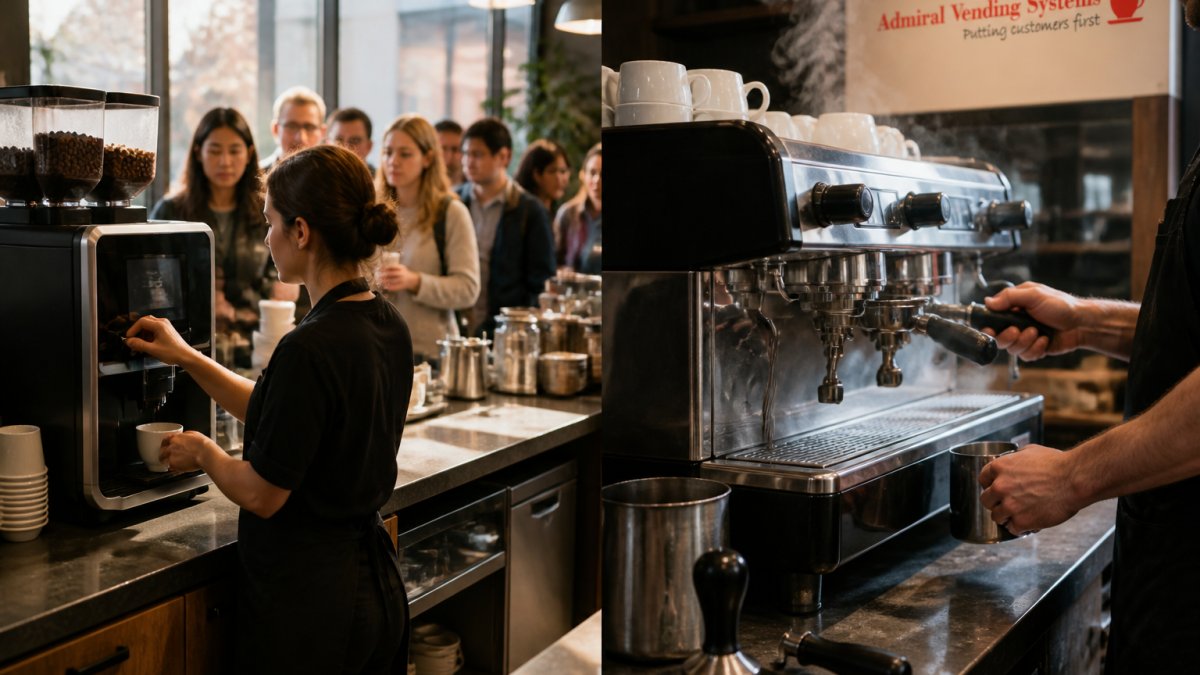
The choice between bean to cup and traditional espresso comes down to who operates the machine and how consistent every drink must be. Bean to cup machines grind, dose, tamp, and extract automatically, so any staff member can produce a repeatable flat white with minimal training. Traditional espresso machines put a skilled barista in control of every variable, delivering the highest ceiling but demanding real expertise.
When a Bean to Cup Machine Makes Sense
Bean to cup wins in offices, showrooms, hotels, and sites where staff rotate and speed matters more than theatre. Our commercial bean to cup coffee machines handle espresso, americano, cappuccino, latte, and hot chocolate at the touch of a button, and selected models add fresh brew tea.
When a Traditional Espresso Machine Wins
A traditional machine suits a cafe with trained baristas, a menu built around espresso, and customers who watch the pour. You gain control over shot quality, steam pressure, and extraction consistency, but inherit a steeper training curve.
| Factor | Bean to Cup | Traditional Espresso |
|---|---|---|
| Skill required | Low | High |
| Consistency | Very high | Depends on barista |
| Speed per drink | Fast | Moderate |
| Best for | Offices, hotels, showrooms | Specialist cafes |
Plumbed-In vs Pour-Over Water Supply and Electrical Requirements
Water supply and power decide where a machine can physically go, and this is where many installations stall. A plumbed-in machine connects directly to the mains water supply and drains continuously, so it never needs refilling and suits high daily throughput. A pour-over machine uses a manual tank, so no plumbing, but someone must top it up and empty the drip tray.

Electrical demand matters just as much. Commercial machines draw significant power, and some models need a dedicated circuit rather than a shared ring main. Check your site’s supply before committing, because retrofitting power is far more disruptive than choosing the right machine first.
If your site has no accessible water feed, do not assume plumbing is impossible. A competent installer can often route a supply, but confirm this before purchase rather than after delivery.
Water Filtration for Commercial Coffee Equipment: Why It Decides Long-Term Reliability
Water filtration is the least glamorous part of the buying decision and the one that most often determines whether your machine lasts five years or fifteen months. Hard water leaves scale inside boilers, narrows pipework, and destroys the thermal stability that makes espresso taste right.
As water heats, dissolved calcium and magnesium precipitate out as scale. That scale coats heating elements, reducing heat transfer and forcing the boiler to work harder. It also blocks narrow passages in group heads and solenoids, causing uneven extraction and eventual failure.
Most commercial filtration systems combine carbon block and ion exchange resin. Carbon removes chlorine and organic compounds that affect taste, while resin exchanges calcium and magnesium for sodium or hydrogen ions, softening the water without removing all minerals.
Sizing a filter correctly requires two things: your daily water volume and your water hardness. Hardness is measured in parts per million (ppm) or German degrees (dH).
Filter capacity is rated in litres. A small under sink filter might handle 3,000 to 6,000 litres, while a larger cartridge for a busy cafe can process 10,000 litres or more.
Water UK guidance on water quality explains how supply hardness varies by region, which is why the correct filter specification depends on your location, not just your machine.
A filter that is too small will exhaust quickly and let scale through. A filter that is too large may sit unused for months, allowing stagnant water and bacterial growth.
Finally, do not overlook the drain. A plumbed in machine needs a drain connection that can handle waste water from rinsing and backflushing. A pour over machine means emptying the drip tray manually.
Commercial Coffee Machine Maintenance Requirements and Service Contracts
Commercial coffee machine maintenance requirements fall into two categories: daily care by your staff and scheduled service by a qualified engineer. Daily tasks include rinsing the group head, cleaning the drip tray, purging steam wands, and running the machine’s cleaning cycle. Skipping these shortens component life and shows up as inconsistent shots.
Scheduled service covers descaling, seal replacement, grinder calibration, and inspection of pumps and valves. A service contract spreads this work across the year and keeps the machine running at its rated output.
The difference between a machine that lasts and one that fails early is almost never the brand. It is whether filtration and servicing happen on schedule.
Total Cost of Ownership: Buying vs Leasing a Commercial Coffee Machine
Total cost of ownership is the full cost of running a machine over its working life, and it usually decides the buying versus leasing question more than the headline price does. Purchase price is only one line.
To calculate TCO properly, estimate costs over a realistic lifespan. Commercial espresso machines typically last seven to ten years with proper maintenance, while bean to cup machines may last five to eight years depending on usage.
Start with the acquisition cost. If buying, that is the purchase price plus delivery and installation charges. If leasing, add up all monthly payments across the term, then any initial deposit or documentation fee.
Next, add installation and infrastructure: plumbing for water supply and drainage, electrical work for a dedicated circuit if required, and any counter modifications. Get quotes before you commit.
Water filtration is a recurring cost many owners overlook. Filters need replacing at least annually, and the cost depends on capacity and water hardness.
Consumables are the largest ongoing cost for most cafes. Coffee beans, milk, cleaning tablets, and descaler all add up. To estimate, work out your cost per drink.
Energy is another significant line. Commercial machines run for hours each day. A traditional espresso machine might draw 3 to 5 kW during heat up and 1 to 2 kW while idling.
Servicing and repairs are the next category. A service contract typically covers scheduled maintenance and may include call outs. Without one, you pay per visit.
Finally, consider the end of life cost. When the machine reaches the end of its useful life, you may need to pay for removal and disposal.
What to Include in Your TCO Calculation
- Purchase price or total lease payments across the term
- Professional installation and any plumbing or electrical work
- Water filtration units and replacement filters
- Coffee beans, milk, and cleaning materials
- Scheduled servicing and any call out charges
- Energy consumption based on power rating and hours of use
- Expected machine lifespan and replacement cost
- End of life removal and disposal
Once you have these figures, compare the total cost per drink or per year. Leasing often makes sense if you want predictable monthly costs and bundled servicing, and if you plan to upgrade every few years. Buying can be better if you intend to keep the machine long term and have the capital available. Neither is universally better; the right answer depends on your cash flow and how long you intend to stay in the premises.
Businesses that want predictable monthly costs, servicing, and supplies bundled into one arrangement, particularly offices and multi-site operations.
A final tip: ask your supplier for a total cost of ownership breakdown. A good supplier will help you model costs over the expected lifespan, including filtration and energy, so you can decide based on facts rather than showroom appeal.
POS Integration, Energy Efficiency, and Staff Training: What Competitors Miss
Three factors separate a machine that works from one that frustrates: point of sale integration, energy consumption, and how quickly staff can learn to use it. POS integration lets you track drink sales against your till data, turning coffee from a cost line into a measurable revenue stream.
Energy efficiency deserves scrutiny because a commercial machine runs for hours each day. Models that heat only what they need, or schedule standby periods, consume noticeably less power across a year. Ask for energy consumption figures rather than assuming all machines are equal.
Staff training is the factor most often overlooked. A machine that takes a week to learn will produce inconsistent drinks during that week. Our tabletop coffee machines and larger floor standing units are designed so operators can produce cafe style drinks confidently after a short session, and every Admiral Vending installation includes operator training as standard.
Carbon Trust guidance on business energy use offers a useful framework for assessing how much a continuously running appliance costs you over a year.
Conclusion: Match the Machine to Your Workflow, Not the Brochure
Choosing well comes down to discipline: measure your peak demand, decide who will operate the machine, confirm your water and power, then calculate the full cost of ownership rather than the sticker price. Get those four things right and the model almost chooses itself.
If that sounds like a lot to work through alone, it is exactly the work we do every day. Admiral Vending supplies commercial bean to cup coffee machines to businesses across the UK, with expert machine selection, professional installation, operator training, ongoing service support, and coffee supplies, all backed by our AI powered instant quote system and a 5.0/5.0 Google rating. Get your instant quote from Admiral Vending and get the right machine installed and running.
Frequently Asked Questions
What is the typical daily output capacity required for a busy cafe?
A busy cafe typically serves 200 to 500 drinks per day, with peak hour demand reaching 40 to 80 drinks. A commercial coffee machine with a 2-group head and sufficient boiler capacity handles this volume. For higher throughput, a 3-group machine with dual boilers and a rotary pump maintains thermal stability during rushes. Match capacity to your busiest hour, not your average day, to avoid queues and recovery time issues.
What are the key differences between traditional espresso machines and bean to cup systems?
Traditional espresso machines require a trained barista to grind, dose, and tamp each shot, offering full control over extraction consistency and shot quality. Bean to cup coffee machines grind on demand and produce drinks at the touch of a button, reducing training time and ensuring consistency across staff. Bean to cup suits high-volume sites with variable staffing, while traditional machines appeal to cafes where craft and manual control define the brand.
What maintenance schedule should be expected for a high-volume coffee machine?
Commercial coffee machine maintenance requirements include daily backflushing and milk line rinsing, weekly group head cleaning and grinder burr checks, and monthly descaling depending on water hardness. Water filtration for commercial coffee equipment extends these intervals by reducing scale build-up. An annual service by a qualified technician covers seals, boiler inspection, and pump performance. Preventative maintenance contracts reduce downtime and protect extraction consistency.
Do commercial coffee machines require specific electrical or plumbing installations?
Most commercial coffee machines need a dedicated electrical supply, often 13-amp or 32-amp depending on the model, and a plumbed-in water connection with a stop valve and filtration. Pour-over machines require manual filling but still need drainage for waste. Check your site has adequate ventilation, a water softener if hardness exceeds 200ppm, and space for a grinder and knock box. Professional installation ensures compliance and protects your warranty.