Quick Summary
A coffee machine water filter should be replaced when it reaches its rated litre capacity or shows warning signs such as flat or metallic taste, slower water flow, residue, or more frequent descaling. Replacement intervals should follow the rating on your own cartridge rather than a general rule. Early replacement costs far less than repairing a damaged machine.
- Check the litre rating printed on the cartridge packaging as the starting point.
- Change the cartridge early if the coffee tastes flat, sour or metallic.
- Slower water flow or longer fill times are signs the filter is spent.
- Estimate weekly litres to calculate when a cartridge will reach its limit.
- Fit the new cartridge, then flush two or three cycles to clear air and carbon dust.
Table of Contents
- Why Commercial Coffee Machine Water Filters Matter
- How Often to Change Coffee Machine Water Filter Cartridges
- Commercial Coffee Machine Water Filter Installation, Step by Step
- Choosing the Right Replacement Filter for Your Machine
- Coffee Machine Water Filter Capacity and Litres Treated
- When a Water Softener Makes Sense for Commercial Coffee Machines
- Booking Your Next Filter Change and Machine Service With Admiral Vending
- Frequently Asked Questions
Why Commercial Coffee Machine Water Filters Matter
A commercial coffee machine water filter does more than improve taste. It protects the boiler, grinder and brew group from scale, and it keeps the water consistent from one cup to the next.
Water makes up most of every drink a machine produces. Hard water carries calcium and magnesium, which leave limescale inside heating elements and pipework (Water Hardness / Hard Water). Chlorine and particles affect taste and can block flow. A filter removes or reduces much of this before the water reaches the machine.
Treating filters as a routine part of machine care is generally a sensible approach compared with repairing the damage they are meant to prevent. Many operators only think about filters after a fault appears, which is the wrong order.
How Often to Change Coffee Machine Water Filter Cartridges
Most cartridges are rated by the volume of water they treat, usually in litres, and by time. Whichever limit is reached first should trigger a change. Ignoring the rating is the most common reason filters fail early or stop working altogether.
Manufacturers publish capacity figures for each cartridge, and these should be your starting point. Check the packaging or the product sheet for the exact figure, as capacity varies widely between models and filter sizes. Replacement intervals should always follow the rating for your specific cartridge rather than a general rule of thumb.
Water conditions change the picture. A site with hard water or heavy use will exhaust a cartridge faster than a site with soft mains supply and light use. Keeping a simple log of cups or litres treated will show you the real pattern for your premises.
Calculating Replacement Timing From Litres Treated
To work out when to change a filter, estimate how much water your machine uses each week. Multiply the number of drinks by the average water used per drink, which your machine supplier can confirm. Then divide the cartridge’s rated capacity by that weekly figure to find the expected life in weeks.
Busy sites will need a shorter interval, and quieter ones can stretch it, so calculate the expected life from the rating shown on your own cartridge.
Signs a Filter Has Reached the End of Its Life
A filter that has passed its useful life usually gives warning signs before it fails completely. Watch for a gradual change in the coffee rather than a sudden one. Common signs include:
- Coffee that tastes flat, sour or metallic
- Slower water flow or longer fill times
- White or grey residue in the water tank or on the drip tray
- More frequent descaling cycles than before
- A filter indicator light or alert on the machine
If you see any of these, change the cartridge even if the time or volume estimate has not yet been reached. Early replacement costs far less than a damaged machine.
The table below pulls together the replacement triggers the article describes, so you can check them at a glance.
| Trigger | Action | Note |
|---|---|---|
| Rated capacity reached | Change the cartridge | Check the litre rating on the packaging |
| Flat, sour or metallic taste | Change early | Do not wait for the time estimate |
| Slower water flow | Change early | Longer fill times are a warning sign |
| White or grey residue | Change early | Check the tank and drip tray |
| More frequent descaling | Change early | Indicates the filter is spent |
| Filter indicator light | Change the cartridge | Reset the counter afterwards |
Commercial Coffee Machine Water Filter Installation, Step by Step
Fitting a new cartridge takes only a few minutes, but doing it in the right order prevents leaks and air in the system.
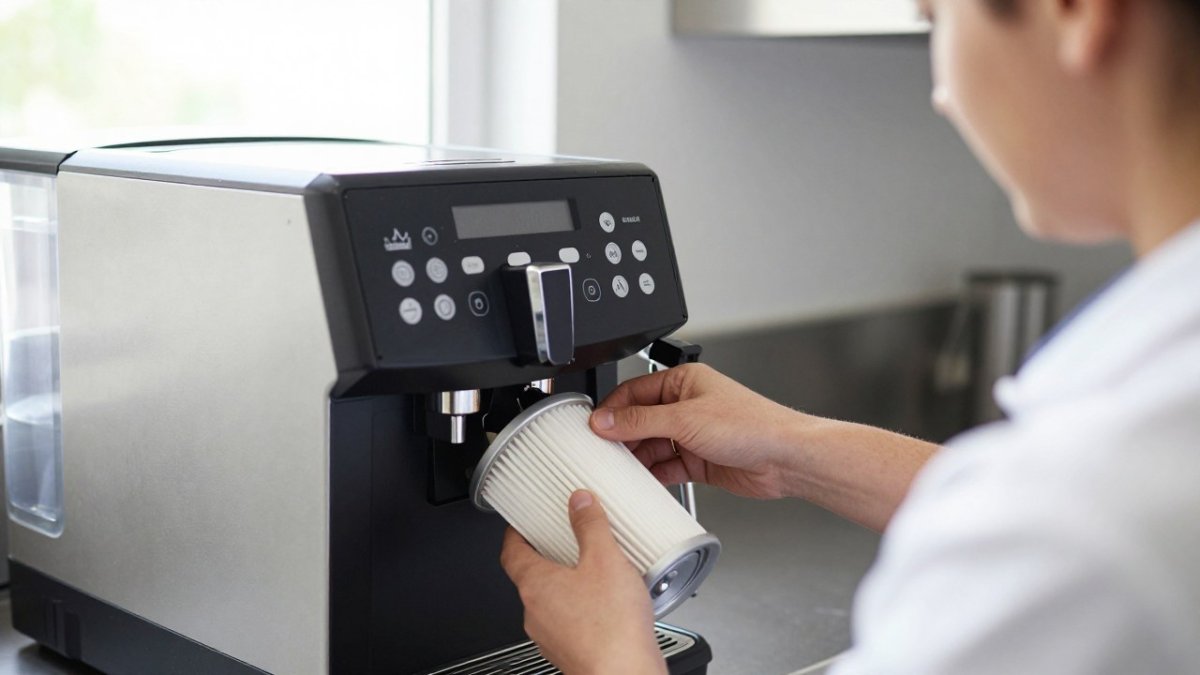
- Isolate the machine. Switch off at the socket and close the water supply valve feeding the machine. If your model has a pressurised boiler, allow it to cool before opening any filter housing.
- Release pressure. Open the machine’s water outlet tap or dispense valve briefly to release residual pressure in the line. This reduces the risk of spray when the cartridge is removed.
- Remove the old cartridge. Place a towel and a shallow bowl underneath. Twist the cartridge a quarter turn anticlockwise or unclip it from the head, depending on the fitting. Pull it straight down and expect a small amount of water to drain out.
- Inspect the head and seals. Check the O-ring inside the filter head for cracks, flattening or debris. A worn O-ring is a common cause of drips after a new cartridge is fitted. Wipe the head clean with a damp cloth.
- Prepare the new cartridge. Remove the protective cap and, if the instructions advise it, rinse the cartridge under running water for about 30 seconds to remove loose carbon fines. Do not scrub the cartridge body.
- Fit the new cartridge. Align the cartridge with the head, push it firmly upwards and twist clockwise until it locks. You should feel a positive stop rather than a soft resistance.
- Flush the system. Slowly reopen the water supply and check for leaks at the head before switching the machine back on. Run the machine through two or three rinse cycles, or dispense around 2 to 4 litres of water, to push out air and carbon dust. Discard this water.
- Reset the filter indicator. Many commercial machines have a filter life counter that must be reset manually after a change. Check the manual for the reset sequence, which is often a button press or a menu option.
- Record the change. Write the installation date and the cartridge model on the cartridge body or in your maintenance log. This makes it easy to track the next change and to show a service engineer when the filter was last replaced.
Watch out: If water flows slowly or the machine reports a low-flow fault after fitting, air may be trapped in the line. Re-check that the cartridge is fully seated and run another flush cycle before calling for service. A persistent leak at the head usually means the O-ring needs replacing, not the cartridge.
After installation, taste a cup before returning the machine to service. A faint carbon taste in the first few cups is normal and should clear after the flush. If the taste persists beyond the first day, check that the cartridge is the correct type for the machine and that the flush volume was sufficient.
Choosing the Right Replacement Filter for Your Machine
Not every cartridge fits every machine. Before ordering, confirm the make and model of your coffee machine and check which filter it takes. Many manufacturers specify a particular cartridge, and using an incompatible one can cause leaks or poor filtration.

Pay attention to the connection type and the cartridge size. Clip-in fittings and screw-in designs are not interchangeable. The physical length and diameter must also suit the housing. If you are unsure, your supplier can confirm compatibility from the machine’s model number.
Consider the water conditions as well as the fit. Where water is very hard, a cartridge with scale-reduction properties will protect the machine better. Matching the cartridge to the water conditions also makes it easier to recognize when its performance is fading, a point worth keeping in mind when considering Awesome Water®.
Coffee Machine Water Filter Capacity and Litres Treated
Capacity is the most important figure on a filter’s specification. It tells you how many litres the cartridge can treat before it stops performing reliably.
To turn a litre rating into a replacement date, you need two figures: the cartridge’s rated capacity and your machine’s weekly water use. Water use per drink varies between machine types, so ask your machine supplier to confirm the figure for your model.
A simple calculation can help you plan replacement timing:
- Weekly litres = number of drinks per week × litres per drink
- Expected life in weeks = cartridge capacity ÷ weekly litres
- Change date = installation date + (expected life in weeks − 20% safety margin)
Keep a rough running total of litres treated, even if it is only an estimate. Add the volume each week and compare it against the rating. This habit removes guesswork and makes it obvious when a filter is nearly spent, especially on sites with variable demand.
Remember that capacity ratings assume typical water conditions, and very hard water or a high number of drinks can use up capacity faster than expected.
When a Water Softener Makes Sense for Commercial Coffee Machines
A water softener is worth considering where water is consistently hard and scale builds up quickly. Softening removes much of the calcium and magnesium responsible for limescale, which protects heating elements and reduces the frequency of descaling. It works alongside a cartridge filter rather than replacing it.
Softeners suit high-volume sites such as hotels, busy offices and factory canteens, where machines run for long hours. They can extend the working life of expensive equipment and keep flavour consistent. For light use in soft-water areas, a standard cartridge is usually enough.
Before investing, test your water hardness. Your machine supplier or a local water utility can advise on the level at your premises. The right choice depends on the hardness, the machine and how much it is used, so get that information before buying.
Booking Your Next Filter Change and Machine Service With Admiral Vending
A regular filter change is one of the simplest ways to protect a commercial coffee machine and keep drinks tasting right. If you are not sure when your cartridge is due, or which one fits your machine, we can help you work it out. Admiral Vending provides businesses across the UK with machine selection, professional installation, operator training, ongoing service and coffee supplies.
Get a quote from Admiral Vending to arrange your next filter change or machine service. We will confirm the right replacement for your model and help you set a schedule that suits how your site uses the machine.
Last Updated: November 19, 2026
Frequently Asked Questions
How often should a commercial coffee machine water filter be replaced?
Replacement depends on the litres treated and the hardness of your water supply, not only on time elapsed. Most manufacturers state a maximum litre capacity for each cartridge, and the filter should be changed when that capacity is reached or when the recommended interval passes, whichever comes first. Heavy-use sites such as busy offices or hotels will reach that litre limit far sooner than a small meeting room, so keep a simple log of litres or cups served. Check the cartridge packaging or your machine handbook for the exact figure before setting a schedule.
How do you replace a commercial coffee machine water filter?
Switch the machine off and isolate the water supply, then remove the old cartridge from its housing, usually by twisting or unclipping it. Fit the new cartridge, check that the seal sits correctly, and reconnect the supply. Run several cycles of water through the machine to flush the filter before brewing, discarding the output. Always follow the specific instructions supplied with your filter and machine, as fitting methods vary between models.
Can a water filter improve the taste of coffee?
Yes. Chlorine, strong odours and high mineral content can all affect coffee flavour, and a correctly fitted filter reduces many of these impurities. Filtration does not fix poor beans or incorrect grind settings, so it works best alongside good equipment maintenance. Consistent water quality also helps protect the machine from scale, which can change how the brew tastes over time.
What happens if a coffee machine water filter is not replaced?
An exhausted filter stops removing scale-forming minerals and particles, so limescale can build up inside the boiler and pipework. This reduces heating efficiency, slows water flow and can lead to costly repairs or downtime. Taste may also decline as the filter no longer removes impurities. Keeping to a replacement schedule is far cheaper than dealing with descaling or breakdowns later.