Table of Contents
- What Counts as an Industrial Coffee Machine
- Commercial Bean to Cup Coffee Machines for High Volume Sites
- Machine Capacity: Matching Drink Output to Your Daily Volume
- Commercial Coffee Machine Leasing vs Buying
- Office Coffee Machine Maintenance and Cleaning Cycles
- Installation, Nationwide Support and Warranty Cover
- Frequently Asked Questions
Last Updated: September 13, 2026
What Counts as an Industrial Coffee Machine
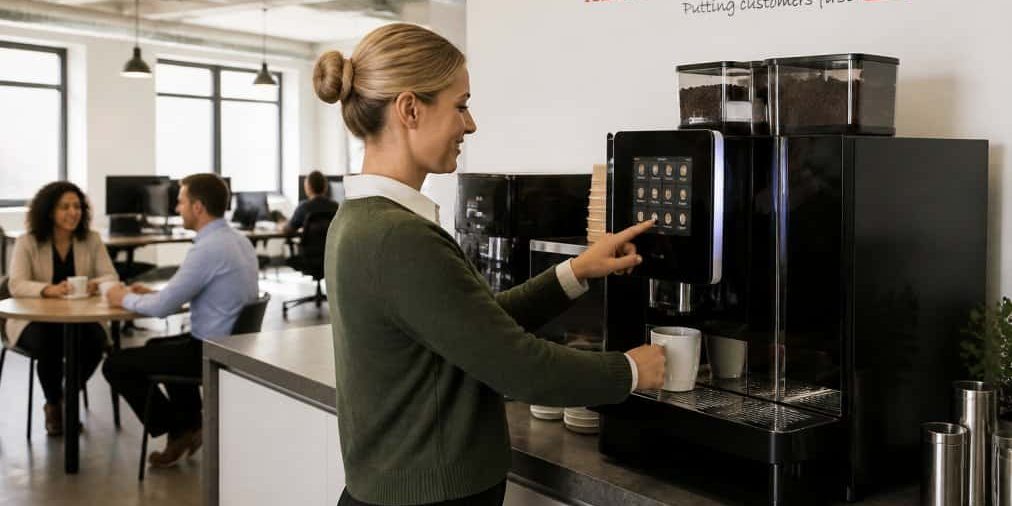
An industrial coffee machine is a commercial grade brewing system built to produce consistent espresso based drinks at high daily volumes, typically in workplaces, showrooms, hotels and hospitality venues rather than domestic kitchens. At Admiral Vending, we supply these machines to sites that need reliable output without a barista on every shift.
The defining features are output capacity, build quality and serviceability. Machines in this class use larger boiler capacity, commercial grade group heads and pumps rated for continuous use, and are designed to be cleaned, descaled and repaired on a schedule rather than replaced when they fail (Introduction to pressure equipment).
Industrial vs Domestic Machines: Key Differences
Three things separate an industrial coffee machine from a domestic one: duty cycle, water handling and support.
- Duty cycle: domestic machines overheat under sustained use; commercial units run all day.
- Water handling: commercial machines pair with water filtration, protecting the boiler and keeping extraction consistent.
- Support: commercial equipment comes with installation, preventative maintenance and warranty support; domestic machines come with a returns policy.
If your site serves more than a few dozen drinks a day, domestic equipment is the wrong tool. It will fail early, and the downtime costs more than the machine did.
Commercial Bean to Cup Coffee Machines for High Volume Sites
Commercial bean to cup coffee machines grind fresh beans on demand and produce espresso, americano, cappuccino and latte at the touch of a button. They suit high volume sites because they remove the need for trained baristas while keeping drink quality consistent.
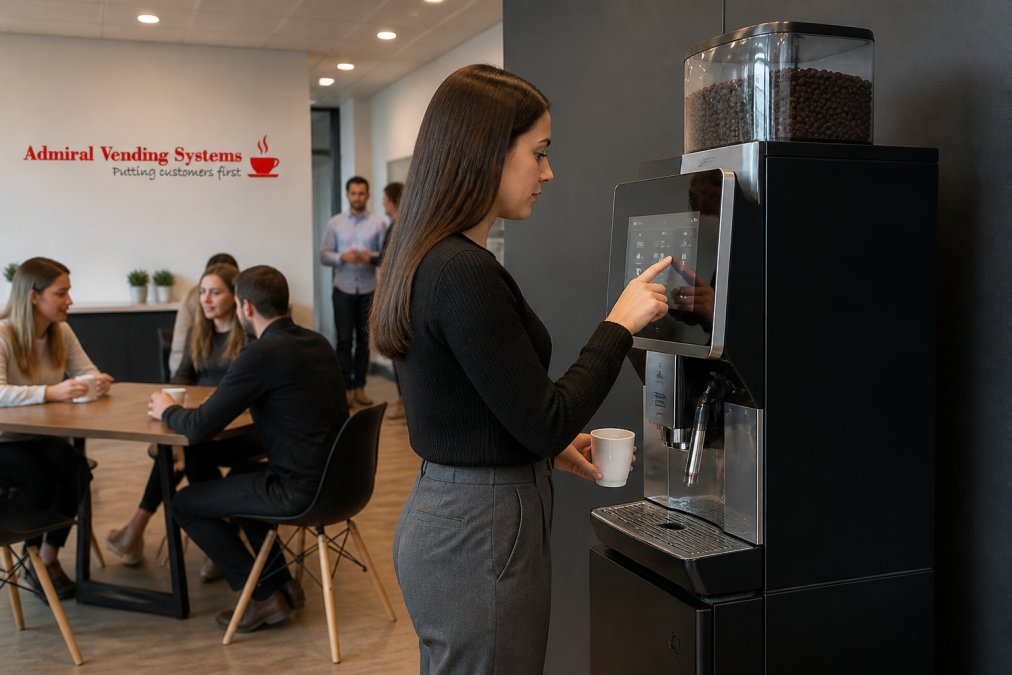
A common mistake is buying on headline drink output alone. What matters more is recovery time: how quickly the machine returns to full temperature between drinks. A machine that claims a high hourly figure but takes minutes to recover will still produce queues at 9am.
How Bean to Cup Compares to Traditional Espresso Machines
Traditional machines give a skilled operator more control over espresso extraction. Bean to cup gives you consistency and speed without the training burden.
For most offices, showrooms and hotel breakfast services, bean to cup wins. For a specialist coffee bar with trained staff, a traditional commercial espresso machine with a separate coffee grinder may still be the better fit. Many larger sites run both.
Machine Capacity: Matching Drink Output to Your Daily Volume
The right capacity covers your peak hour, not your daily average. A site serving 150 people does not spread demand evenly; most of it lands in two short windows. Work backwards from your busiest 60 minutes.

Technical Specifications That Determine Real World Output
Headline hourly figures are misleading. The specifications that govern whether a machine keeps up are boiler type, recovery time and group head configuration.
Boiler type is the single biggest factor. Heat exchanger boilers use one boiler for brewing and steam, recovering reasonably well but losing steam pressure under heavy use. Dual boiler machines have separate boilers, so extraction and milk steaming happen simultaneously without temperature fluctuation. Where lattes and cappuccinos dominate, dual boiler prevents queues.
Recovery time is the interval between pulling a shot and the boiler returning to full brewing temperature. A fast recovery lets a machine produce drinks back to back without the temperature dropping; a slow one produces a good first shot and a mediocre second. Ask for the recovery time in seconds, not the hourly maximum.
Group head configuration matters too. A single group machine suits lower volumes; two or three group machines allow multiple drinks at once, essential for peak hour throughput.
Matching Specifications to Site Type
| Site type | Peak hour drinks | Recommended specification |
|---|---|---|
| Small office (20 to 50 staff) | 10 to 20 | Tabletop bean to cup, single group, 1.5 to 2 litre boiler |
| Medium office or showroom (50 to 150 staff) | 30 to 60 | Floor standing bean to cup, dual boiler or high recovery heat exchanger |
| Hotel breakfast or large office (150 to 300 staff) | 60 to 120 | Floor standing bean to cup with two group heads, dual boiler, high capacity hopper |
| Hospitality venue or factory floor (300+ staff) | 120+ | Multiple machines or a high output traditional espresso machine with separate grinder |
These are starting points, not rules. The variables that shift the recommendation are drink type (milk based drinks demand more steam capacity), shift patterns (a single peak versus all day demand), and whether staff or customers operate the machine.
Water Supply and Drainage Requirements
Plumbed in machines need a mains water connection and a waste drainage route. If either is missing, you are limited to tank fed machines, which need manual refilling and suit only lower volumes. Confirm the water pressure at the point of connection: most commercial machines need a minimum incoming pressure, and if it is too low you will need a booster pump. Hard water accelerates scale build up, so a water filtration system sized to your water hardness is not optional on a plumbed in commercial machine (BS EN 13523).
Footprint and Clearance
Measure the space before you shortlist machines. Floor standing units need clearance above for the hopper lid and around the sides for ventilation and service access. Tabletop machines need a sturdy counter and enough height for the cup warmer and steam wand movement. A machine that fits the output requirement but not the space is not viable.
Ask for the recovery time in seconds and the boiler type before you compare hourly output figures. Those two specifications tell you more about real world performance than the maximum drinks per hour claim.
Commercial Coffee Machine Leasing vs Buying
Leasing spreads the cost of a commercial coffee machine across a fixed monthly agreement and usually bundles servicing, while buying means paying upfront and arranging maintenance separately. The right choice depends on your cash position, your expected usage period and how you weigh predictable outgoings against long term asset ownership.
The Total Cost of Ownership View
Most buyers focus on the purchase price or the monthly lease figure. The more useful calculation is total cost of ownership across the expected life of the machine, including:
- Equipment cost: purchase price or total lease payments across the agreement term
- Electricity: commercial machines draw significant power, especially during heat up and recovery. A dual boiler machine with a high recovery time uses more energy than a heat exchanger machine, but may also serve more drinks per hour, which changes the cost per drink calculation (gov.uk)
- Water filtration: filter cartridges need replacing on a schedule determined by water hardness and volume, a recurring cost that is easy to overlook
- Coffee beans: the largest ongoing cost for most sites. A machine that produces inconsistent shots wastes beans
- Maintenance and repairs: scheduled servicing, descaling, seal replacement and breakdown call outs
- Downtime cost: the operational impact of a machine that is out of action. For a hospitality venue, that is lost revenue. For an office, it is staff time and morale
When you add these together, the cheapest machine to buy is rarely the cheapest to own. A machine with a lower purchase price but higher energy consumption, more frequent breakdowns and slower recovery time can cost more over three years than a higher priced machine that runs efficiently and needs fewer repairs.
Leasing: What It Actually Covers
A commercial coffee machine lease typically bundles the machine, servicing, water filters and sometimes coffee supplies into a single monthly payment. The advantages are predictable cash flow and no surprise repair bills. The trade offs are that you do not own the asset at the end of the term, and the total cost across the agreement is usually higher than buying outright.
What to check before signing:
- What is included in the service element: does it cover parts and labour, or just call outs?
- Response time guarantees: what happens if the machine breaks down and how quickly will an engineer attend?
- End of term options: can you upgrade, extend, or return the machine, and what are the costs?
- Coffee supply tie ins: some leases require you to buy beans from the provider. Compare the per kilogram cost against your current supplier
- Exit terms: what happens if you need to end the agreement early?
Buying: When It Makes Sense
Buying suits businesses with capital available and a stable, long term requirement. You own the asset, you can sell or part exchange it later, and you are not locked into a supply agreement. The trade off is that you carry the maintenance risk and the upfront cost.
If you buy, budget for a preventative maintenance contract separately. Reactive repairs are more expensive than scheduled servicing, and a machine that is not serviced on schedule will fail earlier than one that is.
A Practical Decision Framework
Ask these questions:
- How long will you keep the machine? If less than three years, leasing is usually more cost effective. If more than five years, buying often works out cheaper overall.
- Can you absorb an unexpected repair bill? If not, a lease with inclusive servicing removes that risk.
- Do you want to own the asset? If the machine is on your balance sheet and you value that, buying is the route.
- How predictable is your drink volume? If you are growing or uncertain, a lease with upgrade options gives you flexibility. If your volume is stable, buying locks in your cost base.
The headline monthly lease figure and the purchase price are starting points, not the full picture. Calculate total cost of ownership across the expected life of the machine, including energy, filters, beans, servicing and downtime. That number is the one that matters.
::: Factoring in these operational variables allows you to calculate your return on investment and determine the precise moment your equipment transitions from a recurring expense to a profitable asset.
Pricing depends on the machine, the agreement length and the service level, so it is worth getting a quote based on your actual drink volume rather than a generic package. Ask for a breakdown of what is included in both the lease and the purchase options so you can compare like for like.
Office Coffee Machine Maintenance and Cleaning Cycles
Office coffee machine maintenance separates a machine that lasts a decade from one that limps through eighteen months. Daily rinsing, weekly cleaning and scheduled preventative maintenance keep espresso extraction consistent and prevent the scale build up that kills boilers.
A practical schedule looks like this:
- Daily: run the automatic cleaning cycle, empty and rinse the drip tray, flush the steam wand.
- Weekly: clean the group head and brew unit, check the coffee grinder burrs for build up.
- Monthly: run a descaling cycle if your water hardness requires it, inspect the water filtration.
- Annually: full service, seal replacement and a check on boiler capacity performance.
Skipping descaling is the most expensive shortcut in commercial coffee. Scale insulates the boiler, the machine works harder, energy consumption climbs and eventually the boiler fails. That is a repair bill, not a cleaning task.
Water filtration is not optional on commercial grade equipment. It protects the machine and is the single biggest factor in whether your espresso tastes the same in month twelve as it did in week one.
Installation, Nationwide Support and Warranty Cover
Professional installation makes a commercial machine work properly from day one. It covers the plumbing, electrical connection, water filtration setup, calibration and operator training, so staff can make a cappuccino or latte without guesswork.
What to confirm before you order:
- Delivery and installation service included in the quote
- Operator training for the team, not just the person who placed the order
- Warranty support terms and what is covered
- Response times for breakdowns and whether parts are held locally
- Ongoing service support and coffee supplies from the same provider
The thing nobody tells you about commercial coffee is that the machine is only half the purchase. The other half is the support behind it. A machine with no service contract is a machine with a countdown timer on it.
Admiral Vending provides expert machine selection, delivery, professional installation, operator training, ongoing service support and coffee supplies, backed by eight years of industry experience and nationwide coverage. Our AI powered instant quote system gives you a tailored proposal based on your site and drink volume.
Frequently Asked Questions
What is the best brand of commercial coffee machine?
The best brand depends on your daily drink volume, available space and whether you want bean to cup or traditional espresso. Focus on machines with commercial grade boilers, reliable group heads and accessible service support rather than brand names alone. Admiral Vending supplies industrial coffee machines from trusted manufacturers and helps match the right model to your site, with installation and ongoing maintenance included.
How long do industrial coffee machines last?
A well maintained industrial coffee machine typically lasts seven to ten years in a commercial setting. Lifespan depends on daily drink volume, water hardness and whether preventative maintenance is carried out on schedule. Machines that receive regular descaling, group head cleaning and annual servicing consistently outlast those run until they fail. Choosing a supplier that provides warranty support and replacement parts is as important as the machine itself.
Do I need a plumbed-in or tank-fed coffee machine for my business?
Plumbed-in machines suit sites serving more than 50 drinks a day because they remove the need for manual refilling and support automatic cleaning cycles. Tank-fed models work well for smaller offices, meeting rooms and locations without a nearby water supply. If your daily drink volume is uncertain, a plumbed-in bean to cup machine gives more headroom and reduces staff intervention throughout the day.
What are the key differences between industrial and domestic coffee machines?
Industrial coffee machines use commercial grade components, larger boiler capacity and higher bar pressure to handle continuous drink output without recovery delays. Domestic models are built for a few drinks at a time and wear out quickly under workplace demand. Industrial machines also support water filtration, remote monitoring and preventative maintenance schedules that domestic equipment cannot match.