
Last Updated: November 22, 2026
Quick Summary
Quiet zone signage is physical signage that marks an area in a shared office as reserved for low-noise, heads-down work, telling everyone who enters that conversations, calls and collaboration belong elsewhere. It works because it sets the expectation before anyone opens their mouth, and it is the cheapest, fastest way to make the rule obvious.
- Short, positive wording such as quiet please, calls and conversations in the breakout area outperforms a bare silence sign.
- Office quiet zone rules should fit on one page and name who owns the space and who reviews it.
- Place signs at every entrance to the zone, at eye level, with nothing between the sign and the reader.
- Run a four to six week pilot with one space, one rule set and one sign design before rolling out.
- Measure results with an interruption count and a short pulse survey, and review after a month, not a week.
Table of Contents
- Why Shared Offices Need Quiet Zone Signage
- Quiet Zone Sign Wording That People Actually Respect
- Office Quiet Zone Rules for Shared Spaces
- Quiet Area Signage Ideas: Materials, Sizes and Mounting
- Open-Plan Office Quiet Zones: Making Them Work
- Sign Placement, Visibility and Accessibility
- Measuring Whether Your Quiet Zone Signage Works
- Launching Your Quiet Zone: A Pilot Plan for Facilities Managers
- Frequently Asked Questions
Why Shared Offices Need Quiet Zone Signage
Quiet zone signage for shared offices is physical signage that marks an area as reserved for low-noise, heads-down work, telling everyone who enters that conversations, calls and collaboration belong elsewhere. It works because it sets the expectation before anyone opens their mouth.
Open-plan layouts spread noise further than most people expect. A single phone call carries across a bank of desks, and a two-minute chat between colleagues pulls attention away from everyone within earshot.
The case for marking a quiet area rests on three practical points:
- Expectations travel faster than instructions. A new starter learns the office by watching and reading, not by reading a policy document.
- Conflict drops when the rule is visible. Most noise complaints are not about malice; they are about people not knowing a space was protected.
- Protected space protects output. Teams doing focused work need somewhere to go that is not a meeting room or a corridor.
Get the signage right and you spend less time refereeing. Get it wrong, or skip it entirely, and your quiet area becomes the place people take calls because nobody told them not to.
Quiet Zone Sign Wording That People Actually Respect
Quiet zone sign wording works best when it is short, positive and specific. “Quiet please, calls and conversations in the breakout area” outperforms a bare “Silence” every time, because it tells people what to do rather than just what to stop. Tone matters more than most facilities teams expect.
A common mistake is treating the sign as a warning. Language like “Do not disturb” and “No talking” reads as an instruction from above, and adults tend to ignore instructions they did not agree to.
Quiet sign wording generally falls into three useful types:
- Instructional: “Quiet zone. Please take calls elsewhere.” Clear, direct, best for high-traffic entrances.
- Descriptive: “Focused work area. Low voices please.” Softer, better for spaces shared with visitors.
- Time-bound: “Quiet hours 9am to 12pm.” Useful where a room is only protected part of the day.
Test the wording before you commit. Print two or three versions, put them up for a fortnight, and watch which one people actually follow.
Office Quiet Zone Rules for Shared Spaces
Office quiet zone rules should be short enough to fit on one page and specific enough that nobody has to guess. The best rule sets cover phones, conversations, food, meetings and what to do when someone breaks the rule, and they say who owns the space.

Here is an example rule set to start from. Adapt it, cut it down, and make sure it is signed off by whoever manages the building:
- Phones on silent; calls taken outside the zone
- Conversations kept brief and at low volume
- Headphones welcome, but not as an excuse for calls
- No impromptu meetings; book a room instead
- Hot food eaten in the breakroom, not at the desk
- Desks cleared at the end of the day
- Anyone can politely remind a colleague of the rule
- Facilities reviews the rules each quarter
The last two points matter more than they look. A rule nobody feels able to enforce is a suggestion, and a rule nobody revisits drifts out of date. Naming a review cycle keeps the zone honest.
Watch out: rules written by one team and imposed on another tend to fail. Involve the people who will use the space before you publish, even if it is just a short email asking for objections.
Quiet Area Signage Ideas: Materials, Sizes and Mounting
Quiet area signage ideas fall into a few practical categories, and the right choice depends on where the sign goes and how long it needs to last. A door sign in a low-traffic corridor has different demands from a hanging sign above a busy walkway.
| Style | Typical material | Best for | Watch out for |
|---|---|---|---|
| Door sign | Acrylic or rigid PVC | Meeting rooms, focus rooms | Blends in if too small |
| Wall graphic | Vinyl or foamex | Open-plan boundaries | Needs a flat, clean wall |
| Hanging sign | Rigid board on cables | High walkways, open ceilings | Can sway or catch light |
| Floor sticker | Anti-slip laminated vinyl | Marking a zone edge | Wears faster under footfall |
| Desk divider sign | Clip-on or adhesive | Individual desks | Looks cluttered if overused |
Size matters more than colour. A sign that is too small gets read once and then ignored. As a working rule, a door sign should be legible from two paces and a wall graphic from across the room.
Mounting height is the detail people get wrong. Put door signs at eye level, wall graphics where a seated person will see them, and hanging signs above head height but below the ceiling line.
Open-Plan Office Quiet Zones: Making Them Work
Open-plan office quiet zones only work when the physical space supports the sign. When the route cannot be changed, a nearby quiet meeting room can give focused work a practical alternative, and Boss Business Centres offers another way to think about separating conversation from concentration.
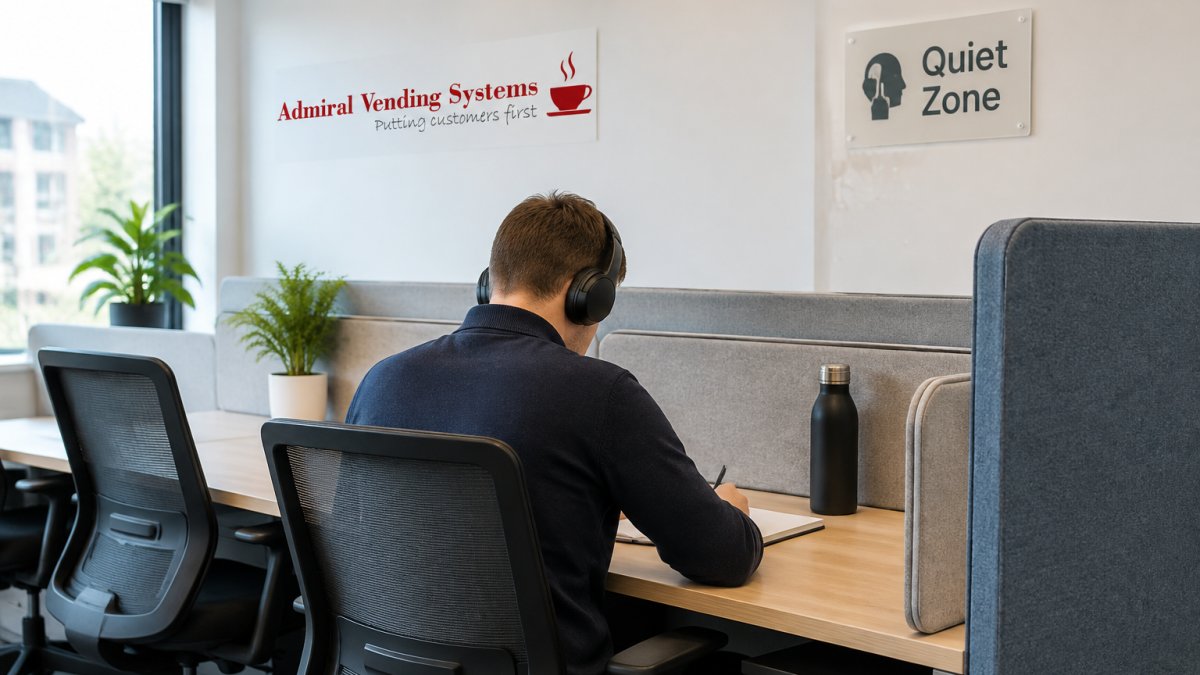
The practical moves are straightforward. Use acoustic screens to break sightlines and absorb some sound. Position desk dividers to shield the quiet desks from the main walkway. Where budget allows, an office pod gives people somewhere to take a call without leaving the floor.
A common mistake is placing the quiet zone in the middle of the floor plan. Corners and edges work better, because foot traffic naturally routes around them.
The other half is cultural. If managers hold impromptu huddles in the quiet zone, the sign is dead within a week. Lead by example, and the space holds.
Sign Placement, Visibility and Accessibility
Sign placement decides whether quiet zone signage is read at all. The right position is the point where someone is about to enter the zone, at eye level, with nothing between the sign and the reader. Visibility beats design every time.
Readers planning a bigger change will find practical help in our guide on how to design a quiet zone in the workplace, which walks through the layout decisions that sit behind the sign. For teams deciding where the focus room itself should sit, our article on where to put a workplace focus room covers the trade-offs. And if the quiet zone sits near a shared breakroom, our steps to make your office breakroom accessible are worth reading before you finalise the route.
Accessibility is the piece most signage plans skip. Signs should use high contrast, a clear sans-serif typeface, and text large enough to read from a sensible distance.
Three placement rules we would not skip:
- Consider placing a sign at every entrance to the zone, not just the main one
- Repeat the message inside the zone at desk height
- Keep the sign clear of doors, fire equipment and noticeboards
If a sign is competing with a fire exit notice or a health and safety poster, it loses. Give it its own clear space.
Measuring Whether Your Quiet Zone Signage Works
Measuring quiet zone signage comes down to two questions: are people following the rule, and do the people who use the space feel it is quieter? Neither needs a research budget. A short survey and a simple interruption count will tell you more than a year of anecdotal feedback.
Try this before-and-after approach:
- Interruption count. Ask one person to log how often they are interrupted during a two-hour focused block, for one week before the signs go up and one week after.
- Short pulse survey. Three questions: is the zone quiet enough, do you feel able to focus here, and do you know the rules. Run it before and after.
- Rule breaches. Note how often someone has to be reminded. A falling count is a good sign; a flat one means the wording or placement needs work.
- Occupancy. If the zone is empty, either it is not quiet enough or people do not know it exists.
Review the results after a month, not a week. Habits take time to shift, and the first fortnight after any change is noisy in every sense. If the numbers do not move, change the wording before you change the signs.
Launching Your Quiet Zone: A Pilot Plan for Facilities Managers
Launching a quiet zone works best as a short pilot rather than a permanent rollout. Pick one space, one rule set and one sign design, run it for four to six weeks, measure it, then decide.
A pilot plan we would use:
- Week one: choose the space, agree the rules with the teams who will use it, and order a small batch of signs.
- Week two: install the signs, brief the team leads, and run the baseline survey and interruption count.
- Weeks three to five: leave it alone. Resist the urge to keep tweaking; you need clean data.
- Week six: repeat the survey and count, then review with the team.
- Week seven: adjust the wording or placement, then decide whether to extend the zone.
The pilot also gives you a chance to test sign wording in the real space rather than in a meeting. Two versions of a door sign, one on each entrance, will tell you which one people respond to.
Once the zone is running, the practical question is what people do when they step out of it. Our commercial bean to cup coffee machines grind fresh beans on demand and can provide espresso, americano, cappuccino and latte, helping keep breaks short. For smaller spaces, our tabletop coffee machines fit a meeting room or a quiet corner without taking over the floor.
A quiet zone that nobody uses is just a sign on a wall.
Frequently Asked Questions
What should a quiet zone sign say?
Keep it short and specific. A clear quiet zone sign might read ‘Quiet Zone: Calls and Conversations Outside’ or ‘Silent Area: Headphones for Audio’. Avoid vague ‘Quiet Please’ if the room allows low-level talking, because people will interpret it differently. Add a small line about what to do instead, such as taking calls to a booth or breakout area. Specific wording reduces awkward corrections and helps new starters understand the expectation without asking.
Where should quiet zone signs be placed in a shared office?
Place signs at every entrance to the area, at eye level (around 1.4 to 1.6 metres), and on the approach so people see them before they walk in. Add a floor sticker or hanging sign where the open-plan office transitions into the quiet zone. Inside the area, a small repeat sign near desks reinforces the message. Avoid placing signs only on a distant wall or behind a door, because people miss them when they are already talking.
How do you create a quiet zone in an open-plan office?
Start with a physical boundary: acoustic screens, desk dividers or office pods help, but signage does most of the behavioural work. Define the zone clearly, write office quiet zone rules that cover calls, music and meetings, and place signs at entrances and transition points. Run a two-week pilot, gather feedback, and adjust wording or placement. Pair the zone with a nearby phone booth or breakout space so people have somewhere to go when they need to talk.
Should quiet zone signs include specific hours?
Yes, if the space is shared and used differently at different times. A sign that says ‘Quiet Zone: 9am to 12pm and 2pm to 5pm’ sets clear expectations and avoids conflict when the area is used for collaboration outside those hours. If the zone is permanently quiet, state that instead. Specific hours work best when they match the team’s actual working patterns, so check with the people who use the space before printing the signs.